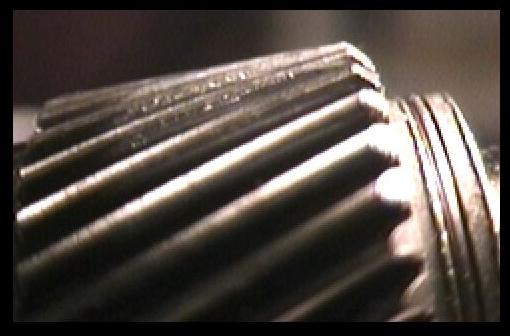
The helical gear thrust formula is  T = F * TAN(helix angle)
F is the tangential force and T is the thrust in pounds.
The Ford C6 sun gear has pitch diameter of roughly 1.8 inches.
>From that you can figure the tangential force given the torque.
The helix angle from eyeball is about either 30 degrees or 60
degrees depending. Probably around 30 degrees.

I think Tracy knows what angle it is exactly.

Paul Lamar
22 degrees. Why do you take me through the calculations to get the tangential force.
Let's say we're trying to transfer 200 HP at 6500 RPM.

Finn
My trig calculator battery is dead. Did you get a digital camera Finn?
If so take some pictures of the shaft. It is hard for people to follow
what you are trying to do. Or make a sketch with dimensions and send
it to me. I will then make a drawing. I think we can come up with some
way of putting an effective thrust bearing on the machined side of the
bell housing. Did you look for a new input shaft?

Paul Lamar
Just give me formulas in sequence. I can do the calculations. Tan(22) = 0.404
200 foot pounds of torque is 2400 inch pounds .9 inch radius
so 2400/.9 = 2666 times .44 is 1173 pounds of thrust. Seems like
a lot. Are you sure about that 22 degrees? I got one right here and it
looks closer to 28 degrees. What is the tan of 28? Don't have a protractor
but the rise is .5 inches in 1.68 inches. What is that angle?
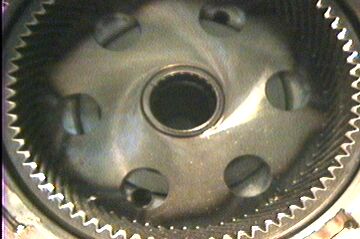
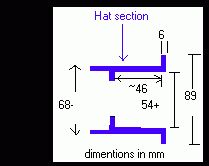
First two sketches is of my first idea of how to make a hat section that wouldn't require
machining of the rear side of the bell housing bulkhead. That was before Tracy suggested
using a shortened sun gear. The forward flange is probably too thin unless it's machined
from steel.

Last sketch is the current idea. Sun gear shortened to 40.2mm (1.58"), 12 mm (0.47") thick
thrust bearing (when I said 2", I had forgot the thrust bearing). 1/2" thick thrust plate
(mounting bolts not shown). Current shaft thickness is 1.441" all the way from the splines
except the 1" forward journal. Thrust bearing to be used is 35mm (1.378") ID, so shaft needs
to be machined down from rear end of sun gear all the way to the splines. Thickness of
bulkhead varies from .52" to more than .53". Thrust plate needs 35mm center hole and a
counter bore from the rear side to hold the oil seal.

Maybe, if I get hold of a end mill bit, I can "machine" the rear bulkhead in
my drill press.
No way. Send me the box and I will do it for free except if I have
to farm out some parts for grinding. You pay for all parts and shipping both
ways. I will need a new gear as no way can we salvage the gear you have.
Or take it up to Tracy's and do it on his mill.
I don't know where to get hold of a new input shaft. Current shaft:
Overall length: 235mm  [9.59 inches].
Take your clutch disk to a junk yard and check manual transmissions until
you find an input shaft spline that fits. That's your input shaft.
Try a Chevy V8 manual transmission first. That clutch disk is a stock
marine unit. Perhaps Bulent or Ken can tell us what kind of marine
engine it came from.
Front journal: 35mm [1.377 inch](non critical, could be as short as 31mm)
>From front of sun gear to spline area: 120mm [4.724 inch]
>From front of sun gear to e-shaft contact point: 165mm [6.496 inch]
Spline area OD: approx 34.5mm [1.358 inch]
I need the distance from the planet gears to the bell housing dimension.
If the Ford shaft Tracy is using is long enough, I'll have to get a new "clutch" plate to
match the 1" ford shaft splines. Not necessarily bad, as I can then use the "gerbos", but a
lot more work.

I'm new to this airplane ownership thing. Paul, I know you're used to throwing money at your
certified airplane like there's no tomorrow, but my RV-3 was supposed to be a very low
budget project and the only reason for putting in a rotary was to keep cost low. I know the
best thing to do would be to put in Tracy's drive, but that would mean $5,500 for re-drives
alone (unless you have a buyer for my Ross drive), and more than $8,000 for the engine
installation. I'm told I could easily get a used Lycoming for that. So much for bragging
about low cost engine installation.

Finn
True Finn you have had a lot of bad luck. Remember that 10,000 RPM no
load no oil pressure engine run away you had. If you did that with a
Lycoming it would cost you close to $15,000. And then there was the
fire (on the ground fortunately). Nobody said flying was cheap.

Quit complaining and get another job :-)

Paul Lamar

The AirCraft Rotary Engine NewsLetter.              Powered by Linux.
ACRE NL web site.
http://home.earthlink.net/~rotaryeng/            http://www.linux.org