<snip>
Where do you plan to put the radiator(s) Monty?
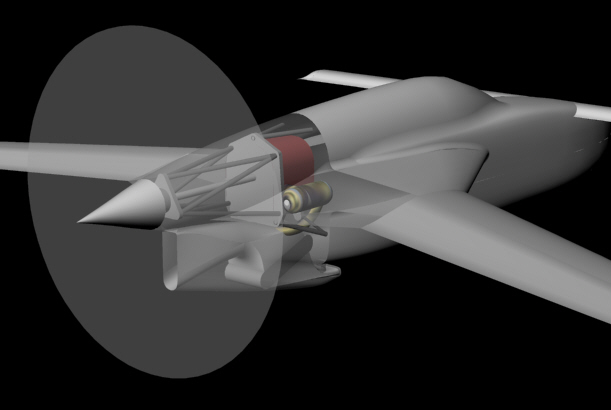
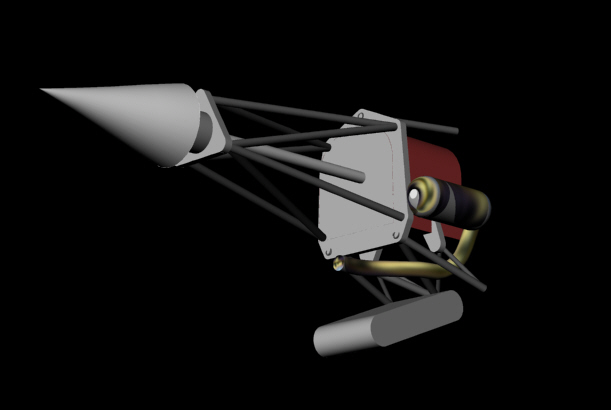
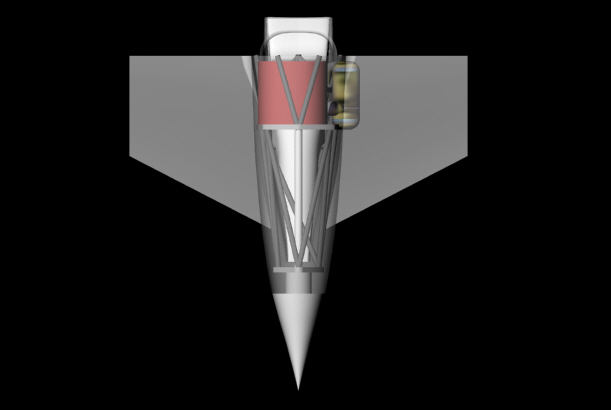
Send us one of these fancy pictures showing us the under the cowl layout
:-)
I would settle for just a three view.

Paul Lamar
Hello all,

I said I had considered the plugs up orientation. Not that I planed to use
it!! There is not enough room in a vari to use plugs up with the tight cowl
I wanted to use. Unless you move the prop centerline down considerably. This
is a single rotor installation, in the normal orientation. However, in a
larger aircraft like a Cozy it would be possible (once again, I think the
disadvantages outweigh the advantages) Even If I turbo charged this engine I
would place it in the normal orientation except I would re-index the turbo
and point the exhaust at the firewall, that way I could curve the pipe
around and get it into the ejector.

But since you asked for it I decided to post what I had. I have been
reluctant to do so because I have not done the real hard engineering on this
concept. This is only conceptual design stuff. In other words, these are
cartoons. The tubes have not been sized, the reinforcement of the firewall
has not been looked at, etc, etc. If anybody tries to copy this I promise
nothing, do so at your own risk!!

I am still not satisfied with the radiator inlet duct. I need to go check
out Kucheman and Webber and do some thinking on that part of the design. The
engine is just the envelope size, I have not added the accessories, water
pump, water lines....... Oil pan must be designed.

There are aluminum plates on both the front and back of the engine. I was
planning to use a whole new front cover.

The liquid/liquid oil cooler goes in the left strake. Radiator is four core,
counter flow. (I know the four core is less efficient than a two core, but I
have very limited space)

Gear box is the ford planetary unit. Located next to the prop. This makes
the heavy parts that have to take the most torque smaller and lighter. The
drive shaft can be small and lightweight. Oil drains from the gear box back
into the oil pan.

Exhaust is wrapped with insulating tape to prevent radiant heat transfer to
the radiator and surrounding cowl. Cowl will be insulated on the inside with
reflective and insulating material. I may have to air cool the exhaust in
such a tight cowl. If so I will take the air from the armpit area, using a
naca duct.

Cowl flap will extent the opening in the rear downwards, or possibly have
two flaps on the side that open like turkey feathers. I prefer the former,
because there is room to put the actuator under the inner duct.

Herb has talked me out of the vari, anyway, so I probably will not pursue
this much further. If I were to build a Long EZ it would be similar, but
with two rotors.

Monty.
Wow! That looks great Monty. I was just kidding about the under the cowl
renditions and here you have them done. So cool. You ought to do  a article for the
EAA Sport Aviation magazine on this. Judging by the results Charlie
Airesman is getting this thing ought to be real fast.
Won't be long before someone is going 300 MPH with a rotary at this
rate. You got dimensions on the engine so you can do a 3D on that too?

BTW Butch is getting ready to spring the LAEV variable pitch
prop on the world which you will need.

Paul Lamar

The AirCraft Rotary Engine NewsLetter.              Powered by Linux.
ACRE NL web site.
http://home.earthlink.net/~rotaryeng/            http://www.linux.org