Too bad Lynn I was counting on you for some good data. Omega has a whole
slew
 of products that will work. Some are ceramic coated. To be useful the probe
 needs to be with in 2 mm of the combustion chamber surface right adjacent
 to the leading spark plug. If you are reading this in time and are still
interested
 I can give you some part numbers out of the Omega catalog. I assume these
are  12A rotor housings.

 Paul Lamar
At Curtiss-Wright/Deere/RPI, we always used spring loaded thermocouples to
measure metal temperature. You want to make sure that the thermocouple is in
firm contact with the metal (and it should be down a dry hole, not in the
coolant passage). Any material that gets between the metal and the
thermocouple will insulate it and change the results.

Jon Lauter
Rotary Power Marine Corporation
Good points Jon thanks.

Paul Lamar
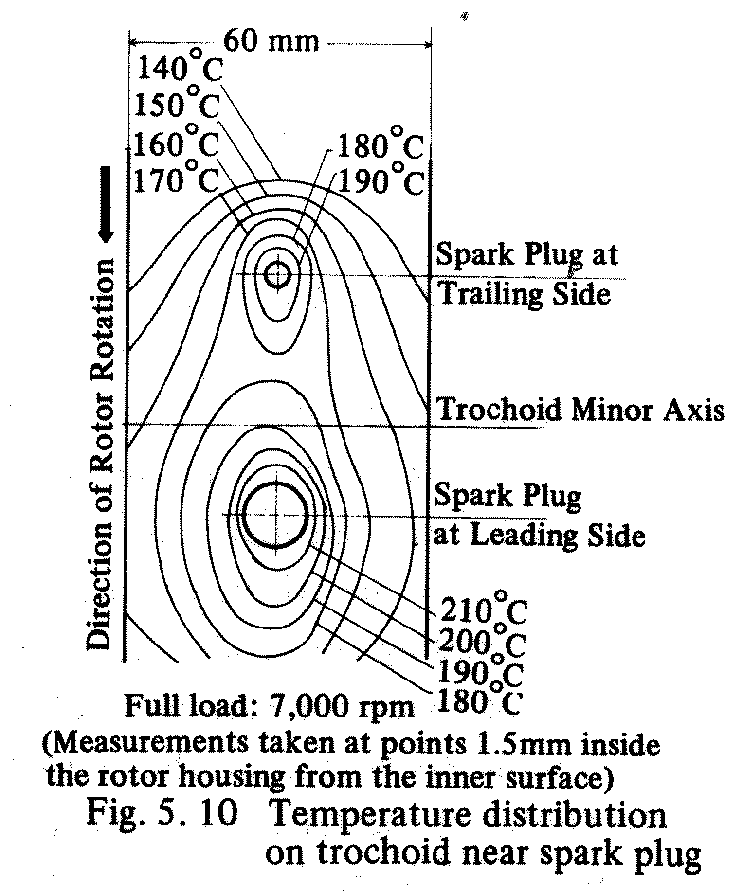
I thought that Mazda had a pretty good idea of the wall temps around the plugs. I saw that diagram here. I thought you wanted the coolant temps a few thousandth away from the wall. Was this incorrect?

Lynn E. Hanover.
Incorrect yes.

We need the temp data  right down by the combustion chamber wall. 2 mm away.
There was no power level mentioned along with the Mazda data.
All it said was full load 7000 RPM. Not what HP level. Was that
75 HP per rotor or 100 HP per rotor?

This will determine just how much continuous HP per rotor we can expect with
turbo charging or peripheral ports. It will also tell us if we need to grind
groves inside the water jacket to improve the heat transfer between metal and
coolant. The need for this has been a guess in the past based on oil
coking on the trochoid surface. With two cycle oil we probably don't have this
indicator. It will also tell us if the groves are doing
any good and what kind of groves work the best.

Paul Lamar

The AirCraft Rotary Engine NewsLetter.              Powered by Linux.
ACRE NL web site.
http://home.earthlink.net/~rotaryeng/            http://www.linux.org