Vance,
Thanks for taking the time to run this thru your program.  I plan to turn
my 13b up to 7400 RPM which equals 2,597 prop RPM.  I have the prop program
spreadsheet by John Ronze (sp?? - the guy of Longez canard and RV-9 wing
fame) that I have used to run the numbers but that data is at work and I do
not have the data (or the program) before me or I would compare the data
points.  I think that his program also used the Clark Y airfoil.  I was also
interested in what airfoil would really be best suited to this flight
envelope - is the Ckark Y really still the best?
Here is Vance's program I think Ken. You will need QB or GW Basic to run it.

Paul Lamar
***** BIG SNIP *****
  Paul,

I started off thinking that the "stupid ole sections" like the ClarkY
just couldn't be as good as a really great new modern low drag foil.
NACA even created a whole series of foils esp for props, and to
work well in the high subsonic range.   Only problem is they built
a pair of "identical" constant speed aluminum props - one with the
16 series special prop airfoils and one with the Clark Y.  They only
tested them in the wind tunnel and at low speeds, but there wasn't
a dime's worth of difference.

As I worked on the prop design and looked and literally hundreds
of runs, with the 16 series and other foils, it became clear that there
is so much "off design point" operation of any prop that a high
CL max and a moderate drag at stall and post stall are extremely
important.  The 24XX series is similar to the Clark Y, but there is
a LOT more solid wind tunnel data for a range of section percent
thicknesses.  This is why I went with the 24XX foils.  The NACA
16 series should be slightly better at the tips at very high speeds, but
I couldn't find much benefit and the 16 series has lower L/D max
which is important.

Short answer:  Might be able to beat the Clark Y, but not easily and
not by much.

Bill
Gosh I love you engineer types! You and Vance (and Paul) pretty much all told me the
same thing and why (in terms that I can understand).  Now all I have to do is take this
info and learn how to carve a prop.

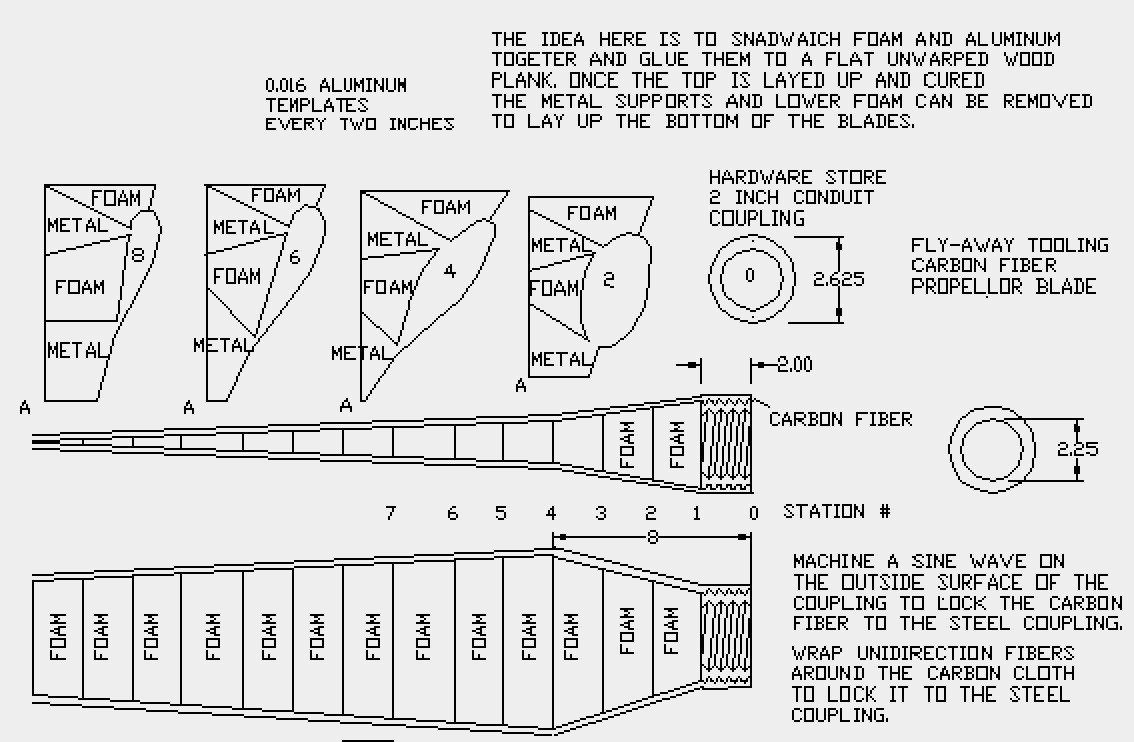
Try making one by using this method Ken except use a solid hub.
If it works it will be a minor breakthrough in accurate blade angles
and contours for a composite prop.

Paul Lamar

The AirCraft Rotary Engine NewsLetter.              Powered by Linux.
ACRE NL web site.
http://home.earthlink.net/~rotaryeng/            http://www.linux.org