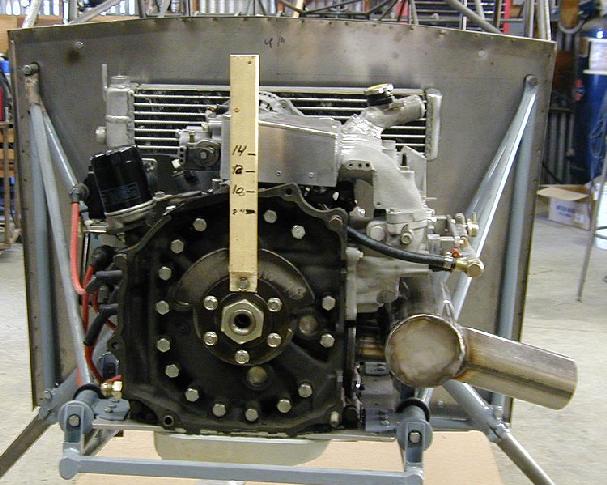
> > We had a discussion on this at Rotormotor.
 >
 > For those that don't want to use the rubber bushing in the
 > firewall (trick see the jpg) we are trying to come up with a simple
 > motor mount scheme.
 >
 > What is the dimension from the upper motor mount hard point
 > on the Long EZ firewall to the top of the fus?
 >
 > What is the dimension from the lower motor mount hard point
 > on the Long EZ firewall to the very bottom of the fus?
 >
 > See the gif.
 >
 > I think at this point it will be easier to change the hard points
 > on the firewall.
 >
 > Paul Lamar
 Paul,

 I've been doing a lot of thinking about the narrow firewall engine mount
 problem. Long-EZ and RV-4 people all have the same problems. What we need is
 a mount that will work on various narrow firewalls. Talking to you this past
 weekend about the beam style mount incorporated in the P51 got me started in
 the right direction. I think that I have a solution. If we use a
 compression/tension beam with a diagonal tension member for vertical loads
 that mounts to a bracket on the firewall we can solve a lot of the problems.
 The bracket can mount to various hard point configurations, and can be
 easily customized for different aircraft. The tension member can be tubing
 with rod ends so it can be adjustable for each installation. The
 compression/tension beam and engine mounts can be the same for all the
 different applications. The lateral loads can be taken care of with a
 diagonal under the engine. This would work for both types of aircraft. A
 structure where all members are in either compression or tension is the most
 efficient type of structure. By taking the bending loads out by using rod
 ends and pivot type connections, it should be lighter than an equivalent
 welded space frame. It would also take up much less space than a welded tube
 type mount. We could literally produce a kit with the right parts and you
 just cut a few things to length, drill some holes, make a few simple welds
 and bolt the thing together. I know this is hard to visualize, as soon as I
 have the chance I will draw up a sketch and send it on.
> Monty
The engine mount on my Tailwind starts with Tracy's flat plate
between the case and pan.  The outside measurement (bushing to
bushing) is 20.5".  The bushings were easy and inexpensive to build.
The engineers on this list might be able to do a better job with the
concept.  Hard to imagine a narrower engine mount that still gets
the job done.  BTW, I intend to overhaul my engine while it is
mounted in the airplane.  When it is completely torn down, the only
thing left on the plane will be the flat plate.  Jerry
Jerry, It is not narrow at the engine we are talking about per se.
It is the narrow width of the fuselage that is the limiting factor. In your
case I.E.  with a side by side cockpit you could have gone to wider rubber
bushing mounts on the engine. Side by side airplanes are not the problem.
In fact in your case you would have wound up with more room for a larger
tangential muffler.

I am afraid we are going to need to differentiate the composite Long EZ
and metal tandem airplanes here. The long EZ is very amenable to bushing
in the firewall trick while with metal airplanes this is generally not
practical. The other thing the Long EZ has going for it is the
ability to brace the motor mount sideways to the wing ribs
with a ball jointed strut as mentioned by Monty above.

What the RV4 has going for it is the possibility of moving the engine
forward as it will tolerate more engine weight than a Long EZ. In a Long
EZ designed for an IO 240 engine weight is critical. The RV4 has more
room for a P51 type beam mount.

Paul Lamar

The AirCraft Rotary Engine NewsLetter.              Powered by Linux.
ACRE NL web site.
http://home.earthlink.net/~rotaryeng/            http://www.linux.org