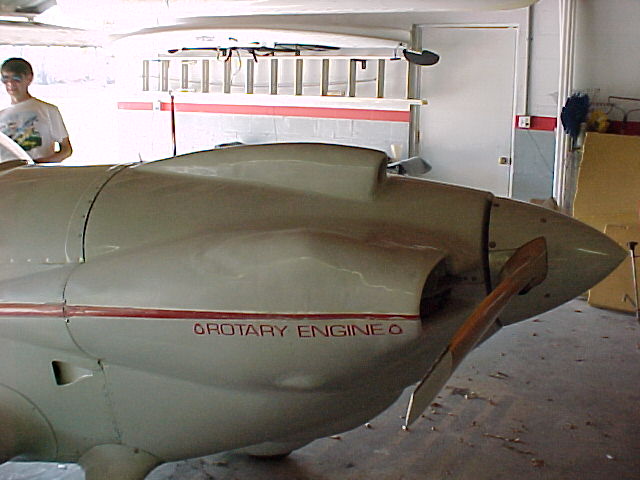
I'd love to see a good dyno run to nail down the BSFC better for these
motors.  I think that the number is more like 0.6 lb/Hp-hr, but I have no
really SOLID basis.  I think Paul's 0.5 number is possible, but probably
too low.  Most spark ignition engines get about 0.42-0.45 lb/HP-hr and
the rotary is known to be "thirsty".  If it can get 0.5, then it's great, but
in the absence of hard dyno data, I'll bet on 0.6, and we can see who's
right.  I'd be willing to bet up to $1, but no more ;-)

The difference is significant.   If you are burning 8 gal/hr, then you are
burning 48 lb/hr, and at 0.5 lb/HP-hr you are producing 96 HP.  If the
BSFC is 0.6, then the HP is 80.   With a pretty efficient spark ignition
engine you will have about 0.42 BSFC (brake specific fuel consumption)
so 8 gal/hr works out to about 114 hp.  This about 75% of 150 hp, and when
you fly a 150 HP C172 around at 75% power, the fuel burn is 8-8.5 g/hr.
Higher compression ratio increases efficiency, so diesels get better BSFC,
like maybe 0.375 lb/HP-hr.  Diesel fuel is heavier, about 7 lb/gallon.  One
aircraft engine, the liquid cooled Continental Voyager series can get a
BSFC at the 0.375 level.  This is phenomenal and is due to a very high
compression ratio and a special combustion chamber design.  This engine
powered the Voyager "around the world on one tank of gas".  Unfortunately,
it has not been commercially successful.

Bill Freeman
Long EZ builder & pilot
BSME, MSME
EAA Technical Counselor
Bill, Tracy, on his trip up from Florida, with head winds towards the
end of the trip,  averaged about 160 MPH on 6.6 gallons an hour as I recall.
How does this compare with a Lyc powered RV4?

Paul Lamar
Well, I don't know the RVs very well, but I avg 150 kts GS on a little less
fuel burn with my O-235 (low compression) 108 hp.  Usually I burn less,
maybe about 6.2-6.4 at under 8k MSL, and down to 5.6 or so at 12K MSL.

6.2 gph * 6 = 37.2 lb/hr / 0.45 lb/HP-hr = 82.66 HP / 0.75 = 110 hp,
so I'm running VERY close to 75% power and 0.45 BSFC at 150 kts
which is 173 mph.  If I was running exactly 0.45 BSFC and 75% the
answer would have been 108 HP.  I can live with a 1.8% error in this kind
of "bak of the envelope" calculation.

Now Tracy is burning 6.6 gph, at 160 mph.

   6.6 gph * 6 = 39.6 lb/hr /0.45 = 88 HP
                           or
   6.6 gph * 6 = 39.6 lb/hr /0.50 = 79.2 HP
                           or
   6.6 gph * 6 = 39.6 lb/hr / 0.55 = 72 HP
                           or
   6.6 gph * 6 = 39.6 lb/hr / 0.6 = 66 HP

 My Long EZ will do 173 mph on about 83 HP.   I wouldn't be surprised if
a RV4 would do 160 mph on between 66 and 72 HP.   If we do a cube
regression on my Long EZ, we have my bird needing 21% less HP at 160
mph compared to 173 mph, or about 83 * 0.79 = 66 HP.

OOPS !  Accidentally stumbled into a BSFC of 0.6 for Tracy's bird (i.e 66 HP
@ 160 mph).   I actually think the RV4  is a bit faster per HP than the LE
(i.e. a bit lower drag), but perhaps not; really not sure.  If they're the same
drag, then I'm right on with my 0.6 BSFC estimate.

Either way, I stand by my view that until you run a pair of similarly loaded
(wt) RV4s with similar equipment (like wheel pants on both, etc) side-by-side
for a couple of hours (4 hrs would be better) one with a Lyc and Tracy's
as the other and then land and refuel, you are out there in the noise and
can tell nothing of real scientific value.

Bill Freeman

BTW -- Tracy - did you get the TAP form via FAX???
Long EZ builder & pilot
BSME, MSME
EAA Technical Counselor
Tracy does not have a low drag RV4 by a long shot.
Look at huge the rad air intakes and the induction air inlet on the cowl.
Last I checked he still does not have a radius on his cowl outlet
and his wheel strut farings do not fit very well. Also he is dragging
that long four inch diameter, four foot long muffler under the airplane.
Sorry Tracy :-)

I think you are high on Tracy's BSFC numbers  by at least .01 Bill.

Paul Lamar

The AirCraft Rotary Engine NewsLetter.              Powered by Linux.
ACRE NL web site.
http://home.earthlink.net/~rotaryeng/            http://www.linux.org