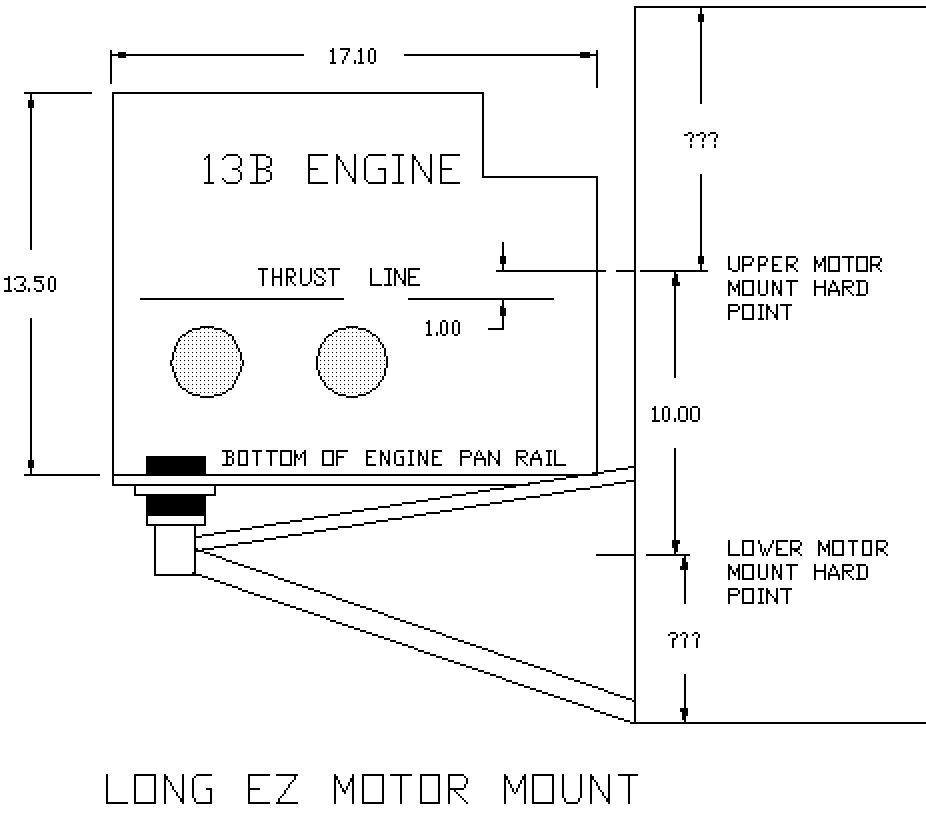
The upper hard point is ON the upper corner of the fuselage, basically
the fore-aft angle nestles against the upper longeron.  The lower
mounts are bolted to the bottom of the main spar box and to the upper
part of the main gear hardpoints for the gear attach fittings.

I can get the actual dimensions if that is what you want.

Moving the hard points will be extrmely difficult as they tie into inserts
in the center section spar and into the longerons and the main gear mount
hardpoints.  All these are hard to relocate.

Bill Freeman
Long EZ builder & pilot
BSME, MSME
EAA Technical Counselor
Can't we just slather on some more layers of inside carbon fiber and tie
the whole ass end onto the spar?

Paul Lamar
No need for carbon, it isn't a stiffness problem.  What is
wrong with attaching to the original mounting points???
The bed mount attached to the original points should be fine
unless it is too narrow.  You can reinforce the firewall, but
why not use the original hard points, just a different space
frame?

The real problem is a CG problem with all that cast iron back
there.  The LE was designed for the O-235 WITHOUT a
starter.   A rotary with a starter is guarenteed to need some
lead in the nose.  Not a good airplane for an experimental
engine, IMHO.   The RVs have a much lower landing speed,
better for an off field landing.  Min speed on a LIGHT LE
like mine is about 58 kts, at full aft stick.   Many of the
heavier birds have a min speed of 65 or more kts.   I bet
the RVs are 10-15 kts slower.

Bill Freeman
Long EZ builder & pilot
BSME, MSME
EAA Technical Counselor
Carbon is lower density than fiberglass for the same tensile
or compressive strength.

The stock firewall hard point mounts are in the wrong place for a rotary.
They are also not spread very wide at only ten inches vertical. This puts
a tremendous load on the firewall hard points with a six G pull up when the
engine
CG is 15 or so inches aft of the firewall. Like 2250 pounds pull
at the top and 2250 push at the bottom not counting 1500 pounds shear.
This is assuming everything else is hung from the firewall which
is probably not the case.

It would be better to spread the mounts vertically as Perry has done
or move them to better locations. How many layers of glass would we need
in there to make the aft fuselage an extension of the spar so to speak?

Paul Lamar
Why are we re-engineering something that has worked for 20 years and
1000+ airframes???   Regardless of what we might about the "flimsy looking"
and "not spread very wide", they have worked for up to O-360s for decades.
Just work out a different space frame, possibly increase the alum extrusions
from 1x1x1/8 2024 to 1.5 x 1.5x 1.8 2024, but unless there is some impossible
issue of space, I can't see why the stock mounts aren't adequate.  They are
VERY strong.  Possibly add a third strut down to the bottom of the
NACA duct addons or to the bottom longerons, but this is guilding the lilly
and probably just adding weight.  What's an O-360 weigh?  Melville
has been flying one for about 10 years with just enlarged alum extrusions.
There are no problems except a few of the Dynafocal mounts have had a
few weld cracks out in the big ring.  I reinforced the joint between the
ring and the dynafocal bisquit support rings a few years back for a LE
here in town, (it had no cracks) but the basic mount and extrusions and
hard points in the fuselage have never given any signs of problems.

Bill Freeman
Long EZ builder & pilot
BSME, MSME
EAA Technical Counselor
Because it is easier to beef up the firewall and aft fuselage than design a
space frame to go around all the ports and water pump inlets and outlets
it has to go around on the right side of the rotary engine.

It is an  impossible issue of space.

Three or four layers of carbon fiber or even glass are not going to
weigh that much. What we will wind up with is a simple and  cleaner
design that is easier to service.

Just humor me for now Bill and suggest some fuselage beef ups.

Paul Lamar

The AirCraft Rotary Engine NewsLetter.              Powered by Linux.
ACRE NL web site.
http://home.earthlink.net/~rotaryeng/            http://www.linux.org