Paul,
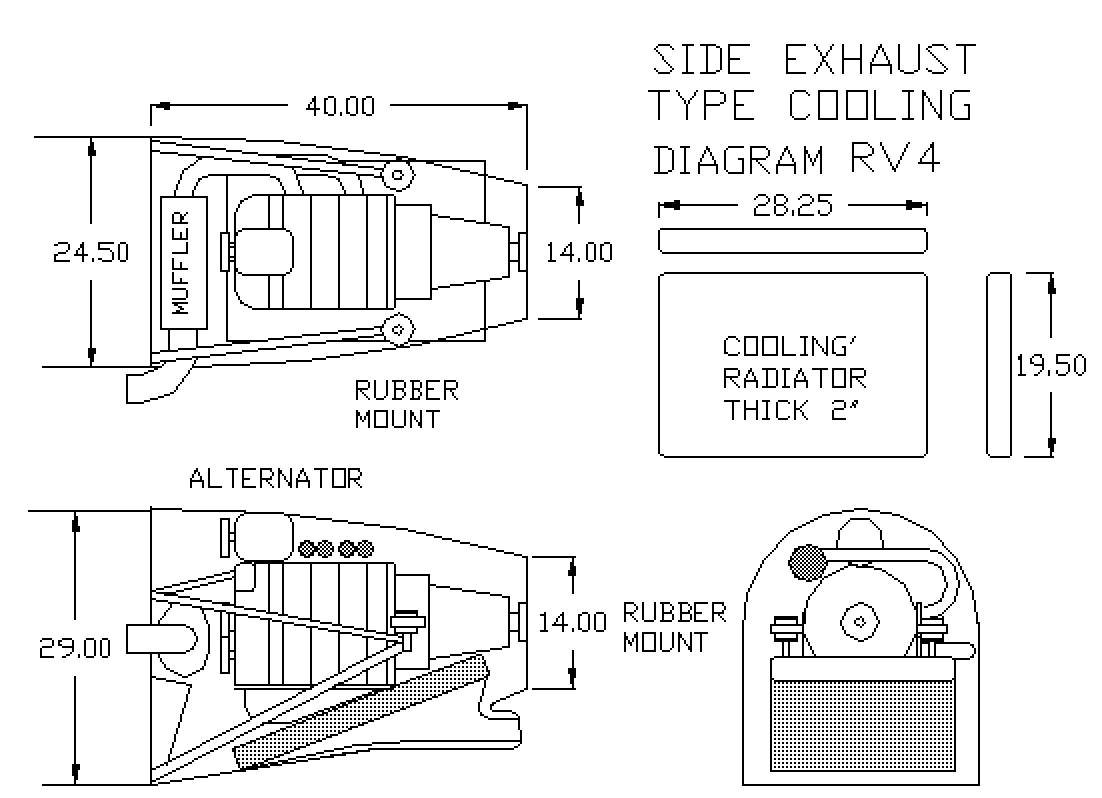
   I feel that the RV-4's narrow cowl severely limits our options for the radiators and exhaust and that this should be of primary concern for the design of the motor mount, with the exception of safety of course.  I will address the issues that I raised previously and the attached photos will give you an idea of what I have in mind.  My comments will follow yours.
Paul,
There are three problems with this layout:
1. It would appear that a side exit exhaust will be required. There is 'almost' room for a tangential muffler right off the exhaust ports, but will reqire a 'bump' in the cowling. I think that most of us would prefer to use a tuned exhaust which requires pipe lengths of 26" to 32" depending on engine RPM (I hate to give up horsepower that is almost free).
I cannot think of a way to get the exhaust to come out the bottom and and
still have a rad under the engine. What did you have in mind? What do you
see wrong with a side exhaust?
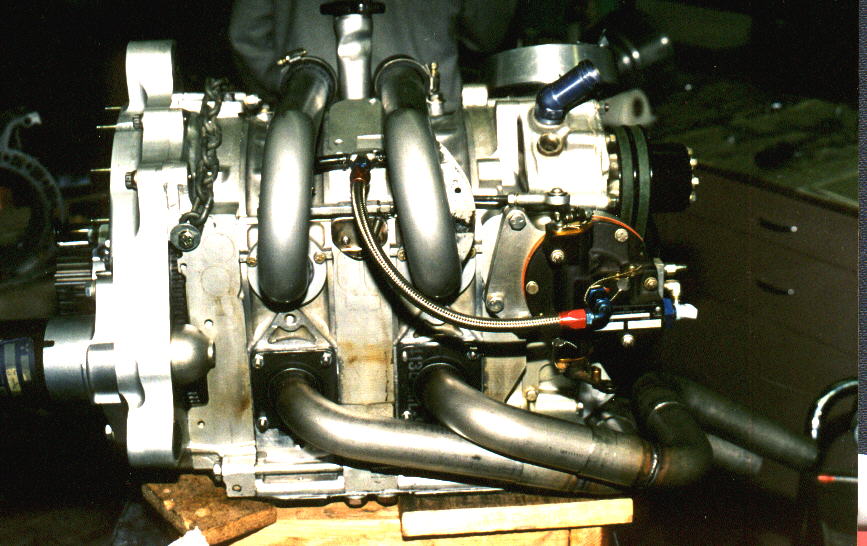
KP - I have attached a picture of Everette Hatch's RV-4 exhaust. I think you have a better picture on you web site. This will allow a tuned exhaust and a muffler. The exhaust pipes extend out ~ 2" past the block so the radiator can extend past the block a little, but must be shielded from the exhaust heat. This is what I want to build.
2. The radiator cannot extent near this far forward. Figure that you only have a max radiator width of ~ 19" under the front edge of engine. This is to allow the remainder of the taper of the cowling to the spinner (the stock spinner is 13" in diameter). I am going to be placing the oil cooler beside the radiator so this is a vitally important issue.
Well I was thinking of a 12 inch wide rad. How wide is your rad?
KP - Yes, I see where a 12" wide radiator would allow this extension to the front of the cowl - a good idea. I was planning a 15.75" wide radiator but might use your 12" width. Note that the stock oil cooler is only 22" x 4.625" x 2" so it will fit alongside and to the rear of the coolant radiator on the right side of the engine (where the cowl is wider). This will leave room for the exhaust on the left side of the engine. However, it is imperative that the motor mount not be in the way or the pipes cannot be run like this.
3. If you move the front edge of the radiator under the front of the engine you will find that the motor mounts are in the way. This is really hard to see, but I have 'mocked up' a design very close to what you are proposing.
Got any pictures of your mockup?
KP - Yes, I can see that a 12" wide radiator would keep this from being a problem but only if the oil cooler will still 'fit' beside the radiator - I'm not so sure that there is enough 'length' for the oil cooler if the motor mount is placed forward. I also do not think that the cowl is wide enough as it passes the flywheel end of the engine to allow this placement of the motor mount rubbers.
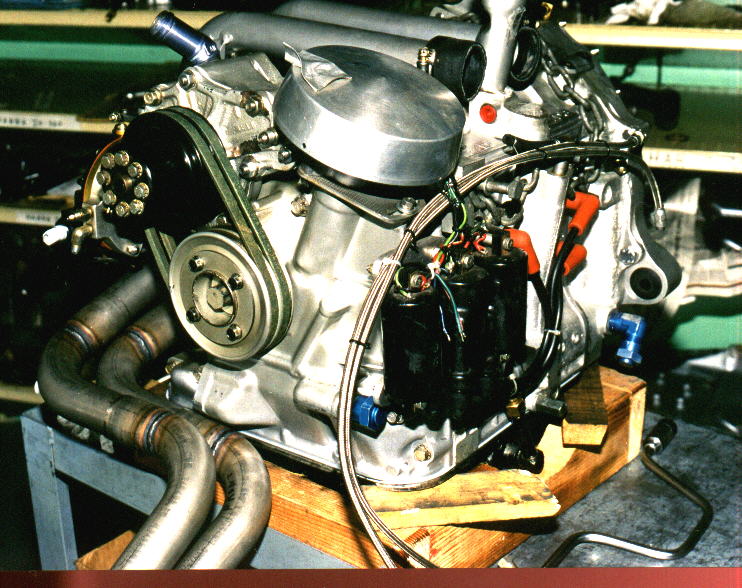
I only recently bought a cheaply digital camera and, as usual, my scanner is not working so I cannot send any pictures of my early attempts. They were really pretty pathetic, but I am learning. I have included some photos of my most recent attempt to build a cantilever mount off the rear of the engine, but I have some better ideas and am starting over. An engineer friend took a look at what I was doing and thought that it would work, but did not perform any load calcs since I don't have drawings and I am building 'on the fly' (pun intended). Note that the actual mount points will be in the same plane as conical mounts and off the rear of the engine.
In conclusion, my mockup shows that this proposal really doesn't work any better than Mike's design.  The only way to provide more room for the exhaust and radiator is to cantilever the mount off the back of the engine.  This may be much tougher structurally but the room freed up is needed.

Thanks,
Ken Powell
Well I am open to suggestions. What would you use for hard points on the back
of the engine? Mecanair made a whole new front cover to do this.
KP - Note that I am using the front cover from a 1983 12A and I am building a custom oil pan. The lower mounts; will bolt to this front cover and will also have tubes running from the outside of this lower mount to the engine. The upper right mount is also pretty easy (all kinds of mounting points on the right side). The left side is harder but the attached photo will give you an idea - this mount is also being rebuilt.
My next modification of this mount will put the rubber bushing even further
forward onto Tracy's motor plate. I figure I will then have room for a tangential
muffler and a side exhaust. I think people are over estimating the advantages
of a pointy cowl. A bit of a bulge up there will make little difference
in prop efficiency and an un-measurable reduction in over all drag IMHO.
KP - Paul, I agree that a 'pointy' cowl is overestimated as to performance advantages.  But Mike Will's cowl is beautiful and I just HAVE to build one like it.

Thanks,

Ken Powell
kenpowell@aristotle.net
Here is a companion picture to the one you cited. I took both at
Everett's place in Oregon. Note how far out from the side of the engine
the pipes extend. You will not get this into a 20 inch wide cowl as the
engine is 12 inches wide and these pipes stick out another six or seven
inches. You might get this in something like this earlier drawing with
high mounted rubber bushings on Tracy's motor plate. Unfortunately this
early drawing shows an impractical upper mount and there is no obvious
way to brace the motor mount laterally. The rad is too wide as well.
I will correct this and redraw it. A ball jointed A arm might work
but I am very pessimistic about that. I will have to modify this
sketch to see if this can be done. The fact of the matter is the
Mazda rotary engine is designed for a bed mount.

Everett also used a shorter PSRU than Tracy's so it was possible to move
the engine forward.

The huge, almost insurmountable problem with cantilevering the engine from
the back side is getting the loads into the stock RV4 motor mount firewall hard
points and from good brackets on the engine. Just too much in the way.
I am willing to listen to any new ideas on this.

If one is willing to redesign the front fuselage of the RV4 or build a new
rear cover this might be accomplished. The alternator will get in the way
as well as the water pump. Mecanir totally redesigned the accessory section
of the engine to achieve this end.

Paul Lamar

The AirCraft Rotary Engine NewsLetter.              Powered by Linux.
ACRE NL web site.
http://home.earthlink.net/~rotaryeng/            http://www.linux.org