This a great link.. Check it out.
Regards, Mike Silverstone

http://www.msnbc.com/news/644281.asp?pne=msn
Jeff Spitzer
Manager of Mechanical Engineering
General Atomics Aeronautical Systems Inc.
(858) 455-2667


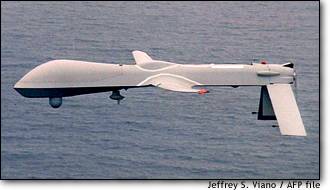
Jeff, what kind of engine is in this version? The cowl looks too
small for the usual 914 turbo Rotax. Is it a Mazda rotary?


Paul Lamar


           Oct. 18 -  The United States is for the first time
           flying armed, unmanned aircraft into combat
           and controlling them with operators in the
           United States thousands of miles from the
           battlefield in Afghanistan, Defense Department
           officials said yesterday.


  THE USE of the armed RQ-1 Predators is a
                   revolutionary step in the conduct of warfare. The
                   slow-moving, propeller-driven aircraft have been
                   flown by the Air Force for six years to gather
                   intelligence, most recently in combat during the
                   Kosovo war in 1999. But now the Air Force has
                   outfitted them with Hellfire antitank missiles,
                   powerful weapons usually carried on helicopters,
                   the officials said.

                                             Not much is
                                      known about how
                                      the armed Predators
                                      have been used in
                                      Afghanistan, but a
                                      government official
                                      said they have fired
                                      their missiles several
                                      times. The attacks by
                   the Predators mark a turning point in military
                   history because they signal that the Air Force is
                   now able to survey and then shoot at ground
                   positions from lower altitudes without putting
                   pilots at risk.

                   EXTENDING REACH, FLEXIBILITY
                          The armed drones also give the military
                   enormous reach and flexibility, creating the real
                   possibility that the United States could someday
                   fly combat missions without having to put large
                   numbers of military personnel on nearby land
                   bases or aircraft carriers.
                          Military strategists said the Bush
                   administration's war on terrorism could lead to
                   the use of additional new technologies and
                   methods, some of them still secret.
                          "I think this war is going to give you the
                   revolution in military affairs," said Eliot Cohen,
                   an expert in military strategy at Johns Hopkins
                   University.
                          The Air Force is also believed, for example, to
                   be trying to weaponize the RQ-4A Global Hawk,
                   a much longer-range unmanned surveillance
                   aircraft that might eventually be able to carry
                   weapons from the continental United States to
                   targets around the world. In April, the craft -
                   which has a longer wingspan than a Boeing 737 -
                   flew 8,600 miles from California to Australia.


                          Predators are usually operated by the Air
                   Force. But in the Afghanistan conflict, the
                   day-to-day operation has been handled by the
                   Central Intelligence Agency because of its
                   ongoing effort tracking suspected terrorist Osama
                   bin Laden, according to a source familiar with the
                   operation. After the Predators take off, control is
                   turned over to Air Force personnel in the United
                   States. In case the satellite link is lost, the CIA
                   has backup operators standing by to take over
                   control.
                          "The more bouncing you have to do off of
                   satellites and relay stations, the more potential
                   trouble you have to prepare for," one official said.


                          The deployment of the armed Predators was
                   first reported in the Oct. 22 edition of The New
                   Yorker magazine. At first Pentagon officials
                   dismissed the report, saying that the Air Force
                   was still experimenting with putting weapons
                   aboard the aircraft.
                          Publicly, that is still the Air Force's position.
                   Gen. John P. Jumper, the Air Force chief of staff,
                   was asked at a congressional breakfast on Tuesday
                   about putting weapons on drones. "We will have
                   armed unmanned air vehicles in due course," he
                   responded. "We don't want to push it any faster
                   than it can reliably perform."
                          Tests on the unmanned aircraft run by the
                   Air Force's Air Combat Command, which
                   Jumper commanded until recently, culminated
                   last February with a successful shot of a live
                   Hellfire missile from a Predator against a
                   discarded Army tank in the Nevada desert. At the
                   time, officials said the test was artificial because
                   the Hellfire is designed to be launched by an
                   attack helicopter flying at treetop levels, while the
                   Predator usually flies at 10,000 feet and would fire
                   its missiles from a relatively high altitude as well.

                   TREATY ISSUES
                          Another impediment to flying an armed
                   drone aircraft was that some State Department
                   officials objected to the Pentagon effort, arguing
                   that "weaponizing" any drone aircraft constituted
                   a violation of the U.S.-Soviet treaty on
                   Intermediate-Range Nuclear Forces. That 1987
                   accord calls for the elimination of, among other
                   things, all ground-launched cruise missiles with a
                   range of more than 300 miles. Some State
                   Department officials argued that an armed drone
                   was essentially a recoverable cruise missile.
                          But it emerged yesterday that soon after the
                   Air Force test in Nevada was completed, the CIA
                   took control of two armed Predators and began
                   using them in its intelligence-gathering effort
                   aimed at bin Laden. Photographic images taken by
                   the Predators are routinely transmitted back to
                   analysts in the United States.
                          The New Yorker article, by Seymour M.
                   Hersh, said the Predator was tracking a convoy
                   carrying Mohammed Omar, leader of the Islamic
                   Taliban militia that rules most of Afghanistan. A
                   request for an airstrike was turned down by
                   officials at the Central Command, which oversees
                   U.S. military operations in the Middle East and
                   Central Asia, the magazine said. Instead, it said,
                   the CIA was asked to have the Predator fire a
                   missile just outside the building where the convoy
                   stopped.
                          That account could not be confirmed.

                   © 2001 The Washington Post Company


The AirCraft Rotary Engine NewsLetter.              Powered by Linux.
ACRE NL web site.
http://home.earthlink.net/~rotaryeng/            http://www.linux.org