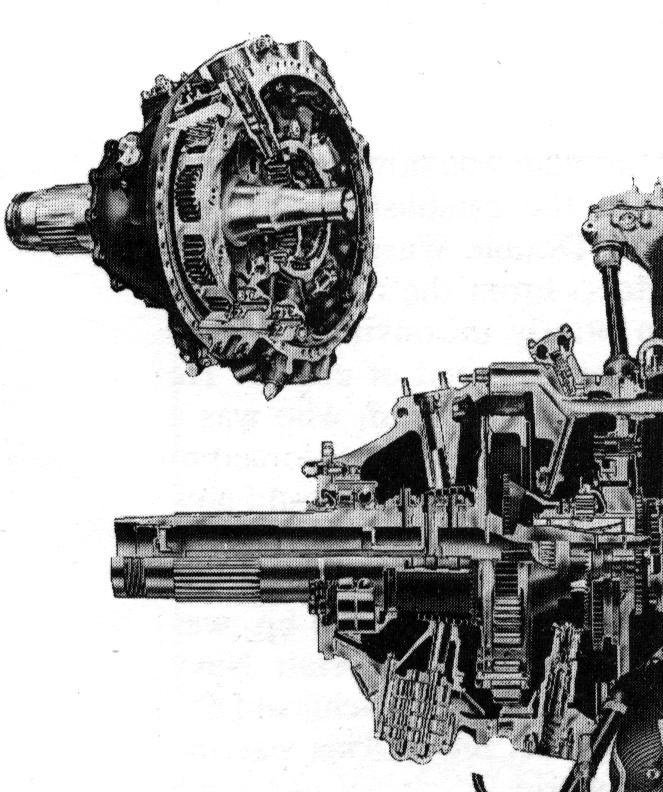
Yet another one.

Subject:        Gear Set Info
   Date:        Mon, 20 Nov 2000 18:46:28 -0800
  From:        Paul <rotaryeng@earthlink.net>
Paul, I need your (group) help in helping me determine the adequacy of a
gear set. I need to know how much horsepower that the set is capable of
handing with a reasonable safety factor. This is being considered for a
psru. I hate to admit it, but it's been too long ago that I could do these
calculations.

The spur gear set is as follows:

Width:  .750"

Outside Diameter:  pinion-2.56" (26T)   driven-5.36"(52T)

Gear heigth: .200"

Material: 8620 (Rockwell 55 est) heat treated steel

Max rpm of pinion: 7,000

Thanks for the help.

Chuck H
I think you need to invest in a copy of Marks Standard Handbook for
Mechanical Engineers. Tenth Edition. There are ten or 15 pages in fine
print on gear stress. Too many to scan in and upload here.

Don't forget some sort of torque isolation device as it will IMHO really pay off
in a much stronger drive for not a lot of extra weight. I suspect impact loads on
the gear teeth are a major factor in the durability of gear drives.

The big unknowns are the rate of application of torque pulses to the teeth of
a drive and the effect of prop inertial loads. I have never seen those addressed
in any of the gear formulas I have seen so far  but I am  not a gear expert.
To my way of thinking several dozen people using a gear prop reduction
drive for hundreds or thousands of hours  under actual conditions
is far more important than all the formulas in the world. The history of
aircraft engine psru's is littered with tooth fragments.

Also planetary drives are always much lighter for a given torque capacity.
One of the reason is you are using more than just a couple of teeth on the pinion.
In a spur gear most of the teeth are not being used most of the time so they
are just going along for the ride while still weighing something. Also
for a given width and diameter of the pinion gear, far more torque can be
transmitted because the line contact length is multiplied by the number
of planet pinions used. The gear surface stress is therefore divided by the
number of planets.

The picture is of a R4360 4000 HP corn cob engine planetary PSRU.

Paul Lamar

The AirCraft Rotary Engine NewsLetter.              Powered by Linux.
ACRE NL web site.
http://home.earthlink.net/~rotaryeng/            http://www.linux.org