In the side port engine, the intake ports open and close during
operation.
In the periphery port engine, the port never closes, but is valved by
the
apex seal, between the retreating combustion chamber and the exhaust
header
via the combustion chamber in the face of the rotor during overlap. When
the
exhaust system is anything like tuned, and the RPMs are high enough, the
inlet column is exposed to a pressure that is always well below ambient.
It
is difficult to screw this up to the extent that is doesn't make a bunch
of
power. The tuning of the inlet tract is the icing on the cake.

 Lynn E. Hanover
I agree Lynn. In the six port the closed time is slightly less than the
four port.
In other words it is only completely closed for an instant.

I fail to completely understand why tuning works at all in the peripheral
port unless the back pressure from the exhaust has something to do with
it.
I expect it does as the exhaust chamber and the intake chamber are
connected
together through the recess in the rotor for awhile. That is why I would
like to see
Finn instrument the intake runners with high speed pressure sensors.

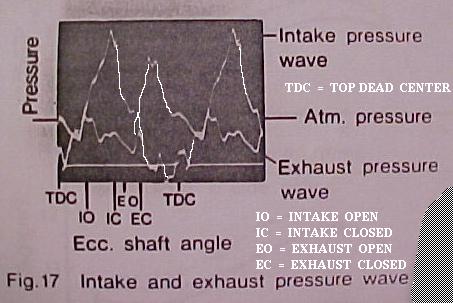
This peripheral port pressure chart is from SAE 841017 by Mazda.
The pressure sensors are right next to the port openings in exhaust
pipe and in the rotor housing next to the intake port.

It is interesting that the exhaust pressure is below atmospheric
most of the time. It is also interesting that the pressure in the
intake port starts building up when the port opens and reaches
a peak just as the intake port closes. Fascinating stuff.

We would get a much better picture of what was going on with three
or more pressure sensors located along the length of the intake pipe.

My scanner is down so I had to take a picture.

Paul Lamar
Lynn is usually "right on" with rotary info so I was surprised at the
comment about intake tract always being well below ambient.  This is
obviously not true since it is widely known that a well tuned rotary can
achieve volumetric efficiency well over 100%.   Higher intake tract
pressures are also shown on the chart Paul sent.

The principle behind the higher pressure is very simple and has very little
to do with sonic waves or resonance.  It is simple inertia.  Air rushes down
the intake tract at high velocity (there's that dreaded term again) and as
Newton said, a mass in motion tends to stay in motion until acted upon by
another force.  The "other force" in this case is the rise in pressure
(above ambient) in the chamber.

My standard bet is $500.00.  Any takers?  :-)

Tracy Crook
tcrook@rotaryaviation.com
www.rotaryaviation.com
I am really mystified by that chart. I even suspect it was labeled wrong
in the translation. Note intake opens before exhaust. I hope Finn will
spend some time instrumenting the intake tubes. Perhaps you will install
Finn's data acquisition system on your intake pipes so we can really see
what is going on in your system. I'll pop for the pressure sensors.

Paul Lamar


The AirCraft Rotary Engine NewsLetter.              Powered by Linux.
ACRE NL web site.
http://home.earthlink.net/~rotaryeng/            http://www.linux.org