Sounds plausible. Perhaps we can come up with a tiny venturi to
measure
air velocity in the intake runner.
No need to get a venturi Paul. Your pressure transducers will work if
they
have a short enough response time. Tracy is correct, but there is also a
component of sound in this explanation. The air stopping and starting or
slowing and speeding, whichever you prefer, does create pressure waves.
As
that column of air comes to a stop a positive pressure wave is created
and
travels up the intake runner in the OPPOSITE direction of the flow. It
emerges from the opening and a subsequent negative pressure wave travels
back down the runner. What you don't want is for this negative wave to
arrive just as the next chamber is starting to fill. It will produce
less
flow. What you do want is the negative pressure spike at the INLET of
the
runner at the instant the flow is needing to accelerate into the runner.
That is why long runners are better for low speed, and short runners are
better for high speed. Their resonant frequencies are inversely
proportional
to length.

The object of keeping the velocity high is that there is more inertia to
work with and the subsequent pressure pulses are stronger. Given the
same
airflow, a smaller runner is more efficient than a larger runner because
there are stronger waves to work with. If there were a problem with
tuning
the rotary using this method, a large runner could work better, because
there would be relatively weak pulses. I doubt this is the reason for
the
large runners on the Le Manns engine, because they are variable length.
This
indicates tuning to me, kind of like a trombone :-)Race engines tend to
have
massive ports and runners to reduce pumping losses at high rpm, and
subsequent airflow rates. Smaller more efficient runners are more
important
when throttle response and low end torque is the name of the game. The
dynamic chamber concept uses these pulses in a different fashion. It
conducts the positive wave from one rotor to the other at the proper
times.
There is a book called Scientific Design of Intake and Exhaust Systems
in
which most of this stuff is laid out in a fairly easy to understand
manner.
It is written by Philip H. Smith and John C. Morrison. They did their
work
before computer data acquisition and used Paul's favorite device, the
water
manometer to do a lot of testing. It was really quite clever. They used
a
bank of manometers attached to pressure taps along the intake and
exhaust
tracts of a test engine. They had a valve allowing them to sample a
small
increment of time at all the taps. The manometers clearly show the waves
developed in the runners. This is a sound phenomena and can be analyzed
as
such. The speed of sound really is relevant.

I myself witnessed this in action. I had a race car that had a four
barrel
carburetor on it. If you operated it without the hood and aircleaner you
could see a standing wave or cloud of gasoline droplets hovering above
the
inlet at certain rpms. (no it is not smart to operate without an
aircleaner
:-) The cloud would appear as if by magic at certain rpms, and vanish
between .25, .5, .75 resonance. Mesmerizing, to watch but dangerous
because
it was most pronounced at full throttle and you really needed to be
watching
the road!!!

Monty
My point on the Lemans engine was if you run it at a constant RPM
the variable runner length would be fixed at that RPM. That means you
could replace the runner with one of fixed length, the same diameter
and get the same HP results. The fact it had variable runner lengths
then becomes irrelevant. That also means we are using runners that are too
small in diameter as the Lemans engine developed 120 HP per rotor or 240
HP
for a two rotor version at only 6000 RPM. The Power Sport engine
with the similar peripheral porting is only generating 210 HP
at 6000 RPM with somewhat smaller diameter (too small) runners.
Do you agree? Does anybody disagree?

Paul Lamar
We are all now very close to agreement.  Monty added the sonic wave
component to the picture, showing that it can either help or hurt the
inertial tuning.  Obviously we want to tune it so that it helps.  Paul may
be right about there being some more power potential in the Powersport
engine if a larger runner was used.   BUT, to go with the larger runner, you
would need a larger intake port with more radical timing (similar to the
LeMans engine).  Keep in mind that the Powersport engine used very
conservative peripheral port timing in order to get a reasonable idle (and
it still wasn't all that great).  If you have ever heard the LeMans engine
run (did everyone listen to the LeMans engine soundbite link posted awhile
back?) you would know that it had a completely unusable idle for a practical
airplane.  It was litterally worse than supercharged AA fuel dragster
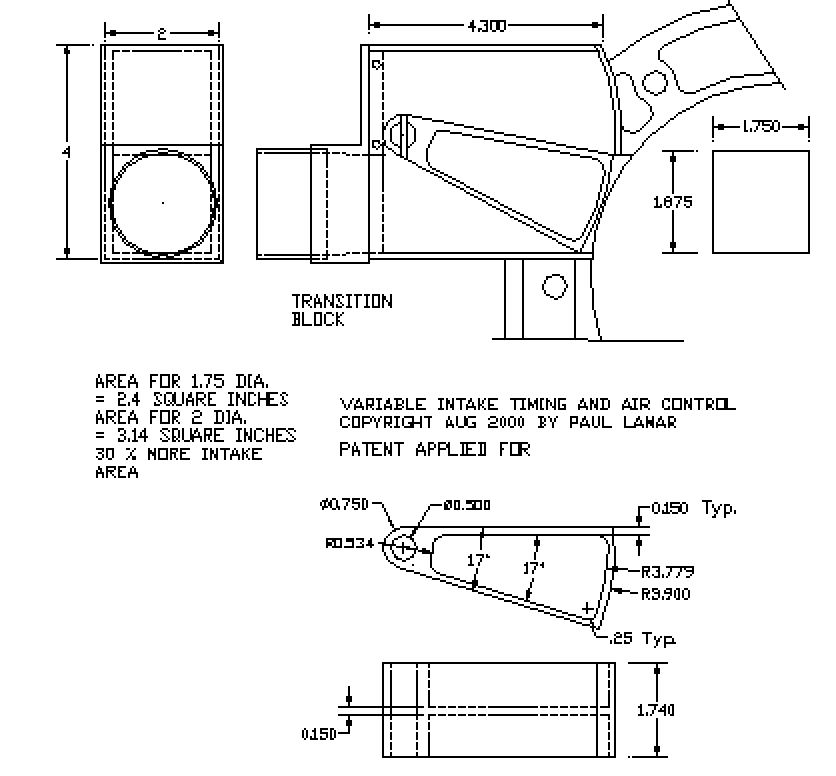
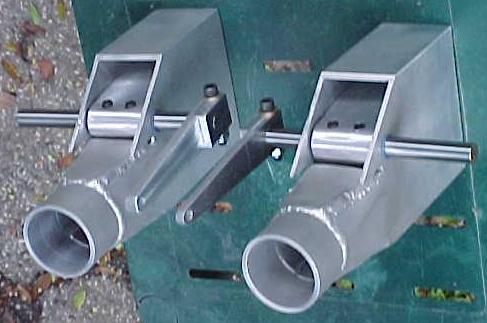
engines.   Maybe Paul's variable intake port scheme would help.  This would
be a substantial R & D effort.

Tracy Crook
tcrook@rotaryaviation.com
www.rotaryaviation.com
Ken Powell is building one so we should find out soon.

The Power Sport trick of putting the throttles plates
right next to the intake port also improves the idle.
I think Everett Hatch (Power Sport) beat Mazda to the punch on that one.

Paul Lamar

The AirCraft Rotary Engine NewsLetter.              Powered by Linux.
ACRE NL web site.
http://home.earthlink.net/~rotaryeng/            http://www.linux.org