snips....

Monty Roberts wrote:
No need to get a venturi Paul. Your pressure transducers will work if they
have a short enough response time. Tracy is correct, but there is also a
component of sound in this explanation. The air stopping and starting or
slowing and speeding, whichever you prefer, does create pressure waves. As
that column of air comes to a stop a positive pressure wave is created and
travels up the intake runner in the OPPOSITE direction of the flow. It
emerges from the opening and a subsequent negative pressure wave travels
back down the runner. What you don't want is for this negative wave to
arrive just as the next chamber is starting to fill. It will produce less
flow. What you do want is the negative pressure spike at the INLET of the
runner at the instant the flow is needing to accelerate into the runner.
That is why long runners are better for low speed, and short runners are
better for high speed. Their resonant frequencies are inversely proportional
to length.

The object of keeping the velocity high is that there is more inertia to
work with and the subsequent pressure pulses are stronger. Given the same
airflow, a smaller runner is more efficient than a larger runner because
there are stronger waves to work with. If there were a problem with tuning
the rotary using this method, a large runner could work better, because
there would be relatively weak pulses. I doubt this is the reason for the
large runners on the Le Manns engine, because they are variable length. This
indicates tuning to me, kind of like a trombone :-)Race engines tend to have
massive ports and runners to reduce pumping losses at high rpm, and
subsequent airflow rates. Smaller more efficient runners are more important
when throttle response and low end torque is the name of the game. The
dynamic chamber concept uses these pulses in a different fashion. It
conducts the positive wave from one rotor to the other at the proper times.

There is a book called Scientific Design of Intake and Exhaust Systems in
which most of this stuff is laid out in a fairly easy to understand manner.
It is written by Philip H. Smith and John C. Morrison. They did their work
before computer data acquisition and used Paul's favorite device, the water
manometer to do a lot of testing. It was really quite clever. They used a
bank of manometers attached to pressure taps along the intake and exhaust
tracts of a test engine. They had a valve allowing them to sample a small
increment of time at all the taps. The manometers clearly show the waves
developed in the runners. This is a sound phenomena and can be analyzed as
such. The speed of sound really is relevant.

I myself witnessed this in action. I had a race car that had a four barrel
carburetor on it. If you operated it without the hood and aircleaner you
could see a standing wave or cloud of gasoline droplets hovering above the
inlet at certain rpms. (no it is not smart to operate without an aircleaner
:-) The cloud would appear as if by magic at certain rpms, and vanish
between .25, .5, .75 resonance. Mesmerizing, to watch but dangerous because
it was most pronounced at full throttle and you really needed to be watching
the road!!!

Monty
Scientific Design of Intake and Exhaust Systems.
Robert Bentley Publishers. 1962
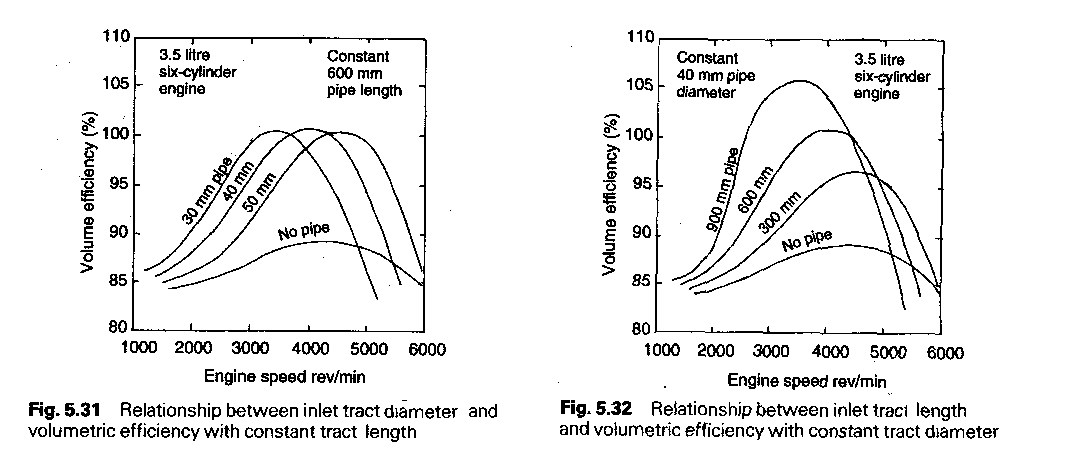
I have that book and I recently
scanned it again looking for velocity effects. As far as I can tell
there is no mention of pipe diameters changing the resonant frequency
as found to be the case in Hienz Heisler's book Advanced Engine
Technology as shown in this gif. If one does not take this into account one
can be fooled by merely changing the pipe length alone.

This appears to be an oversight on the part of the SDIE author. Of course
with most piston engines pipe sizes are limited by valve size.
This is not true with a rotary as port and pipe sizes can vary over
a wide range

The velocity was mentioned in the context of getting a good air fuel
mixture in a carburetor. The SDIE author felt the quality of the mixing
out weighed the advantages of tuning. That of course does not apply to
EFI. I do believe that could be why Paul Yaw is so fond of keeping up
the air velocity as he mainly deals with carburetor engines
for road racing over a wide RPM band.

The amount of air getting into the engine is all that matters
in our case. A large tuned pipe of low velocity is better than a small
tuned pipe of high velocity because the pumping losses are lower.
Mazda obviously varied both diameter and length when designing
the Lemans engine intake system.

Paul Lamar

The AirCraft Rotary Engine NewsLetter.              Powered by Linux.
ACRE NL web site.
http://home.earthlink.net/~rotaryeng/            http://www.linux.org