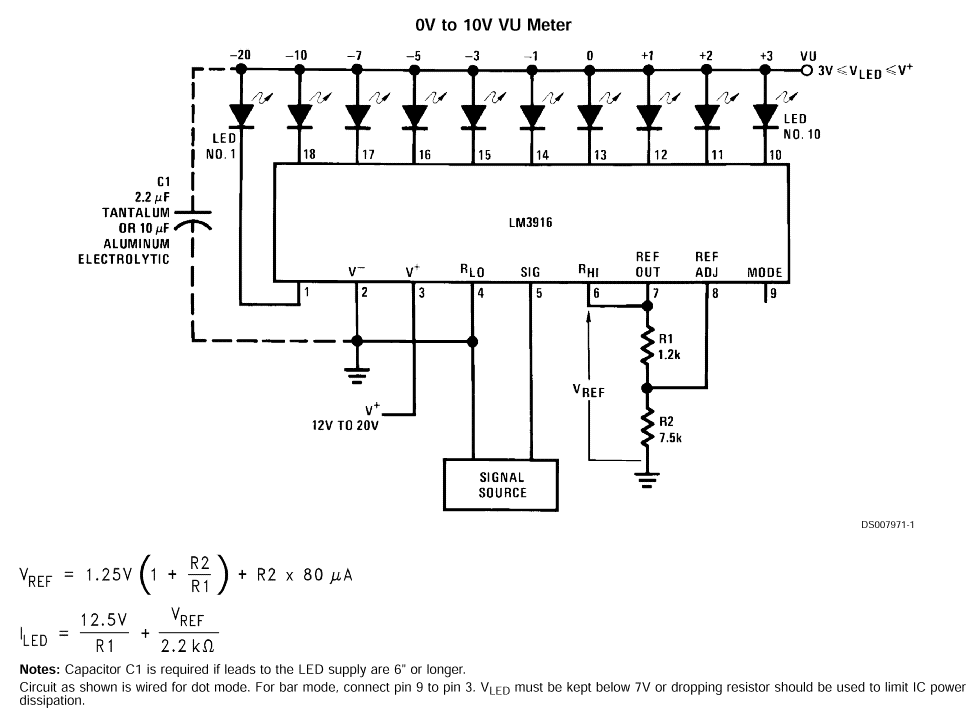
It is possible to make a crude oscilloscope out of ten of these chips
and ten bar graph LED's that would drive a ten by ten LED matrix on
the instrument panel. No programing expertise necessary.

Then all you need is an analog switch chip to select one LM3916 at a time once
each 36 degrees of e-shaft rotation while connecting the pressure sensor in
turn to one of the ten LM3916 voltmeter chips. A little signal
conditioning might be required.

These chips are a about a buck apiece so it would make a cheap
battery powered portable oscilloscope.

It would also be possible to cascade the chips for higher rez
say 20 by 20 which is four times the info of a 10 by 10 display. That would
give an e-shaft angular rez of 18 degrees and a pressure rez of less than
one psi. That would take forty chips.

I haven't built one of these yet so I am not sure of the response time
but from the looks of it it should be real fast as all it is... is
bunch of comparators.

This is one of many possible ways to see what goes on inside your intake
manifold.

Paul Lamar


National Semiconductor.

The LM3916 is a monolithic integrated circuit that senses analog voltage levels
 and drives ten LEDs, LCDs or vacuum fluorescent displays, providing an
 electronic version of the popular VU meter. One pin changes the display from a
 bar graph to a moving dot display. LED current drive is regulated and
 programmable, eliminating the need for current limiting resistors. The whole
 display system can operate from a single supply as low as 3V or as high as 25V.

 The IC contains an adjustable voltage reference and an accurate ten-step
 voltage divider. The high-impedance input buffer accepts signals down to
 ground and up to within 1.5V of the positive supply. Further, it needs no
 protection against inputs of ±35V. The input buffer drives 10 individual
 comparators referenced to the precision divider. Accuracy is typically better
 than 0.2 dB.

 Audio applications include average or peak level indicators, and power meters.
 Replacing conventional meters with an LED bar graph results in a faster
 responding, more rugged display with high visibility that retains the ease of
 interpretation of an analog display.

 The LM3916 is extremely easy to apply. A 1.2V full-scale meter requires only
 one resistor in addition to the ten LEDs. One more resistor programs the
 full-scale anywhere from 1.2V to 12V independent of supply voltage. LED
 brightness is easily controlled with a single pot.

 The LM3916 is very versatile. The outputs can drive LCDs, vacuum
 fluorescents and incandescent bulbs as well as LEDs of any color. Multiple
 devices can be cascaded for a dot or bar mode display for increased range and/or
 resolution. Useful in other applications are the linear LM3914 and the
 logarithmic LM3915.


The AirCraft Rotary Engine NewsLetter.              Powered by Linux.
ACRE NL web site.
http://home.earthlink.net/~rotaryeng/            http://www.linux.org