Al Gietzen wrote:
Paul;
I think we need some clarification on this oil cooler info.  Seems that your
saying that a 3.5" thick oil cooler can't work because the air side pressure
drop based on a specific case that is not applicable.  The pressure drop is
dependent on much more than thickness; at the very least we need to know fin
and tube density, cross sectional area and whatever.
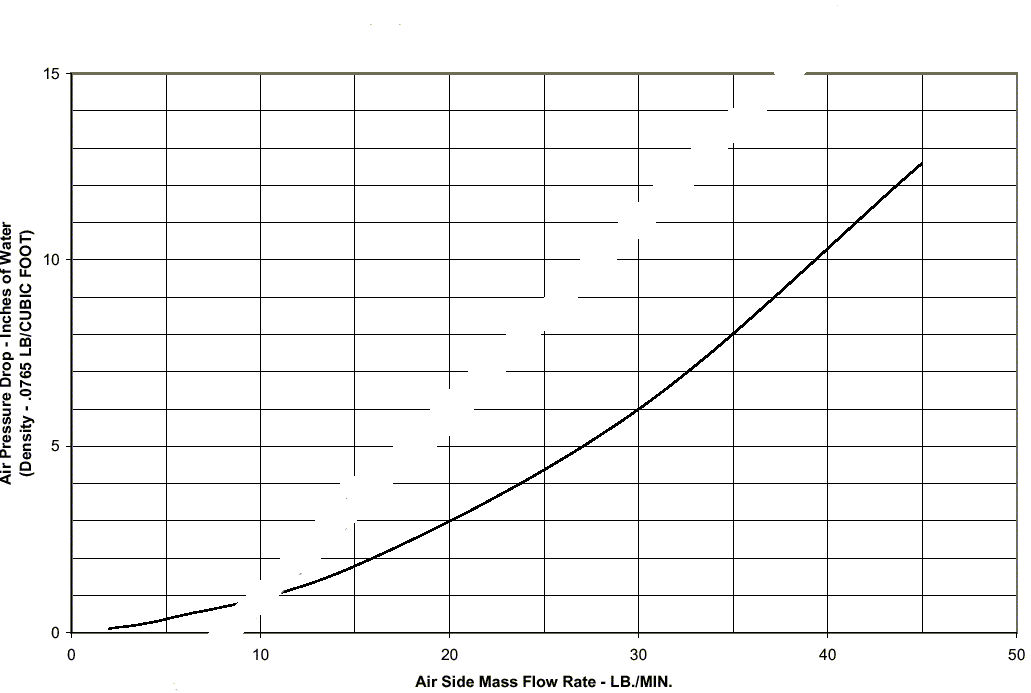
Some of that is unnecessary Al. This is the bottom line. Mass of air flow through
the core verses differential pressure drop. Note this is for a given
core of a given area and thickness.  It is designed as an aircraft oil cooler
so it is a specific case. It needs to be normalized for each square inch
of core. The point is this core will not work well until the pressure
differential gets to 12 inches of water or about 160 MPH in terms of
dynamic pressure and mass airflow.

I am not saying that the core could not be redesigned for more mass
airflow as a function of differential pressure with wider fin spacing
but then the same increase in fin spacing to achieve this would result
in less heat transfer for a core of given volume.

Did you download the oil cooler .pdf file? It takes three curves
to completely characterize an oil cooler. This chart and a chart of
heat transfer as functions of oil flow, air mass flow and oil flow
pressure drop. These charts are all contained in that .pdf file along with
several different area sizes of 3.5 inch thick oil coolers.

They all have the same problem. They don't start to work well
until they get to about 160 MPH. I can understand why they made
them so thick. They assumed everybody would mount them perpendicular to
the air stream to reduce the frontal area which is the traditional
way of doing it. They could not imagine that some one would mount
a large area thin cooler in an oblique configuration.

Paul Lamar

The AirCraft Rotary Engine NewsLetter.              Powered by Linux.
ACRE NL web site.
http://home.earthlink.net/~rotaryeng/            http://www.linux.org