Wrathall Mark wrote:
Mark Wrathall wrote>

Paul, do you want the A300 crash discusions moved off your forum? Here is
the latest NTSB release.
http://www.ntsb.gov/Pressrel/2001/011120.htm
If there is an age problem with composites I think we ought to know
about it. Many of us are building and flying composite airplanes.
Some even with carbon fiber structural parts. This has implications for the
aviation industry far beyond Airbus.

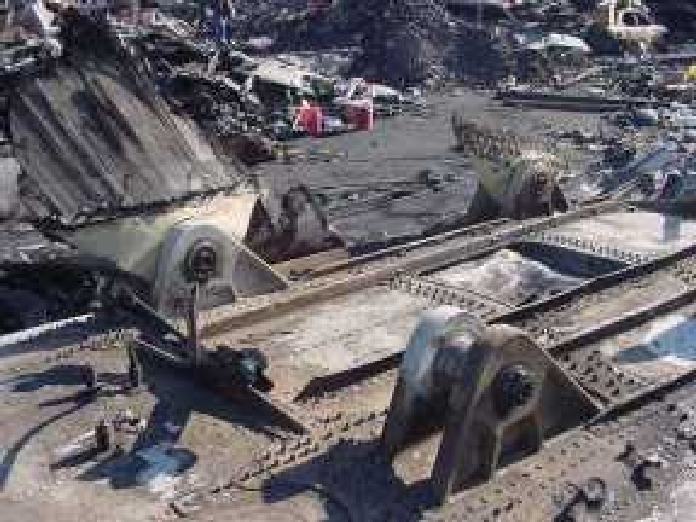
The fact that these metal attachment lugs and bolts are un-deformed is highly
suspicious to me. That means the  carbon was much weaker, at this time, than
the metal lugs and bolts. Engineers strive to make all parts equally strong.

The fragmented carbon in the left side of this picture suggest this is
the origin of failure. The carbon appears to have first failed in shear
between the layers. My guess is the next point shown in the picture just
ahead of or behind this failed next in simple tension as the load on it
was suddenly doubled.

That allowed the fin to move lateral towards the photographer.
The hard points on the other side of the fin then failed due to lateral
bending of the fin. This was a simple brittle fracture caused by bending
in the carbon lugs from the looks of the photos. Again the metal lugs
are much stronger than the carbon as they show no permanent deformation.

Paul Lamar

The AirCraft Rotary Engine NewsLetter.              Powered by Linux.
ACRE NL web site.
http://home.earthlink.net/~rotaryeng/            http://www.linux.org