vjaqua wrote:
For those of you that would like to consider a direct drive Wankel - The 2 stroke version
would be ideal. With double the number of power strokes the torque and horsepowe at the
lower RPM ranges would be roughly doubled. Paul is undoubtedly corect in indicating
that the port area  is probalbly somewhat restricted, but this is not as much of an issue
at the direct drive rpm point. External scavanging would be required, so an electric
assisted turbocharger would be apropriate (like Turbodyne). The motor section could
be run as a generator or alternater once the engine "bootstraps", and this would eliminate
one of the major accessory drives. Just think with modest boost pressure 200 bhp
at 3000 rpm - Vance
The two stroke wankel is in the category called cross scavenged.
In other words the intake is on one side of the rotor and the exhaust
is on the other. Most piston based cross scavenged two cycle engines
have a lump in the piston that directs the intake flow upward into
the chamber and the exhaust flow downward on the other side of the
chamber and out the exhaust port. This is not possible with the geometry
of the wankel rotor so the scavenging efficiency will be low, the
fuel consumption high and the power output way less than expected.
This is because highly undesirable mixing of spent exhaust gases and
fresh charge takes place.

Even in two cycle  piston engine cross scavenging is the least
efficient. It is however widely used in model airplane engines.
Uniflow scavenging is the most efficient. Air is taken
in on one end of the cylinder and exhaust let out on the other end. Almost
all successful two cycle diesel engines in trucks, ships and other industrial
use have uniflow scavenging. The Continental and Junkers Jumo aircraft
diesels among them. I see no way of implementing uniflow scavenging
in a wankel.

The means of supplying the charge air is irrelevant to scavenging
efficiency. A roots blower would be the simplest. The power required
of a pure electric blower makes it impractical. A turbo charger would
use up the least amount of HP providing some way of starting the
engine is devised.

BTW an electric assisted turbo charger is mainly useful to reduce emissions
when the throttle is opened rapidly. This is so because the power
in a diesel is controlled by the amount of fuel injected and not
by throttling the intake pipes. When more power is needed more fuel
is injected... excessively and temporarily richening the mixture
beyond the optimum until the engine RPM can speed up and pump more air.
That is why you see black smoke coming out of trucks from time to time.
This is the why of electric assisted turbo chargers.
They might however be used as Vance suggested... to start a two
cycle turbo charged two stroke engine.

Paul Lamar
This is not cross scavanging in the same sense that
you refer to, in that it would have control over the
port timing opening exhaust early, and keeping inlet
open after the exhaust is closed. This is more akin
to the Junkers Diesel situation, which can provide
fuel specifics in the same range as 4 strokes.
Incidently lumps on pistons are pretty much passe',
with loop and Schnerle scavanging. This would be
a realy neat engine, but no one is likely to have
the funding nor incentive to do anything with it.
Vance
--
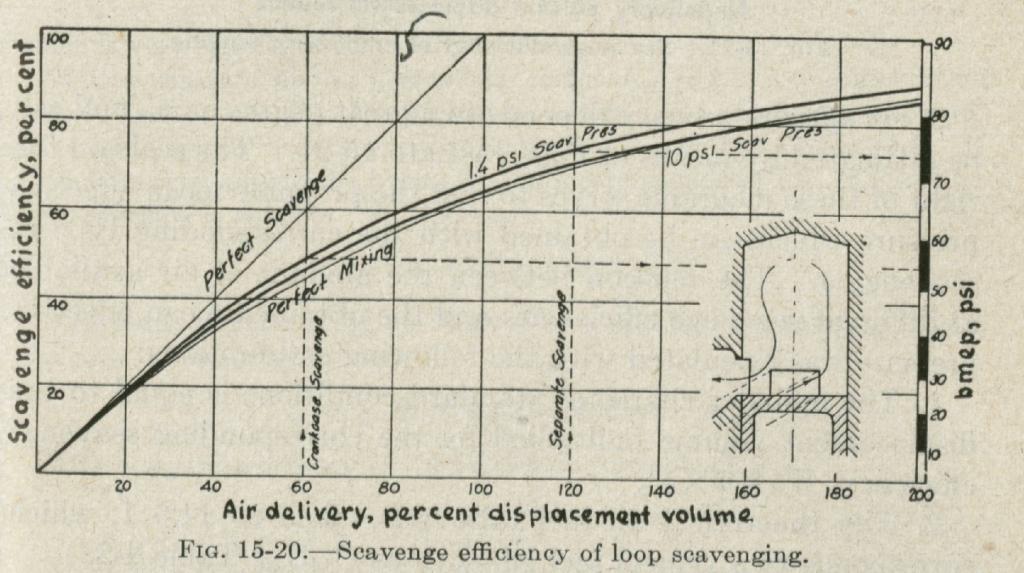
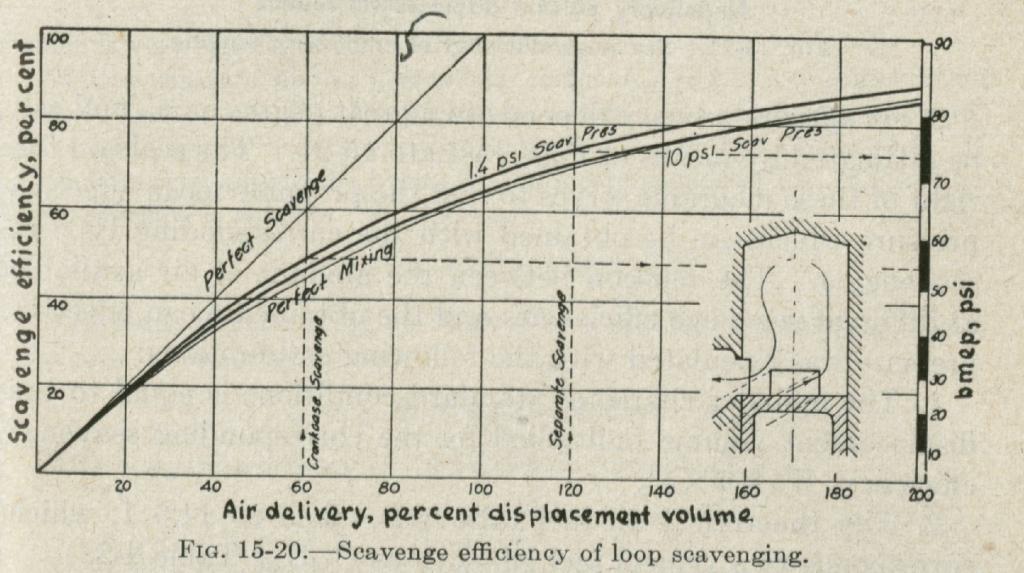
Loop scavenging requires a cylinder and the rotary chamber is about
as far from a cylinder as you can get. The chamber shape is about as
bad from an aerodynamic scavenging point of view as one can get.

The other requirement is direct injection if you are going to scavenge
with excess air as shown by this 10 psi curve. Nobody I know is going
to spend $500 million to make this work :-) Good luck!

The chart is from Internal Combustion Engines by Maleev. IMHO better
book on two cycles than Taylor.

Paul Lamar

The AirCraft Rotary Engine NewsLetter.              Powered by Linux.
ACRE NL web site.
http://home.earthlink.net/~rotaryeng/            http://www.linux.org