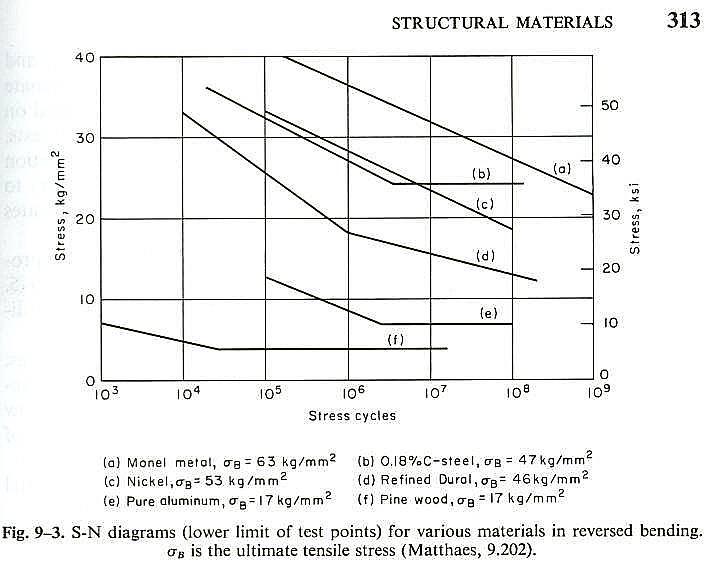
Here is a chart of different metal fatigue characteristics verses
stress cycles. If the stress is below the flat part of the
curve the part (in theory) should last forever.
A race car engine is expected to live for two hours
at up to 8000 RPM. That is 8000 times 120 minutes or only 960,000
cycles. When I was racing the engines would last about two hours
and that was it. Not only was the crank and other parts cracked
but the block itself was cracked. That meant that the engine was designed
right up to the minimum weight limit. If the race was longer it would
fail. This was a race engine that weighed about 450 pounds
made from the finest forged and heat treated materials available
and put out about 600 HP. An engine designed for a longer race
would be heavier or lower HP as the parts such as the crankshaft
would have to be made larger and heavier.

A 350 HP over the road truck engine
weighs in the neighborhood of 2000 pounds and has a duty cycle
similar to an aircraft engine with an expected life of 500,000
miles.

A car engine need put out, on average, only about 30
HP for 150,000 miles. The peak HP can be as much as
350 HP but the engine will only see that for a few seconds
during its entire life. Lets say the car averaged 30 MPH
so that would be 5000 hours or 300,000 minutes.
Lets say 2500 RPM average or 750,000,000 cycles.
Way beyond the fatigue limit of any material so obviously
the parts will be designed for a low stress level at this
average HP. The car manufacturers are not going to put
material in the engine of the highest quality as it cost
too much. They would rather make the parts out of low
cost material such as cast iron and make the parts big
and heavy enough to reduce the stress level below the fatigue limit.
If you ask for more continuous HP  from this engine it is
guaranteed to exceed the fatigue limit and the parts will
crack sooner rather than later.

Fortunately for us the Mazda rotary appears to be an exception.
What the rotary also has going for it are the intrinsically
low stress levels as an out growth of its unique design.
Unlike a crank shaft there are no twist and turns in the
eccentric shaft that cause high stress concentrations.
There are then only two other low stress moving parts.
Namely the rotors.

An aircraft piston engine cruising at 2200 RPM must last
2200 times 1500 hours 90,000 minutes or about 20,000,000 cycles.
To keep the weight down the finest materials must be
used and the stress level kept as high as possible
for the expected life.

The steel shown in the chart is not necessarily the same steel
used in a crank shaft. That will be shown next.

Again the chart is from Taylor.

Paul Lamar

The AirCraft Rotary Engine NewsLetter.              Powered by Linux.
ACRE NL web site.
http://home.earthlink.net/~rotaryeng/            http://www.linux.org