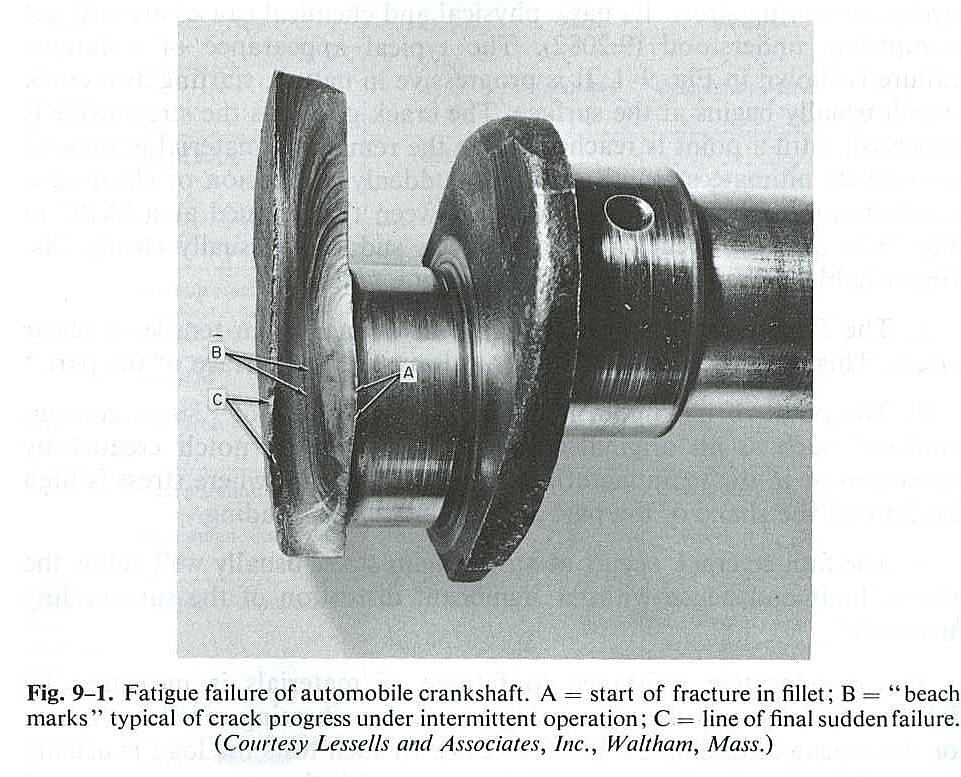
The bottom line if you exceed the design limits of the crankshaft.
Happens all too frequently for aircraft engines.

This appears to be a forged crank but it is lacking
the large radii in the journal area necessary to
lower the stress concentrations and make the crank last
the requisite number of hours for aircraft use. All aircraft
cranks that I have seen have large radii in this area that is
known to reduce stress concentrations. This is typical of auto
engine cranks as low length of the engine is a major design
goal and large radii add overall length to the engine.

Don't send me any anecdotal  information that so and so ran his engine
for x amount of time flat out. No one would really know what the true
circumstances really were. No sanctioning body checks these types of
runs for cheating. Even if they took the engine apart and looked at the parts
they could not tell what they were made from without sending them
out for analysis or destructive testing.

I have been totally unable for the past twenty years to find out
what exact materials are actual used in specific production car engines.
It is now a car company secret. If a sanctioning body discovered
somehow that the crank was indeed made from a high strength material
the manufacturer could claim that all their cranks were made from
the same material. It could be an out an out lie. Judging by the
published SAE papers in the last twenty years the trend is to cast
iron parts except perhaps for real small car engines that run
at a higher duty cycle then say a 350 HP V8.

In the case of the Corvette distance speed records they admitted to
installing throttle stops and for all anybody knows changed
all the moving parts in the engine for higher strength materials.

Furthermore the top speed of a car is proportional to the cube root
of the HP so a small reduction in the top speed will result
in a large reduction in HP required.

There have been no material or
design breakthroughs in the last 50 years that would add significantly
to the life of an aircraft piston engine. This is easily checked by
noting the power to weight ratios of piston engines designed then and now.
In the case of car engines the trend is to better match them to
the low actual HP required and lower the cost. This includes programing
the EFI and IGN  computer to limit the continous HP and hence the
stress on the engine.

Paul Lamar

The AirCraft Rotary Engine NewsLetter.              Powered by Linux.
ACRE NL web site.
http://home.earthlink.net/~rotaryeng/            http://www.linux.org