Delbert Johnson wrote:
I called Tracy Crook this morning to brainstorm an idea that I had to
install a small radiator in the oil pan to provide initial cooling of the
oil and to increase the difference in the water to air temperature for more
efficient cooling.  The idea is similar to Tracy's copper pipe system but
with improved efficiency.
SNIP
If anyone has suggestions pass them on. Also, I may need some help on the
heat transfer physics to determine how much heat can be pulled from a small
radiator.  The engine that I am working with is the 13B
Delbert Johnson
Just remember there is no free lunch. - That true, You will need a water
radiator
one third larger. There is no cooling but air cooling.
Therefore I see no advantage to this. I can see several disadvantages
such as cost, time, less room under the engine for the water
rad and maybe a few others. A major factor is the lower delta T between
water
and oil making the exchanger less efficient. The unknowns make it
inadvisable.
Paul Lamar
Paul, don't you remember the oil-fires from  failed oil cooler
installations??   Three so far!
Two were from the same type junk Chinese oil cooler bought from
Griffin Radiator. Both fires in the same airplane. I think Finn had
the other experience and I forgot the details.
Rotary oil-cooling is a serious,  major issue that must be addressed with
heads-up engineering.

I second Delbert's approach, and as he states, in-pan oil cooling has merit
for the following reasons:
1.) Its real simple and reduces weight - big time!
2.) Eliminates hot high-pressure (60 - 100 psi) oil outside of the engine -
and fire due to a failure!
3.) Eliminates a second air cooler, ducting, high pressure hoses, support
brackets and the challenge of  fitting all of this in the engine
compartment - major advantage!
4.) Oil/water heat transfer is far superior to oil /air heat transfer, and
could assure a consistent and lower oil temperature.  By definition, water
boils.
5.) The higher water temperature to the water/air radiator  increases the
radiator efficiency - and even if  one-third larger, it's still only one
radiator!
The flaw in this reasoning is the coolant temp is already near boiling.
Adding one third more heat to the coolant could put it over the top. In fact
this is probably the show stopper. Once the coolant boils the entire
cooling system becomes divergently unstable. BIG TIME!!! Boiling pumps
coolant overboard....engine gets hotter.....remaining coolant boils faster
pumping even more coolant over board. It is a fast down the cliff slide.
This is absolutely the worst case scenario for a liquid cooled aircraft engine.
You are going down within minutes. In a sense entirely separate cooling systems
are some what redundant to a small degree.

Mazda tried this in the first gen RX7 and gave it up. There must have
been a reason as their implementation was as about as simple as one could
get with the oil/water exchanger under the oil filter.
6.)  Oil flow through the pan mounted oil/water HX is about 30 GPM*, this
plus the residence time of the oil in the sump is sufficient to transfer the
heat, given that oil heat capacity is only one-half that of water.  *as
suction from the oil pump.

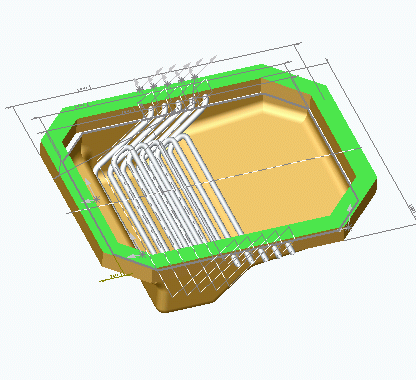
Attached is a design concept such as described by Delbert.

A 1" square AL insert between the pan and engine block supports the heat
exchange tubing (or radiator) that sits in side the oil pan.  The water is
fed from the engine block heater outlet, then merged with the main flow to
the radiator.  The sheet metal baffle to direct the oil flow, and the new
oil pick up modifications are not shown.

This is approach can directly retrofit most all existing Rotary designs.  I
have the materials and have started to assemble a prototype.  Would Tracy
consider testing it?

Regards,

Keith (Blackhat) Moore
Is it worth the risk?
Would Tracy consider testing it in his airplane? Tracy?
Would anybody else consider testing it in their airplane?
Did Power sport get it to work yet? How much money and time
have Power Sport wasted so far on this approach?

Paul Lamar

The AirCraft Rotary Engine NewsLetter.              Powered by Linux.
ACRE NL web site.
http://home.earthlink.net/~rotaryeng/            http://www.linux.org