> > > >Ken Welter wrote:
 >>  >>
 >>  >>   I have my coot at home to work on it for a month or two and one of
 >>  >> the things I am going to try is installing a 80000 BTU fluidyne heat
 >>  >> exchanger and have a separate radiator for it and a electric water
 >>  >> pump for the system and have a valve so I have the option to tie it
 >>  >> into the engine system. I tried the fluidyne cooler before and it
 >>  >> shot the water temp out of site. I have put a larger radiator since
 >>  >> then but I still want a separate system. Does any one know of a
 >>  >> electric water pump that would do the job.
 >>  Ken,
 >>  The power consumption for a water pump for primary engine cooling
 >>  is too large to make an electric pump practical, esp in an aircraft.
 >>  Basically, you have to convert the shaft hp to electricity, transport it
 >>  and then convert the elctricity back to shaft power.  For small loads
 >>  this is lighter and simpler than shafting and belting.  For large loads
 >>  the size of alternator and motor are very large and heavy.
Bad application
 >>  for an electric water pump. I'm afraid the best bet is the
original pump,
 >>  altho a viable alternative is a totally external belt driven water pump,
 >>  available from racecar suppliers.
 >>
 >>  Bill Freeman
 >>  Long EZ builder & pilot
 >>  BSME, MSME
 >  > EAA Technical Counselor
 >   This pump is not going to be used as the primary pump the stock
 >pump will be used for the water cooling the engine and the electric
 >pump will be used for a separate system useing separate radiator and
 >heat exchanger and I don't think it will take that big of a pump to
 >do the job however I may consider the belt pump but that would be a
 >big problem on where to mount it as I have two alternators and space
 >is limited.
It will still need to be around one HP Ken.
At 746 watts per HP and 14 volts from the regulator that
will be at least 50 amps additional out of the alternator.

Paul Lamar
   I am just an eyeball engineer and I look at the heat exchanger then
I look at the radiator and then I look at my garden hose and the
volume that it puts out and I think that should do it and than I look
at where that water comes from. It comes from a 1/3 hp pump that has
to lift it 150 ft out of the ground then push it another 50 ft to the
house then threw a 75 ft garden hose so I think a 1 hp motor is over
kill.  I have found a 12 volt pump that pumps 300 gallons an hr and
draws only 7.5 amps it is made by EWP and they say it will cool a big
block ford so I think I will give this a try and I will let you know
how it works.
Please do. Its a dirty job but somebody has got to do it :-)>

Before you use it hook it up some place and try to pump 300 gallons per hour
or 5 gallons a minute through the heat exchanger and the rads. If you
don't have the heat exchanger and the rad yet use a bucket mounted two
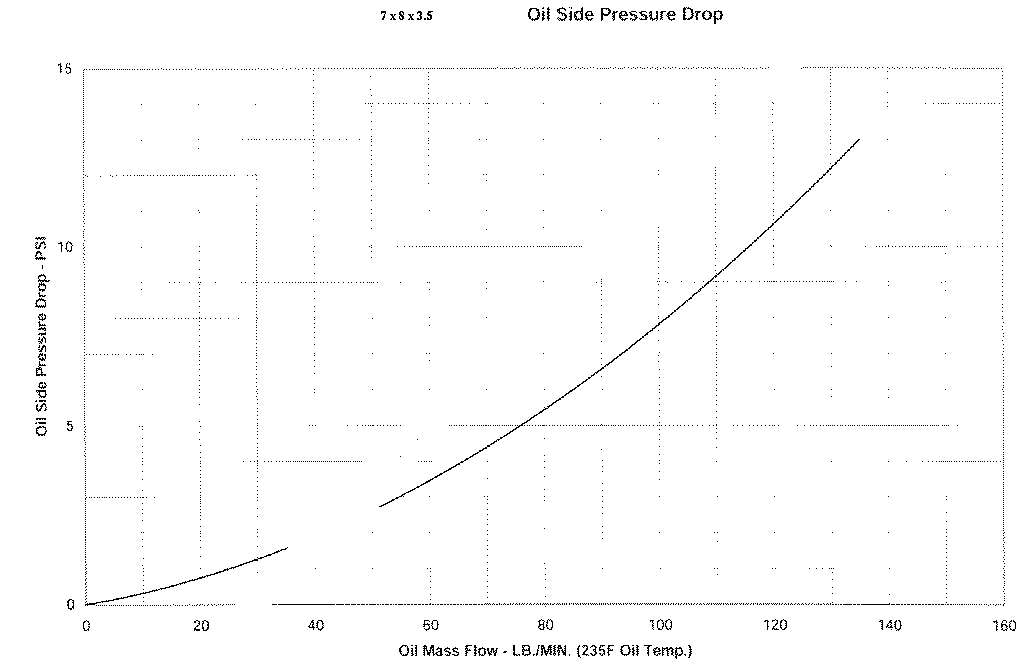
feet higher as a guess. Here is a chart of the oil side pressure drop in
an oil cooler. One can relate this to inches of water pressure head.
Hence the two feet. The total pressure drop could be higher as I have no
numbers on your oil to water heat exchanger.
If it does not  pump  five gallons per minute send it back
and get your money back. Power Sport tested one of these electric pumps
and it pumped no where near as much water as claimed.

BTW Five gallons a minute is way too little water for 13B oil cooling
heat exchanger hook up. The water pump on a 13B pumps about 35 gallons
a minute or 2100 gallons per hour and some engineers on here say that
is marginal. That is just for the water cooling. Since the oil is one
third the cooling that is another 17 gallons per minute or so just
for the oil cooling system.

The electric pump you mention as 7.5 amps in at 14 volts
or .140 HP. Given the electric motor at 85% efficient the HP going
into the pump is about .112 HP as opposed to about a half to one HP
needed for your oil cooling system. Five to ten times as much.

Sure these pumps cool drag race engines. Drag race engines only run at full
power for less than ten seconds. The rest of the time they are idling.

However I am looking forward to your doing this as it will prove
what I have been saying for about a year now on this electric water
pump subject as it comes up from time to time.

Here is an old message on the subject.

Subject:        Jay Tech water pumps
   Date:        Fri, 18 Aug 2000 19:17:29 -0700
  From:        Paul <rotaryeng@earthlink.net>

Michael Paauwe wrote:
Paul,
I realy don't know what flow rate the standard water pumps operate at but
don't think that they are at all eficient I would guess they are down around
5-10% efficient when the engine is at 6000RPM
The water pump has to circulate sufficient water to keep the engine cool at
idle and not over do things at full RPM.
I would guess that the electric version would not require anything like 3HP
to operate because it would be designed to operate at a fixed speed.
Perhaps you could dispense with mechanical thermostats and instead reduce
the speed of the electric water pump at idle or cruise conditions based on
the engine water outlet temp?
Just an Idea.

Mike
It always amazed me the rotary will cool in aircraft service. We are asking it
to cool at 150 continuous HP level when in car use it rarely sees more than 30 HP on
average. I think to reduce the capacity of the system below what it is
now by going to smaller lines and a low power water pump is foolish.
It takes a lot of water flow to get that amount of heat out of the engine and into
the rad. Jim Mederer at Racing Beat and Jeff Spitzer will agree with
me on this I think. As far as the rad goes we have more speed and potential
airflow on our side.

I don't agree the stock pump is so inefficient. On the contrary I think it
is over designed for car use. It probably could be a bit better but I also see
improvements in the later models. My guess on three HP may have been a bit high.
Looking in MacMaster Carr catalog I see well designed centrifugal pumps pumping
35 gallons per minute with only one HP. The intake is 1-1/2 inch pipe size and
the outlet is 1-1/4 inch pipe size which, as I recall, is bigger than the
numbers would indicate.

At 12 volts that would be only about 83 amps. Still an awful lot and more
than most alternators. Given a motor efficiency of 80% and 746 watts per HP.

You must realize those electric pumps were designed for drag racing when full
power is used for less than 10 seconds at a time. The rest of the time the
engine is idling. Even the drag racers go to electric pumps to unload
the modest HP requirements of a mechanically driven water pump.

In the Summit racing catalog one ad says the mechanical pump is
costing 15 to 20 HP and another ad claims their pump only draws
5.6 amps or .09 HP at 30 GPM. The rotating pump parts are probably
exactly the same or they could be. That is the closest thing I
can think of to a 100 MPG carburetor. All this violates the laws
of physics and does not compute.

Paul Lamar


The AirCraft Rotary Engine NewsLetter.              Powered by Linux.
ACRE NL web site.
http://home.earthlink.net/~rotaryeng/            http://www.linux.org