Sinps...
if you
want to keep the velocity low for good heat transfer
More snips...

I don't understand this. Why is heat transfer helped by low
velocity???
Jon
Me either Jon. Sounds like part of the old myth about "slowing the air
down
so it has time to cool the water". Or slowing the water down so it has
time
to cool off in the radiator.  Both are Pure bunk.

Tracy Crook
tcrook@rotaryaviation.com
www.rotaryaviation.com
What he could have meant was if you slow the air the static pressure
increases
and consequently it gets more dense. Course the mass in unit time does not
change. The mass of the air passing through the rad and the efficiency of
heat transfer from rad to air is what counts.

Paul Lamar
Probably right Paul.  The air does slow down in a properly designed diffuser
(as the pressure goes up).  This all happens in front of the radiator.  As
you point out, the mass of air going through the radiator is the main
factor.  The point some people miss is that the end result is that the
velocity of air going through the radiator (internal to the core) is FASTER
than it would have been without the diffuser.  This may seem contradictory
which causes confusion.

Tracy Crook
tcrook@rotaryaviation.com
www.rotaryaviation.com
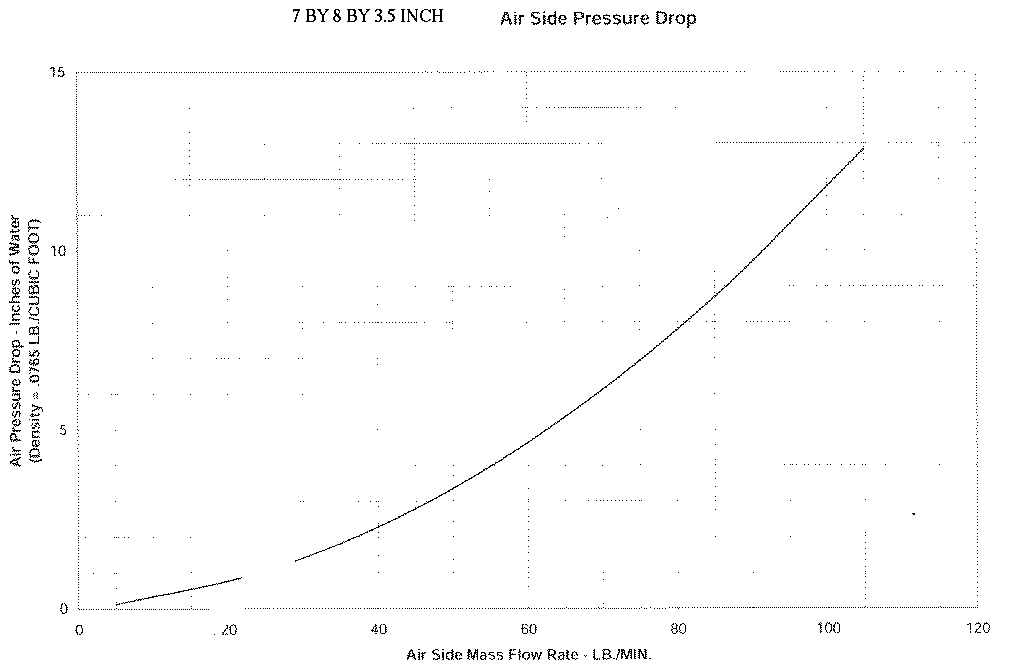
It sure does cause confusion. If you look at the curves such as this one
the mass air flow through the core is a function of the pressure across the core.

Ironically you can get higher pressure at a give air speed with no duct at all.
Rad mounted perpendicular out in the air stream. Probably 100% of dynamic pressure
at the center of the core. Off to the sides it may be less than dynamic pressure
due to lateral airflow and external diffusion.

With a bad scoop and diffuser (duct) you might get only 25% of dynamic pressure and with
a good scoop and diffuser maybe 80% of dynamic pressure. The big downside to no duct at all is
the high cooling drag. Suddenly it is WW one fighter plane time :-)>

Paul Lamar

The AirCraft Rotary Engine NewsLetter.              Powered by Linux.
ACRE NL web site.
http://home.earthlink.net/~rotaryeng/            http://www.linux.org