tom jelly wrote:
Funny thing about forming tubes- I saw what nasa did- they used SILICONE
RUBBER of all things inside a 2 piece mold- 2 half round aluminum parts and
a silicone male cylinder core.  unlimited pressure available as we all know
now....pushing on the ends of the silicone pushed it out, compressing the
matrix in the mold.

Tom>
That is good to know. The florescent light bulb trick is only good for one or two
sizes but that trick will work for all sizes. Furthermore you get a good finish
on the outside of the tube.

Method: Get a piece of thick wall aluminum tube.
Slice it in half on the band saw. Weld bar stock on all four edges.
Match drill holes in the bar stock. Fill it with RTV. Now that can get
expensive. I guess you could use an RTV coated smaller inner tube.
Viola you have a male and female composite tube mold.

Sounds like this trick will
work for all sorts of shapes for composite parts. The red silicone will
take the cure oven temps as well. Perhaps this is the trick they use
for co curing wing ribs into wing skins. I have been wondering how they
do that for the last ten or so years.

A vacuum bag would apply pressure to both male and female mold.

Now I am getting ideas for a molded composite rotary intake manifold
laid up on 1.5 inch diameter RTV rubber rods and a cast concrete
female mold. The RTV rods could have copper wire inside them to
hold the rough curve while the composite was hand laid before they
went into the female mold to be final cured. Or the RTV rods bent into
shape can be used to cast the concrete female molds. There are variations
on this theme where the female concrete molds can be used later to cast RTV
male core molds. This looks like a good low initial investment
business for someone to get into as the concrete female molds and maybe
the RTV male molds may be used over and over again.

Do we need a sketch or does everybody follow this?

We spent a lot of time a couple of years ago trying to figure
out a quick way of making composite intake manifolds. Hand carved
blue foam male molds were determined to be about the best way then.
The blue foam must be removed chunk by chunk from inside the cured tube.
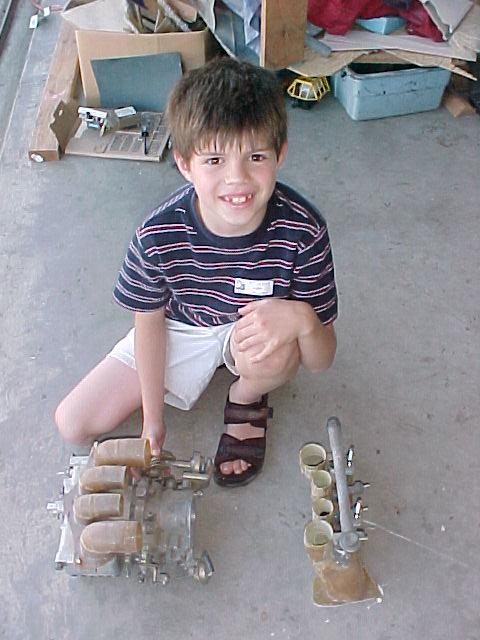
I think this idea beats that. Here is a picture of one that Perry made
with blue foam male molds. That's Perry's son.

I looked into having a cast aluminum intake manifold pattern made
and the cost was about $5000.

Paul Lamar

The AirCraft Rotary Engine NewsLetter.              Powered by Linux.
ACRE NL web site.
http://home.earthlink.net/~rotaryeng/            http://www.linux.org