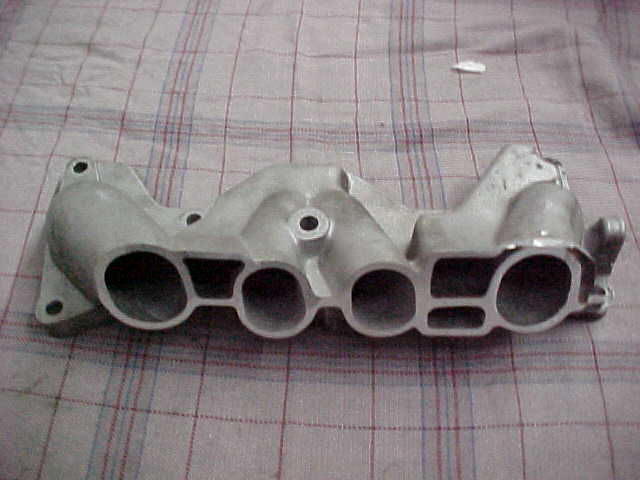
It will be a very small operation at first but I look for a long
product life.

The pattern cost is the big hang up right at the moment. I got a quote
for $5000. If you are willing to front the labor on building the patterns
we can pay you back as sales are made.

Paul
It will require four core boxes Tom. Can you do the patterns?
If so I could front some castings. We could get Tracy to do
the sales and shipping.

Here are a few design ideas. We need to keep the bends in tight so
they will clear the stock turbo charger. I can send you a turbo
manifold so you can copy the runners for the core boxs.

The runners don't have to be this long as rubber hose and tubing
can be used to make the pipes any length.

Paul
Tom Kendall wrote:
Looks like a very interesting challenge, and one I'm enclined to take on.
I'm dying to get involved in making *something*, but don't have much cash to
start a serious effort of my own for now.  Wood is cheap, and I've got all
the tools needed.  So... let's get on with the show:

I've never made serious patterns before, but reading up on 'em in
Machinery's handbook, it doesn't sound all that tough.  I spoke with a
foundry owner several months ago when I had him make a one-off part for my
lathe.  Originally, I was going to make a pattern for him, but he was able
to use the original part as the pattern (yeah!).  He tells me that virtually
all pattern work these days is done by making a CAD drawing which is then
e-mailed to his pattern makers.  They have CNC machines that make the part
out of blue foam, and he simply embeds them in the flask with a few sprues
and risers, pours in the melt, and Voila!  Finished part.  Too easy.  This
is the modern equivalent of the lost wax technique.  Clearly wouldn't work
for a hollow casting.

I've looked at your renderings.  Lots of questions come to mind, but first
and foremost is what material do we want to go with?  Cast aluminum, cast
steel, injection molded plastic (maybe with glass fiber to
strengthen/stiffen it?), laid-up composite, or what?  The various techniques
and requirements may affect the molds greatly.  Lots of ideas running around
in my head, but let's answer what material first, then get to the specifics.
Aluminum.
Am I to understand that the runners will only be supported by the inlet
manifold flange at the engine block?  The "free" end to be connected by
hosing?  If so, the runners should be kept low mass with a reinforcing at
the transition to the flange to prevent fatigue failures due to high stress
risers and vibration.

A core box to cast the center sand core for the four runners shouldn't be
too difficult.  I could make them a number of ways from laminating up a
sandwitch of plys (more work, but very dimensionally stable) to hogging out
a solid block with a router and a template (fast and simple, but not very
stable... which could be a problem with the thin walls needed).  Probably
use a hybrid of both.  Will need some hand detailing to fair in the
transision from round to oval, but nothing exotic.  The parting line will of
course have to be the plane of the bend.  I will definitely have to get more
detailed dimensions to work from.

If a composite layup is desired, then we need a corebox that will be used to
make a foam core.  Probably identical for all intents and purposes to the
sand core box.  Some vaseline and a can of expanding foam and we're in
business.  May have to fill any surface voids on the foam to get the desired
smooth finish, but no rocket science involved.
Forget the composites. The temp capabilities are marginal. Especially for
a manifold that will be used for a turbo.
Can glass (or carbon for that matter) be purchased in bias wound/woven tubes
or sleeving?  This would be ideal to stretch over foam cores!  I've played
with some glass, and found that I can lay up just about any shape as long as
the cloth is on a bias.  With a bias sleeve, simply pulling on the ends
should make the whole thing conform to the core quite well.  With an outer
box to sandwitch the layup in, the overall shape can be just about
guarenteed.  Fabricating the junction with the mounting flange could be a
challenge, but would probably involve having the flange bored to the OD of
the runners, and the runners inserted full depth in the flange, then bonded
in place.

Count me in.  I'll make my first attempt for free.  This is my hobby, not an
avocation.  If expenses get exorbitant (I don't expect them to), then
perhaps we can discuss it.  $5K is for a professional making a living at it
and recouping tooling expenses.  What do you see for a schedule?

Tom
A couple of good books on pattern making are available on the internet.
Wood Pattern Making by Herbert J McCaslin first published
in 1923. Reprinted by Lindsay Publishing in paper back. $12.95

http://www.lindsaybks.com/

Another is Practical Wood Pattern Making J. Robert Hall 1943.
also by Lindsay Pub. in paper back. $14.95

Get both excellent books. I have them.

I can send you a cut down stock Mazda turbo intake manifold you can work
from. It will give you some ideas for parting lines.
Send me your address by private email.

BTW forget the rubber hose. Just put sockets on the ends of the manifold
tubes that we can slip aluminum tubing in. They can be mechanically locked
in place and high temp silicone rubber used to seal them.

As fast as you can :-)

Paul Lamar

The AirCraft Rotary Engine NewsLetter.              Powered by Linux.
ACRE NL web site.
http://home.earthlink.net/~rotaryeng/            http://www.linux.org