<< > > > Now here is the downside to a simple, single spark CD system.
 > > > The spark don't last very long :-)>  This is why you need a multiple
 > > > spark CD system if you are going CD and you are concerned with low
 > > > RPM operation.
 > > >
 > > > If it fires twice or three times that will be twice or three
 > > > times the power consumed probably. The power consumed would
 > > > probably be about the same as an inductive system.
 > > >
 > > > The story at 6000 RPM and above might be different.
 > > > An "ms" or short for milli second is 1/1000 of a second.
 > > > At 6000 RPM a two rotor fires twice per rev so that is 100 revs per
 > second
 > > > or 100 sparks per second for each rotor. That allows a total of 100
 > milli
 > > > seconds for each spark. If we relate that to e-shaft degrees that is
 > > > .277 milli seconds per degree. A 20 degrees e-shaft angle change takes
 > 5.5 milli
 > > > seconds. That is about how long a simple single spark CD system spark
 > last anyway.
 > > > So it appears there is little advantage at high RPM for Multiple Spark
 > Discharge
 > > > CD systems. Check my math. I could be wrong.
 > > >
 > > > Paul Lamar


 > > Now here is where it gets interesting.
 > > The top chart shows what is required to fire the plug as a function
 > > of mixture. Note that at real lean mixtures or high MPG the voltage
 > required
 > > to fire the plug goes up. This is what Klause Saviour LSE  has been
saying
 > for
 > > the past five years or so. There appears to be potential here I suspect.
 > > I am very unsure about this because I don't know at what mixture Tracy's
 > engine is
 > > starting to misfire when he leans it out.
 > >
 > > Tracy?
 > >
 > > The other line on this chart is an indication of the electrical
insulating
 > properties
 > > of air. The higher the pressure the better the insulation. The higher the
 > pressure
 > > the harder it is to fire the plug. Think about that for you turbo guys.
 > > It is also the reason you have to pressurize your magnetos when you turbo
 > > your engine and fly at high altitudes. For those still using mags :-)>
 > >
 > > Ignore the lower chart for now.
 > >
 > > Paul Lamar


 > Sliped a decimal point somewhere.  There is only 10 ms / rev at 6000.  I
 > think the charts you referenced are wrong (or they may have meant
 > microseconds (us).
 >
 > Have to go with the simple approach here.  I have seen no evidence of a
 > voltage shortage on NA or turbo rotaries so I can't get too excited about
CD
 > ignition.  In addition, the long duration of inductive ignition is a
benefit
 > on rotaries since the fuel-air mixture rapidly rotating by the spark plug.
 > 'Corse I'm biased, I still have the scars from a failed CD ignition system
 > :-)
 >
 > Tracy Crook
 > tcrook@rotaryaviation.com
 > www.rotaryaviation.com
 Could be. Would not be the first time that book was wrong.
 I'll research it some more.

 Paul Lamar
Is there any data available comparing inductive vs capacitive ignition
systems at very high cyclic rates? I have thought about running two systems
on the leading plugs and firing one behind the other. The problems are using
air gaps to keep the high voltage ends from shorting each other. It gets a
bit foggy right here, but I have this feeling that there is some power
available on top with more sparks. I know that we can get a miss at the top
if we are not running the alternator and the driver stalls the car a few
times on the way to the grid. And this with the plugs gapped at .010". MSDs
do not like low voltage. We run a garden tractor battery and it is usually
enough to get in 45 minutes at full tilt. That should be between 7,500 and
9,500 RPMs or about 16 amps for both MSDs plus 6 amps for pumps. If somebody
comes up with a way to do it, I will give it a try. The ideal (in my opinion)
would be the amount of power required to dissolve the plugs in one hour. Big
plug gaps (not small)
and delivery from several fully saturated coils. We got to the Moon and back.
Why can't we do this simple thing?

I know what you mean about scars from a CD system. I had a pattern on my left
wrist matching a cheap watch. I contemplated this while sitting beside my
running race car with a timing light in my right hand, only seconds away from
remembering my name. The real pain came just after that.
Lynn E. Hanover
Racing Beat loves CD systems. Jim is using one per spark plug on his
900 HP three rotor. He has a rack of six MSD systems.
A lot depends on the voltage converter design. Back in the early days we used
a mechanical vibrator to change the 12 volts to 300 volts for our tube type
CD ignition systems. They were prone to failure. Modern solid state converters can
be made to work down to 5 volts or so.

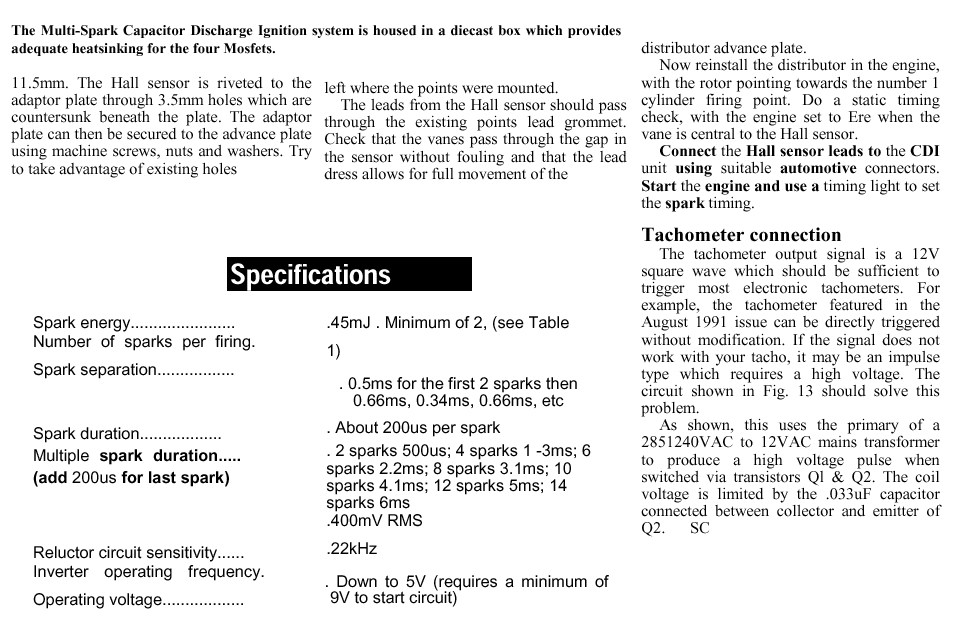
Here is a screen capture of the pdf file system specs on a CDI system designed by
John Clarke. Note the spark time in this system is 200 usec. This means
that at 6000 RPM there is still time to fire multiple sparks.
The H. Heisler chart is also shown again for time comparisons.

One thing John Clarke points out is that due to the rapid rise time
of the CDI spark it is essential to separate the spark plug wires or
you will get cross firing.

Paul Lamar

The AirCraft Rotary Engine NewsLetter.              Powered by Linux.
ACRE NL web site.
http://home.earthlink.net/~rotaryeng/            http://www.linux.org