Old message:

Subject:        Chuck Dunlap's Recent Trip
   Date:        Wed, 20 Jun 2001 09:03:08 -0700
  From:        ACRE NL <rotaryeng@earthlink.net>
<< Chuck wrote:
<snip>
First, I
had a trailing plug fail , it broke the insulator ...
Generally, broken insulators are a good indication of detonation. Do
you
have a knock sensor on the engine or some other means of detecting this
condition?  It may be worthwhile to run a little richer under high load
conditions till you can be certain you don't have a problem.
Second, I noticed that on take-off at the low elevation fields, which
was
most of them on this trip, the RPM would be at 5200 which is normal,
then it
would drop off after 3 or 4 seconds into the takeoff roll to maybe
4700.
Isn't this an indication of cavitation at start up? Once the plane gets
rolling, the prop is able to get a decent "bite" which loads the engine
down.
Regards,
  Peter Militch Cozy Mark IV #740
Chuck wrote:
No, I have no knock sensor. But it did happen after I ran a tank of 80/87
avgas and could have detonated from the lower octane. I have had no
problems
running regular 87 unleaded auto fuel, but had to use avgas on this trip.
Is
80/87 a lower octane than autogas? Jon Lauter suggested retarding the
timing
on the trailing spark, but I am using Tracy's controller with trailing
spark
fixed to fire the same time as leading (not adjustable). I am using stock
factory crank angle sensor timing. I will not use 80/87 anymore, hopefully
that was the cause.

Prop cavitation sounds like as good a theory as any but I wonder why I
never
heard of this on a Lycoming installation. I also fly a Lyc. RV-4 with a
fixed pitch cruise prop and it never did this. Interesting!

Chuck Dunlap
Perhaps the geared rotary has a bit more prop torque at 2160 prop RPM
and can power through the prop stall to reach 2400 prop RPM static.
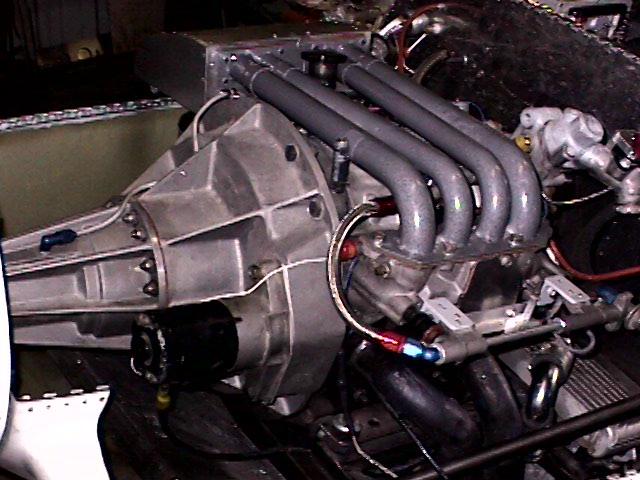
>From the looks of your long tuned intake manifold that could be
quite possible.

On the other hand it sounds to me like your engine is breathing limited and
the HP is near flat from 4700 RPM up. What is max RPM that you see in the
air straight and level?

With a free breathing  rotary and plenty of fuel HP would be steeply
increasing in a more or less straight line from 4700 on up. Have you
changed to the new throttle body?

Perhaps the mixture is a bit too lean for max HP.
Do you have a mixture monitor on there with an O2 sensor?
What is the mixture doing at 4700 and 5200 RPM?

EGT's?

Paul Lamar
Chuck wrote:
New throttle body installed
Max RPM is 5800
O2 mixture monitor installed
With Tracy's ECU the mixture can be easily controlled in flight using O2,
RPM, EGT and engine smoothness as indicators. I did reprogram the ECU richer
at higher manifold pressure I was not able reach before the new throttle
body was installed. EGT runs about 1550 at WOT cruise.

BTW are these messages formatted properly? I am using MS Outlook

Chuck Dunlap
5800 max RPM means you are still down on power. I wonder why?
Do you have inlet bells on those intake tubes where they enter
the plenum?
The message format is fine Chuck.
Paul Lamar
The AirCraft Rotary Engine NewsLetter.              Powered by Linux.
ACRE NL web site.
http://home.earthlink.net/~rotaryeng/            http://www.linux.org