Mike DiFrisco wrote:
Hi Paul,

Happy New Year!

I'm exicted to be preparing your Rotary story for publication in the
February issue of Sport Aviation. I appreciate all the visuals you sent
along to accompany the piece. Can you please give me descriptions (captions)
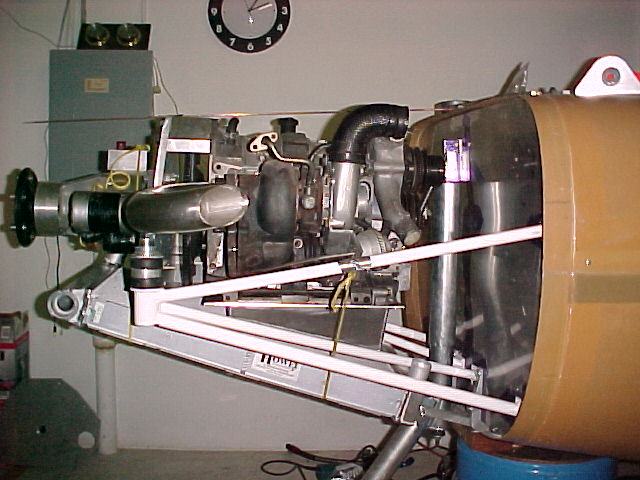
of the attached two graphics. One is the rotary installation on your KIS, I
presume, and the other is your vision for a future Reno racer. I'd like to
use both of these in the article, but could use some help with the captions.

Thanks!!!

 <<rad-engine-overall.jpg>>  <<Reno-racer3.gif>>

Michael G. DiFrisco
Executive Editor
EAA Publications
www.eaa.org
OK the first one.

"Turbo charged Mazda wankel RX7 engine mounted in Pulsar/Kis Cruiser
with single radiator obliquely mounted under engine."

Here too Mike is the latest version of the text.

I'll send the second caption under separate cover so there is no confusion

Paul Lamar

The AirCraft Rotary Engine NewsLetter.              Powered by Linux.
ACRE NL web site.
http://home.earthlink.net/~rotaryeng/            http://www.linux.org
The incredible Mazda wankel rotary aircraft engine.
Copyright By Paul Lamar

Aviation head line nine years from now "Rotary Powered Racer Beats Warbirds
at Reno, 2010".  Employing turbo charged twin 3 rotor engines in the Rotary
Ranger demonstrated what a low cross section, lightweight, reliable, smooth
1000 HP engine will do ..... Ok, so it has not happened yet, but let me
convey why such a headline is not out of this world.....  There is an engine
already proven which when married with the right air frame could certainly
give the old warbirds a run for their money......

Dave Garber built such an airplane in the 1980's and it is now being taken
out of mothballs and refurbished. Dave had some cooling problems and fuel
injection computer problems. He has recently made contact with members of
the Aircraft Rotary Engine Newsletter with experience in solving these kinds
of problems.

 "Why do engine experts seldom? Never? include the rotary engine when
discussing the merits of auto engines for aircraft use" The last two issues
of a popular kit plane magazine had nicely done articles on assessing auto
engine for such an application - but, they did not even mention the rotary.
Are they afraid to? Is it lack of knowledge, or is it because if they did it
the rotary would jump out as a far superior choice to any reciprocating auto
engine?

Let me define the criteria for a "realistically perfect" aircraft engine.

A: Reliable
B: Robust
C: Extended TBO
D: Damage Tolerance
E: Smooth
F: No shock cooling
G: Ability to run low cost fuel
H: Low fuel consumption
I: Low purchase cost
J: High HP to weight ratio
K: Compact size
L: Simple

I think the Mazda wankel rotary engine meets most of these criteria.

The wankel engine was invented way back in the 1930's by Dr. Felix Wankel. I
will use the term wankel engine in the generic sense to differentiate it
from all other rotary engines. It was not before about 1950 that Dr.
Wankel was able to build a running prototype. Many companies were
interested in the engine and under took development. Among them was Toyo
Kogyo AKA Mazda Motors. Mazda installed a state of the art computerized
test facility in 1963 for the express purpose of developing the engine. After a
lengthy development period Mazda started selling cars with rotary engines
in 1967. The first of the five rotary engines cars that I have owned was a
1973 RX2 bought new.  It was a very zippy little car.

Many problems came to light over the years. Only Mazda persevered and
perfected the engine. All but Mazda gave up. Mazda had a strong belief and
good understanding of the superior kinematics of the engine and adopted
the attitude of never ever give up. Eventually Mazda sold over two million
rotary engine powered cars.

Poor kinematics and reciprocating motion are the Achilles Heel of the piston
engine. Things stop and start up again in the other direction twice per
revolution. This causes tremendous stresses on connecting rods, pistons,
piston pins, valves, valve springs cam shafts, lifters, push rods and
crankshafts at high RPM's. The crankshaft in a piston engine is a stress
analyst worst nightmare with twists and turns every which way.

There are no reciprocating motions in the wankel engine. Every part moves in
a circle or keeps moving in more or less the same direction. There are only
three moving parts in a two rotor wankel engine. The eccentric shaft and two
rotors. The eccentric shaft is analogous to the crankshaft in a piston
engine. Unlike a piston engine the eccentric shaft is straight through,
extremely strong and has demonstrated the ability to live in a highly
turbocharged 800 HP two rotor 10,000 RPM Mazda racing engine of stock
displacement. The bare engine weight of this engine is only 200 pounds not
including the monster turbo charger and other accessories. That is an
unprecedented power to weight ratio for all but a turbine engine. Nobody in
their right mind would think of asking 800 HP from a two rotor Mazda wankel
in a general use aircraft of course but it might be fine for air racing at
Reno. I mention this as it illustrates the extreme robustness of the Mazda
wankel engine.

The rotors are cast iron and unlike pistons in a piston engine are nearly
impossible to melt. They can be made from heavy cast iron because they do
not reciprocate. There are no exhaust valves to melt or burn. Burnt exhaust
valves are a common problem in aircraft piston engines. No camshafts to
gall. No lifters to score. The essential valving of intake charge and spent
exhaust gases is done by the rotor moving over openings in either the rotor
housing or the end housings. This is similar to a two cycle piston engine
but the wankel is definitely not a two cycle engine. It is indeed a four
cycle engine and like a four cycle, four cylinder engine it fires twice per
output shaft revolution.

Absolutely nothing stops and starts up in the opposite direction in a
wankel engine! The engine is in perfect balance just like a turbine or an
electric motor. It is impossible to perfectly balance a piston engine as
the CG of certain parts necessarily oscillate or reciprocate. The rotary
is always much smoother running than any piston engine.

The engine never catastrophically fails in the hand grenade mode as is
common with piston engines. The worst thing that can happen is an overheat
due to loss of coolant but the engine will still run and usually get you to
an airport. Cold pressure checking the coolant system before flight is very
important and has been found to detect incipient leaks before they can cause
problems. High quality AN aircraft plumbing is mandatory. There is no
possibilty of the cast iron rotor expanding and seizing in the aluminum
rotor housing. A common problem with two cycle piston engines.

Mazda was the only Japanese company to ever win the 24 hour race at Leman
France outright over all contestants. They did it with a four rotor version
of the two rotor RX7 engine in 1991. There was little or no wear on the four
rotor engine after completing and winning the 24 hour race. The other
contestants included the who's who of European exotic car makers. The next
year, rotary engines were outlawed at the Leman race. It would be
embarrassing to let a rotary engine win the race year after year. Demand for
the engine might have increased in Europe forcing car manufactures to scrap
billions of dollars worth of piston engine manufacturing facilities and
piston engine parts sales and support infrastructure. Currently Mazda
rotaries are either severely handicapped or only race against other Mazda
rotaries as the engine apparently has been deemed unfair to piston engines.
Mostly for durability reasons as they tend to outlast piston engines ten to
one in.

The increasing popularity of the Mazda wankel engine for use in aircraft has
several reasons. Low cost is not the main reason. The main reason is
durability. The stock engine will run for many many hours at high power with
little or no wear. The FAA certification requirements are only 150 hours on
the dyno with a prescribed power duty cycle test. Any Mazda rotary engine
could easily pass that test. The problem is the FAA wants a quality control
paper trail on the engine parts as they are manufactured and Mazda would
never agree to that. Apparently Europe has different rules as I know of one
converted German diesel auto engine that is certified for use in aircraft.
The FAA has a reciprocity agreement with most European countries so there
appears to be a loop hole in this regard. Be that as it may there is a
company in Switzerland called MecanAir that is certifying a Mazda based
turbo two rotor for aircraft use.

RECENT IMPROVEMENTS

The subscribers of the Aircraft Rotary Engine Newsletters and others have
actually improved the durability on what Mazda accomplished by choosing more
recent, somewhat more costly, high tech material for certain parts. A ceramic
apex seal has been developed by Dr. Francisco Inanette that is so hard and
smooth it has no noticeable wear rate. Nobody has worn one out yet.

High temperature, 500 degree Fahrenheit, teflon encapsulated silicon water
jacket seals and oil scraper O-rings have been developed. These increase
the ability of the engine to withstand inadvertent overheating. A common
occurrence as many home builders are relearning lessons learned back in WW
II or before about liquid cooled aircraft engines. These costly materials
are not required as the projected TBO of a stock Mazda two rotor engine in
aircraft use is about 3000 hours based on the wear rate of the stock apex
seals and cruising at about 150 HP and 4500 RPM.

It has been found that simply mixing two cycle oil with the fuel reduces the
apex seal wear and the carbon deposits inside the engine. The ratio used is
about one ounce of two cycle oil to one gallon of gas. The stock engine
injects oil from the crankcase into the combustion chamber. This crankcase
oil, due to certain wear additives, is really unsuited to the task of lubing
the apex seals. It leave's undesirable deposits on the rotor and rotor apex
seal slots that sometimes cause the apex seals to stick. The stock oil
injector pump is disabled when the engine is raced or used as an aircraft
engine and two cycle oil is mixed with the fuel.


POWER TO WEIGHT RATIO

The power to weight ratio of the stock Mazda engine is excellent. As
mentioned above the bare engine weighs 200 pounds despite the use of mostly
cast iron housing parts. Expensive aluminum end housings are available to
cut this weight by about 50 pounds. The fire wall forward installed weight
of a non turbo charged Mazda two rotor engine with PSRU, coolant and
radiators is about the same as an O-320 or O-360 Lycoming. Right around 300
pounds. With non stock peripheral intake ports and no turbo charger as much
as 240 takeoff HP can be had with excellent durability.


PSRU's

Several popular propeller speed reduction units are available that weigh
about 40 pound each. Most of these are based on the Ford truck automatic
transmission planetary gear set. Ford recently beefed up this transmission
by changing the number of pinion gears from four to six making it
suitable for the three rotor or higher power turbo charged two rotors.


TURBO CHARGERS

Turbo chargers for high altitude power add another 35 pounds. We don't know
the long term continuous HP upper limits of the turbocharged versions
because nobody has flown one for more than about 300 hours to my knowledge.
I suspect the basic engine would outlast the turbo charger.

ENGINE SIZE

The two rotor engine is downright tiny compared to an air cooled aircraft
piston engine at about 12 inches wide 14 inches high and 18 inches long less
accessories. It is quite possible to squeeze a turbo charged two rotor
engine, including the coolant radiators, inside a stock kit plane cowling. I
know as I have done it with my Kis Cruiser. By comparison to a Kis Cruiser
the room in a Vans RV cowling is voluminous.


THREE ROTOR ENGINES

Three rotor engines are available imported from Japan and will develop fifty
percent more power. Bare engine weight for the three rotor is about 260
pounds. I would guess firewall forward would be about 400 pounds. This is
comparable to the larger 500 cubic inch air cooled aircraft engines like the
O-540 and O-550. More weight for a turbo version of course. Racing Beat in
Anahiem CA has a three rotor turbo aircraft engine on the dyno generating
900 HP with about 300 hours of dyno runs so far. That of course is 300 HP
per stock Mazda single rotor displacement. The eccentric shaft in the three
rotor is the same diameter as in the two rotor and it gives no trouble. The
Mazda Leman engine was a four rotor non turbo charged developing 690 HP at
9500 RPM with exactly the same eccentric shaft diameter. This is a testimony
to the extreme strength of the shaft in the two rotor engine. Many of the
other three and four rotor parts are similar if not identical to the two
rotor RX7 engine.


FUEL CONSUMPTION

First and formost the Mazda rotary will happily run on auto fuel which is
half the cost of aviation fuel. Aircraft owners flying rotary engines plan
their cross country trips around airports that sell auto fuel. Lycoming does
not recommend auto fuel in their engines. What about fuel consumption and
range? The Mazda will happily run 100 degrees lean of peak with no worry
about burning an exhaust valve. There are none of course! At this setting
the EGT has dropped down into the piston engine range and the engine is only
slightly less economical than an air cooled piston engine. Tracy Crook
estimates the pounds of fuel burned per hour for each HP generated is 0.47
while an air cooled piston engine is about 0.45. If you run the engine at
peak power full rich it will burn 0.65 BSFC just like an air cooled piston
aircraft engine under the same conditions. The new RX8 engine is reputed to
be much more economical.


COOLING

The total heat rejected by a Mazda rotary engine is only a little higher
than a piston engine. All engines have a heat balance. Heat balance is a
term for the distribution of energy contained in the fuel by burning it.
Some energy is rejected to the coolant as waste heat, some goes out the
exhaust and the rest comes out the shaft as mechanical energy. One HP is
equal to 746 watts. An engine generating about 200 HP would be rejecting
about the same amount of HP to the coolant or or about 150 Kilo Watts. This
is not unique to the wankel! All internal combustion engines do the same
thing more or less by only a few percentage points. A wankel engine's heat
balance only differs by single digit percentages compared to all other forms
of internal intermittent combustion engines. A gas turbine is an internal
continuous combustion engine in case you were wondering.


IS THE MAZDA ENGINE ALL PEACHES AND CREAM?

Absolutely not! You will have a considerable engineering challenge
installing one in your airplane. Overhauling the rotary engine is trivial by
comparison. The engine itself is not the problem. Careful planning ahead is
absolutely necessary with any non aircraft engine and it helps if you can
make mechanical drawings and mockup models. You may have to design and build
many parts like the motor mount, custom oil pan, alternator mount, intake
manifold and modify the water pump inlets and outlets. As the engine becomes
more popular many of these unique aircraft parts should eventually become
available to purchase.

Strict attention to cooling details is also essential. Most installers have
trouble with cooling. Many have given up. The exact shape of the ducting to
the radiator is extremely important and sealing the cowl properly to prevent
back pressure on the radiator is also essential. The design of the cowl
flaps and the opening around the cowl flaps is also extremely important.
Wankel engines reject one third of the cooling heat through the oil so a
good oil cooler is necessary. The stock Mazda RX7 oil cooler works well.

The wankel engine is ideal for turbo charging because of the the shape of
the combustion chamber, because of the inherent low compression ratio and
the lack of exhaust valves to worry about. When turbo charging the engine an
intercooler is absolutely necessary to keep intake charge temperature down.
High intake manifold temperatures lead to detonation and detonation can
fracture apex seals with consequent scouring of the rotor housing and
rotors. The engine will not fail catastrophically but will still run
somewhat down on power with leaking apex seals.

A good muffler is essential with a wankel as the exhaust port opens much
more rapidly than a piston engine. Supersonic shock waves are emitted. This
problem is about to go away as the new Mazda RX8 motor will have much more
gradually opening and closing side housing exhaust ports.

A turbo charger helps quiet the engine and its additional weight is off set
by the non existent weight of the mufflers that would normally be required.
Mazda built a good stock turbo charger for aircraft use in the 1989 to 1992
RX7 model years. Later dual turbo chargers were too complicated, heavier and
less reliable. Earlier ones just plain cracked due to poor design.

When purchasing a Mazda engine for use in an aircraft it is best to buy a
running car. Many parts from the car are usable such as alternator, ignition
coils, fuel injectors, starters, oil coolers, etc., etc.. Good years are
1989 and later. 1992 and earlier second generation RX7's can be had for
under $3000. The model years 1993 and later are selling for over
$15,000 as they were initially much more expensive and sophisticated
cars.

I am convinced the wankel rotary is the light aircraft
engine of the future.

Paul Lamar