Ken Welter wrote:
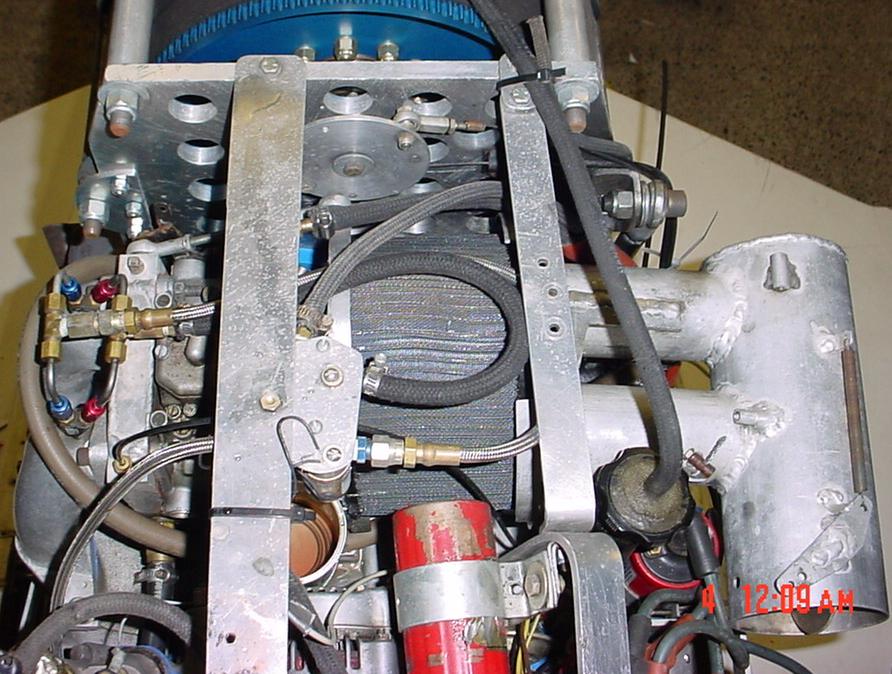
  Here is another view of the air ram that may help tell how it works,
it does two things, for one it is a poor mans super charger and the
other is it controls the mixture, if you do not use the ram the air
is drawn from the air cleaner and you do not have to use the ram at
low alt as it only makes 100 rpm difference but at 15000 ft it makes
1000 rpm more, the two ram tubes are 1 1/5 inches from the velocity
stacks and the float bowl vents are on the side of the velocity
stacks so when you open the ram it creates a pressure differential
between the float bowl and the Venturi there for the main jet flows
less fuel. I have two levers side by side one is throttle the other
is the air ram, and I operate them like it is a twin engine more
throttle more ram at half throttle if you push full ram it will kill
the engine as it leans the mixture out and if you pull the ram back
the engine will start,at full throttle you can use full ram and for
climb and cruise you can adjust the mixture by pushing in the ram
until the rpm peaks and when the rpm drops you have gone to lean so
you pull the ram back until you peak the rpm so you can get full
mixture control with it. There is also another way to control the
mixture and that is with a air bleed system that can change the
pressure on the float bole and that system is used on snowmobiles and
I may play with that in the future. Another reason that this setup
works so well is the Weber carb it is very high tek compared to crude
aircraft and American 4 barrel carbs in that they are pressure
sensitive, as the air gets thinner it draws less fuel and this is
totally adjustable by the air correction jets, now for street use
with the 51mm Weber that I run it would use 180 main jets and 200 air
correction jets, now for aircraft use I run 140 main jets 150 air
correction jets, the fuel to air ratio stays the same with the
smaller mains do to the fact that the smaller air correction jet
makes the smaller main draw same fuel as the larger main and with the
smaller air jet it is more sensitive to air density as the air is
thinner it draws less fuel, the draw back to this setup is that it
runs richer up to about 25 percent throttle which is no problem on a
plane you never fly there but this jetting would not work on a street
car. Also I would like to note that I am running  a 51mm Weber but I
am told that the 48mm Weber more pressure sensitive and the power
difference very little.
  Now I would like to put this in perspective to you people that fly
them 200 mph rocket sleds as I don't think a cruise speed of 100 to
110 mph is that fast or a useable service ceiling of 13000 ft is that
high. My coot packs 100 gallons of fuel and I lift off at a gross
weight of 2800 lbs. The most popular engine for the coot is the rear
engine and prop out of a skymaster which is a 210 hp IO-360 with a
hartzall constant speed and I fly regularly with one of them to give
a comparison on a water take off I can lift off faster and with a
higher gross weight mostly do to the fact to the nitros that I use
and I may add that I could not lift out of the water without it, on
the climb out he can run away from me do to the fact that he has a
constant speed prop and I have a fixed pitch set at cruise pitch, at
sea level cruise speed is near the same and at high alt I am slightly
faster and have a slight higher service ceiling and to note I am
doing this with a fixed pitch prop  and running against a constant
speed so something has to be working well.
  Again for reference the engine is a 13b with 2.95 ratio and 5 blade
warp drive prop.

  Ken Welter
  Rotary.coot2verizon.net
http://homepage.mac.com/rotarycoot/
Good illustration of the added power you can get from a 2.95:1 gear box
and higher rotary engine RPM.

Is the air filter blocked off when you open the ram Ken?

Paul Lamar

The AirCraft Rotary Engine NewsLetter.              Powered by Linux.
ACRE NL web site.
http://home.earthlink.net/~rotaryeng/            http://www.linux.org