Paul,

Well, I'm the "mystery Lycoming lover" over on the Velocity reflector.  The point I was trying to make was that people need to perform thorough evaluations of needs and capabilities when deciding upon an engine.  A lot of people dismiss the Lycoming and Continental options out of hand ("Lycosaur paradigm"), without truly considering those engines' capabilities.  More specifically, the discussion started when one poster recommended a Delta Hawk diesel to another.  I have watched Delta Hawk's development for something like 8 years now, and they don't seem to be any closer now than they were when they started.  If they are taking deposits, then depositors are likely to lose money, all to common in the homebuilt industry.  I was trying to interject a little caveat emptor and pragmatism into the conversation.  If I saved one person from putting cash into a perpetual R&D black hole, then I feel pretty good about it.

At the current time, I do believe that a Lycoming is the best option for my Velocity (operative word . . . MY).  This was based upon a pragmatic evaluation, not an undying love for Lycoming or Continental (who could both learn a hell of a lot from a companies like Honda, Mazda, etc.).  The fact that I subscribe to this list should be evidence enough of that.  Based upon my mission profile (reliable and frequent long distance travel at cruise altitudes of 10K+ to all corners of CONUS), I chose the Lycoming for the following reasons:

1.  Efficient operation (more on this later).
2.  Modifications available to homebuilders (mine runs 9:1 pistons, dual Jeff Rose electronic ignitions, and an Airflow Performance fuel injection system tuned for matched EGT peaks).
3.  Excellent support and parts availability (albeit, at aircraft prices).
4.  Every A&P knows them inside and out.
5.  The FAA AD system.
6.  Reliability (for a reciprocating engine -- it's definitely not a rotary or turbine).
7.  Easy and fast installation, minimum of problem solving required.
8.  Insurability (this is a biggee for me).
9.  Resale value.

Evaluations conducted by others would and should differ, but their decision should be based upon information, not wives' tales.

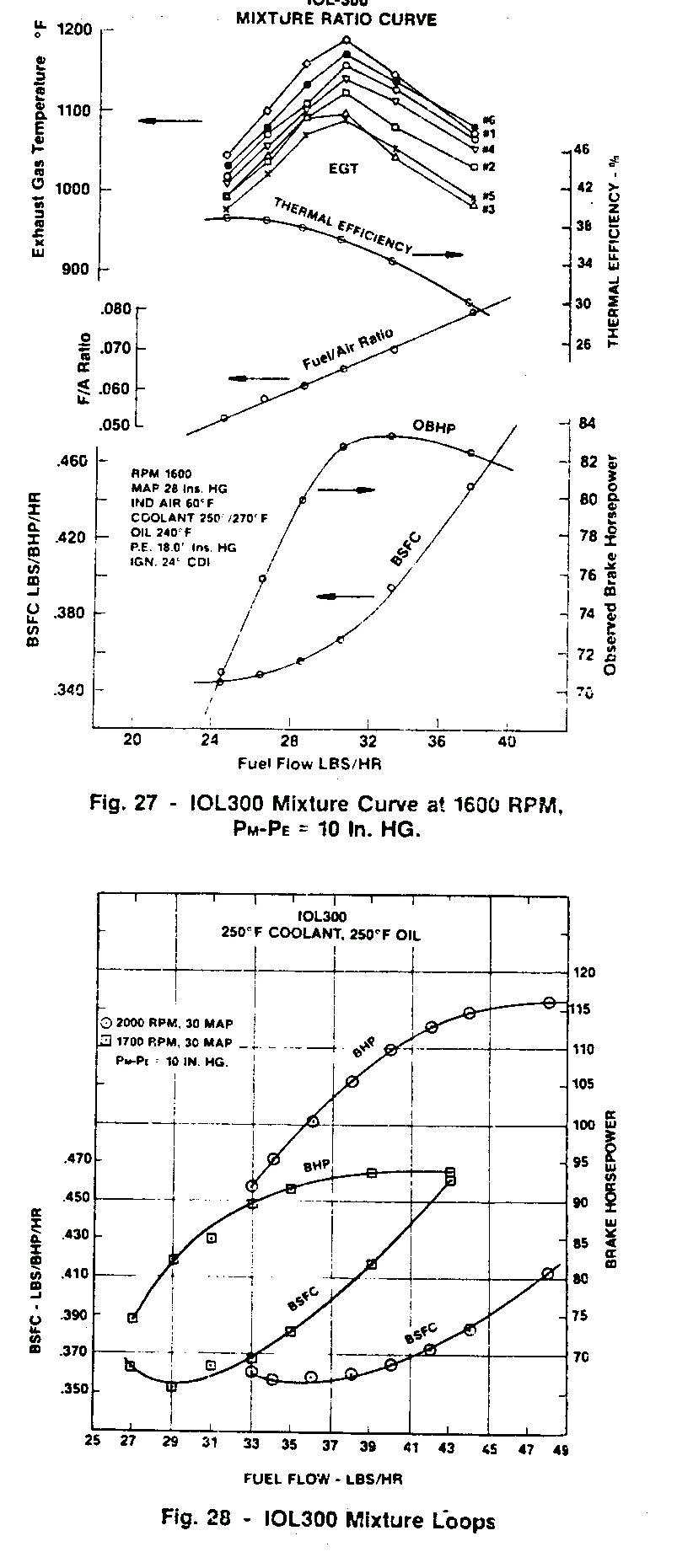
On to efficiency.  Aircraft piston engines, with large valves, polyspherical combustion chambers, decent compression ratios, and effective mixture controls, can generate impressive BSFC numbers (better than contemporary auto engines in many cases).  I reviewed stock engine graphs that I had to be sure I was accurate.  The .375 BSFC came from a graph for a Continental IO-550 running at 25"MAP and 2500 RPM.  The curve for this MAP and RPM varies from .425 BSFC at full lean, to .375 BSFC at best economy, .425 BSFC at best power and .48 BSFC at full rich (mixture, as they say, is everything).  I was incorrect in attributing this number to a Lycoming on the Velocity reflector.  I was going off of memory which one shouldn't do.  4-cylinder Lycoming curves show a BSFC between .395 and .405 at best economy.  Ref. Lycoming Curves 12699B (IO-360-A, C, D, J Series) and 12849A (IO-360-B, E, F Series).  Still pretty darn good.  I'm probably doing a little better, given my modifications.
Someone got confused. That was probably the Continental Voyager water cooled version.
Below is a chart from that engine series. Note the coolant temperature of 250 degrees F.
Continental had trouble with that aspect of the design as the glycol mix
starts breaking down at that coolant temp. PL
As you surmised, to achieve these numbers, you must run lean of peak.  I do this as a matter of course, and, given the popularity of GAMIjectors, more and more GA operators are doing the same.  No sign of valve problems at 600+ hours since overhaul, although I keep my eye out for them.  I created my own GAMIjector system by mixing and matching nozzle restrictors on my Airflow Performance system so that all cylinders hit peak EGT simultaneously.  Another good option appears to be the Ellison throttle body (efficiency gurus Klaus Savier and Gary Herztler both run them).  Note that a carbureted Lycoming would never even get close to these BSFC numbers due to poor fuel distribution.

I think you did your readers a disservice with your .45 BSFC swag.  The rotary engine has enough going for it to stand on its own two feet, it doesn't need help in the form of perpetuating prejudices regarding alternatives.  I've come to expect a high standard of technical accuracy on this reflector.  Let's all strive to maintain that.

Rick Price
(lots of post-name letters available if that kind of thing makes a difference to anyone)
Veiled insults are not taken lightly here.
I can document the 0.45 BSFC for a Lycoming if you wish.
In your dreams will a Lycoming breaks 0.42 :-)> I stand by my statement!
On average for the average pilot not running lean of peak it is 0.45 BSFC.

The overwhelming advantage from a cost point of view is the rotary will
happily run on car gas while Lycoming totally dis allows car gas.
Car gas is half the cost of 100 LL. 100LL is required by high compression
air cooled aircraft engines as I just bought one. That leaves the range issue
for the rotary which is not that much different.

BTW Greg Richter mentioned to me that Brent Regan was ragging him about
his Blue Mountain glass cockpit. What was that all about?
I detect a note of professional jealousy :-)>

Paul Lamar

The AirCraft Rotary Engine NewsLetter.              Powered by Linux.
ACRE NL web site.
http://home.earthlink.net/~rotaryeng/            http://www.linux.org