Someone got confused. That was probably the Continental Voyager water cooled version.
Below is a chart from that engine series. Note the coolant temperature of 250 degrees F.
Continental had trouble with that aspect of the design as the glycol mix
starts breaking down at that coolant temp.
Paul Lamar
No confusion. The .375 number is for an TCM IO-550. The chart was a graphic in the article >"Mixture Magic" which can be found at http://www.avweb.com/articles/pelperch/pelp0018.html. Very >interesting article, and the principles discussed apply to any internal combustion engines, so it >should be of general interest to members of this group.
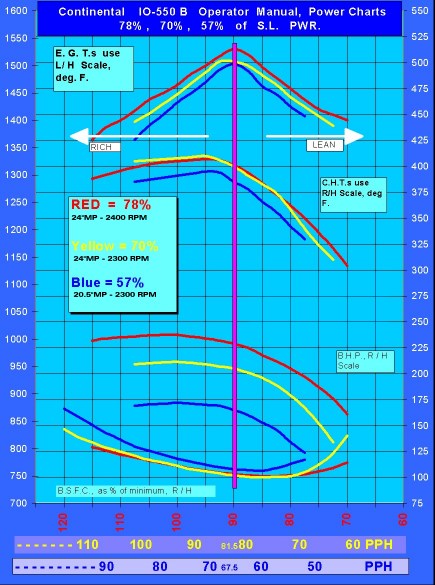
Here is the actual chart in question from that web site.
As near as I can tell by interpolating in this crude and hard to read chart
the engine gets down to .40  and not .375 BSFC at 57% max power at somewhat lean of peak.
At what looks like 70% power lean of peak the numbers are 78 pounds per hour and
190 HP as near as I can read this crude chart. That works out to a .41 BSFC.

The chart is so crude that is near impossible to say exactly what
the numbers are. One could interpret this chart in almost in any fashion
depending on what you want to see. Could be .41 and maybe it was .42.

Here is a quote from the article on the web site which is quite dangerous.

Quote:

"Don't be afraid of that red knob. Learn to use it! With a few pretty obvious exceptions there is nothing you can do with the mixture control over a short period of time that will hurt you or the engine. Used properly, you'll save a lot of fuel, your engine will run cooler, cleaner, smoother, and longer, with less maintenance expense and downtime along the way to TBO."

End of quote.

A quick read of this and you might think you can do no wrong with the mixture knob.
Nothing could be further from the truth. If you lean the engine to peak EGT
and take off at full power an exhaust valve head could separate from the valve stem and
cause catastrophic failure of your aircraft piston engine at just the wrong time.
If there is a right time. I suspect Continental does not condone this kind
of talk. After spending thousands of dollars fixing my Continental O-470 over the years
you better bet I pay close attention to that little red knob.
I would rather run it rich of peak all the time rather than risk screwing up and burning
a $1000 to fix leaking exhaust valve. (You got to pull the cylinder.)
The IOL-300 numbers were very interesting.  BSFCs of .345 @ 1600RPM, .352 @ 1700RPM and .355 @
2000RPM.  Makes a pretty compelling case for liquid cooling when compared to the IO-550 numbers.   > Thanks for the graphs.
Rick Price
The liquid cooled Voyager engine in the real world never see's these kinds of numbers.
I am good friends with the mechanic that maintains Patrick Swazey very rare Voyager
powered twin Cessna. Basically the engine was a big failure in the market place.

Paul Lamar

The AirCraft Rotary Engine NewsLetter.              Powered by Linux.
ACRE NL web site.
http://home.earthlink.net/~rotaryeng/            http://www.linux.org