Paul,

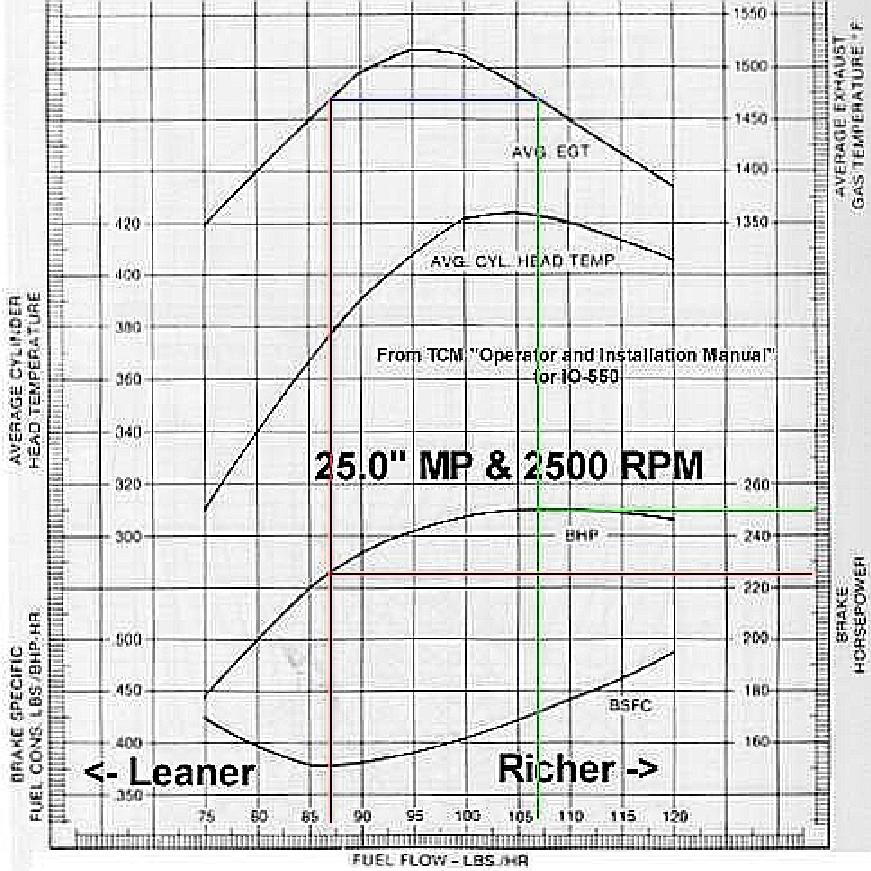
Attached find the TCM IO-550 chart that I was referring to.  As far as the
Lycoming charts go, like I said, they are curves 12699B and 12849A, both of
which are published in Textron Lycoming's Operator's Manual for the O-360
series engine (publication #60297-12).  I don't have scans of those.

Rick Price
That is definitely an easier chart to work with.
I blew it up and added some colored lines.
You are right. If you run the engine 100 degrees lean of peak
(the red line) you get a BSFC of .376 and 225 HP.

However I know of nobody in their right mind willing to risk
a 40,000 dollar engine running it manually 100 degrees lean of peak.

This .375 BSFC is in theory. The EGT for all six cylinders will vary greatly
depending on the mixture and how well that particular cylinder is
cooling. Lycoming and Continental leave it up to the aircraft
designer to design and fabricate the engine cooling baffles
that provides the pressure drop across the cylinder that cools
them. Consequently cylinder cooling from cylinder to cylinder
varies greatly. As does the condition of the baffles as time goes on.

Even with a temp scanner that monitors all six cylinders
CHT and EGT (I have one) it is nearly impossible to run the engine
(even if I was that dumb) smoothly at 100 degrees average lean of peak.
EGTs can vary as much as 100 degrees F between cylinders and
CHTs can vary by about 50 degrees F.
It would be nearly impossible for a person to calculate
the average EGT and set the mixture based on that manually.
What happens is they take the hottest cylinder (or they should)
and set the mixture based on that. A minor screw up in technique here
could cost you $1000 during the next annual.

Lets take a look at running the engine the same 100 degrees F only
this time rich of peak. (green line) The HP is now up to 250
from 225 and the airplane is going faster. The BSFC is now .412.
The MPG difference is less than the savings one might think
strictly calculating it on the theoretical difference in BSFC between
.375 and .412. The average joe blow pilot is not going to be able to
achieve this .412 either. 0.45 is still more like it.

There is no doubt however that these are impressive numbers.
I doubt that any car engine could come close to this despite
the fact that they are computer controlled. Mainly because
they operate at low HP levels with a partially closed throttle.

I have maintained for years the way to control a cylinder or
a rotor is to use EGT for feed back. Tracy Crook says he can't
do it because the EGT thermocouples don't respond fast enough.
I have found smaller thermocouples that have much faster response
than your typical aircraft engine probe.

The potential for EFI, as opposed to mechanical fuel injection,
applied to an air cooled  piston aircraft engine is great.
With the proper thermocouples each cylinder could be controlled
individually. This would be particularly important in a two cycle
engine to prevent piston seizures. So far, to my knowledge,
nobody has done it yet.

You are in a position to do it Rick. Why don't you give it
a try for the experimental market?

The other thing that would help, and I would buy a set in a heart
beat for my O-470, are molded fiberglas cooling baffles. Some are just
now becoming available on the experimental market for certain aircraft
engines. That is something the manufacturer ought to supply with the
air cooled AC engine. Of course the FAA would not let me install them
on my 182.

Having said all that I would still take a rotary for durability reasons
even if the best BSFC it can do is .47. The new RX8 engine should better
that considerable.

Tracy Crook has discovered, what I think, is an intrinsic advantage
to a rotary engine in that it seems to run smoothly leaned out
far beyond the low amount of power you should run it at. Tracy thinks,
and I agree, the engine is naturally stratified charged due to the
centrifugal force on the fuel droplets keeping them in close contact
with the spark plugs.

Paul Lamar

The AirCraft Rotary Engine NewsLetter.              Powered by Linux.
ACRE NL web site.
http://home.earthlink.net/~rotaryeng/            http://www.linux.org