Lets get one thing straight. Fuel injection does nothing for the BSFC or the
HP an engine will generate. Particularly with the same intake manifold
the single carb version uses. Only if the manifold is designed for fuel
injection with long equal length separate runners tuned for best BMEP
(torque) at a certain RPM will you see a HP increase and a slight improvement
in BSFC. There will be no improvement over carbs with separate venturi
for each runner. No way can you improve the thermodynamic efficiency of an engine by matching the fuel flow to each cylinder. It does not change the average
mixture for a given HP.
I agree and disagree.  First, I agree that a cylinder doesn't care how the fuel-air charge that it breathes gets mixed.  Whether a carburetor, injector, or Aunt Edna did the mixing is irrelevant.  Absent really atrocious mixing (i.e., fuel not atomized), nothing in the method of creating the fuel-air charge will change the BSFC.

My disagreement lies in that we don't just fly one cylinder.  We fly between four and six cylinders in most air-cooled flat engines.  Due to variations in runner lengths, turbulence, flow turning, etc., each of these cylinders will see different airflows and mixtures.  Carbureted engines, where one venturi feeds all intake runners simultaneously, are especially bad in this regard (BTW, I've never heard of a carbureted GA engine where there is a "separate venturi for each runner").  With port fuel injected engines, you have the opportunity to fine tune the mixtures that each cylinder sees by swapping out nozzle restrictors that are slightly leaner or richer on individual cylinders.  This lets you tune the engine so that all EGT's peak at the same time, which allows LOP operation while maintaining engine smoothness.  Note that you can only get it perfect at a certain throttle angle, MAP and RPM (preferably, your normal cruise values).  Variations, especially of throttle angle, will upset the balance.

The reason gami can make wild ass claims and get away
with it is because things like BSFC are too hard to measure with out the
controlled conditions of a dyno.
The only thing that GAMI does is sell nozzle restrictor kits that have been through a tuning process as described above. There is no magic to the GAMIjector. You can achieve the same result if you have access to a supply of restrictors of various internal diameters, good multi-cylinder EGT instrumentation, and some time. Tuning allows you to operate lean of peak. The dramatic change in going from .45 BSFC (typical of a rich running engine) to .375 BSFC (attainable by a stock TCM IO-550 running lean of peak according to TCM's engine curves) is due to improved operating technique . . . it is not a "wild ass claim."
If you run your Lycoming lean of peak the warrantee is void and you risk
burning the very expensive $250+ each sodium cooled exhaust valves
.

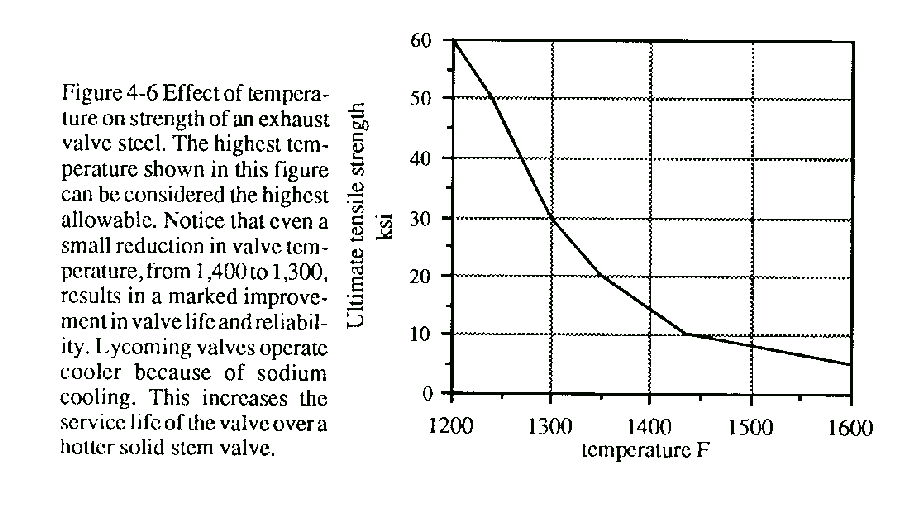
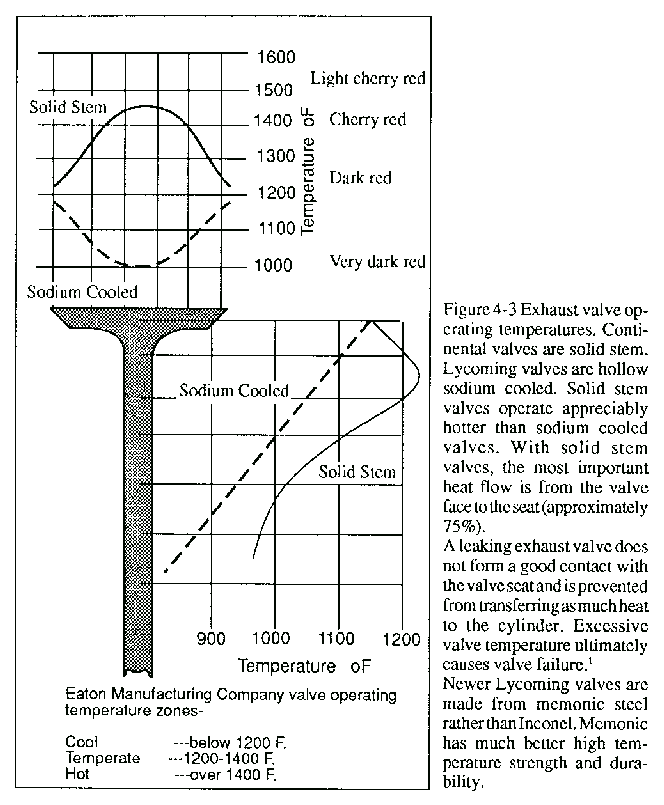
Actually, when you run 50 degrees lean of peak, your exhaust valves run cooler that when you run 50 degrees rich of peak.  This is because, while EGTs are the same, the CHTs for the lean of peak condition are quite a bit lower (45°F lower according to the TCM IO-550 curves!).  It is the delta between exhaust valve temperature and CHT that conducts heat out of the exhaust valves and cooler CHTs are better.

Another difference between lean of peak operation and rich of peak operation is that lean of peak provides a slightly oxygen rich exhaust, while rich of peak provides a fuel rich exhaust.  There is a theory that an oxygen rich exhaust stream can affect exhaust valve life due to corrosion, but I haven't seen any definitive studies on it.  Anyone have access to data on this?

Naturally, you don't lean like this at high power settings (i.e., takeoff or high-power, low-altitude ops), although the reason for keeping mixtures very rich in these conditions has as much to do with avoiding detonation by slowing combustion as it does with keeping things cool.
If I had read this before I responded to your last message it would save me a lot of
work :-) Get the book called the The Sky Ranch Engineering Manual.
Here are some graphics from that book.

The warrantee on Lycoming engines is still void if you run it lean of peak.

That gami stuff is still BS. You still cannot manually control the engine that
close and expect not to screw up once in a while. It only takes once.

All this is totally  irrelevant to a rotary engine as there are no exhaust valves and
you can lean the mixture until the engine quits without hurting the engine.

Its like the price of auto gas being half what it is for 100LL. The exact BSFC
becomes irrelevant. The wankel rotary becomes the  aircraft engine
of choice.

Paul Lamar

The AirCraft Rotary Engine NewsLetter.              Powered by Linux.
ACRE NL web site.
http://home.earthlink.net/~rotaryeng/            http://www.linux.org