<If you are on the lean side of peak and you descend with out changing
the knob (forgot) the  engine gets leaner right away.  Up to peak EGT very
quickly.
You are confusing me here, Paul.  If you are lean of peak, and you get
leaner (by descending,) you move MORE leaner of peak, thus EGT should go
down.  And your next wake-up call is when the engine sputters!

Please don't ask me how I know about the very effective wake-up call.

Bob Darrah
You are absolutely right Bob. See how easy it is to get confused
over the mixture :-)>

Here is what I think happens. Correct me if I am wrong.
There could be other mistake scenarios.

Mistake conditions:

A. WOT, over 8000, feet power less than 75%. Engine leaned.
Climb.. mixture goes leaner engine stutters. Descend... more air, mixture
goes leaner engine stutters. Cowl flaps closed.

B. Less than 8000 feet. Throttle partially closed. Power less than 75%
(No engine manufactures allows the mixture to be leaned at more than 75% power.
for Continental engines the number is 65% power.)
Engine leaned. If you forget the mixture and open the throttle (more air) to climb
mixture goes leaner. Engine stutters. Adjust the mixture to less than full rich.
Valves overheat as more power and EGT is being generated. Cowl flaps closed.

Descend, more air, throttle in same position, engine goes
lean, engine stutters. Adjust the mixture to less than full rich. Valves
over heat as too much power is being generated. Cowl flaps closed.

Descend, throttle closed, less air... engine goes
lean, engine stutters. Adjust the mixture to less than full rich.

There could be some combination of throttle, cowl flaps and mixture
setting between these last two that is bad for the valves obviously.

C. Climbing through 8000 feet. Mixture knob set to full rich. Full throttle
mixture gets richer and richer. Power goes down. Less air.  Plugs eventually foul
and engine stutters. Cowl flaps open.

I always have to think carefully about all this. It is easy to forget
something.  Flying in the congested So Cal basin is a full time job just
looking out the window for other traffic.

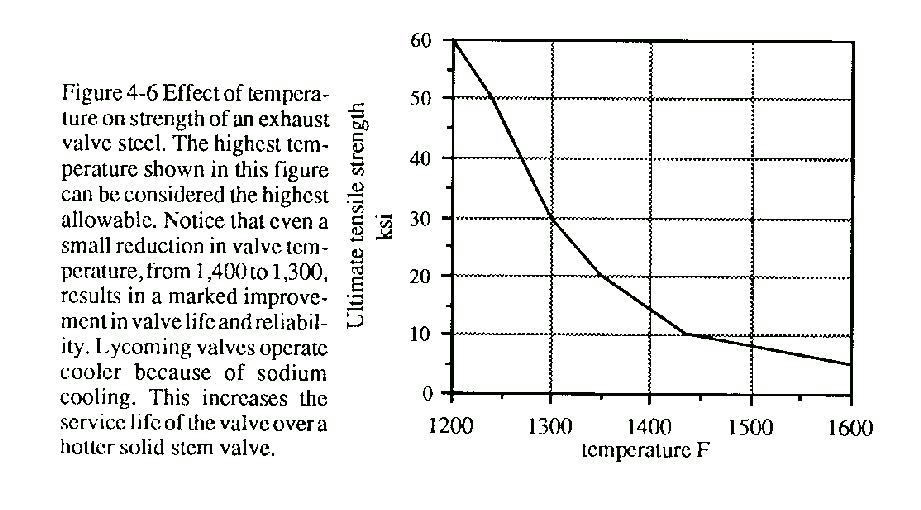
Here is another interesting chart from the Sky Ranch Engineering manual.
It would be so great if we had EFI on aircraft engines that kept track
of all this. I am sure they would charge $10,000 for a certified version.
Perhaps a warning horn on the scanner when the EGT or CHT got too high.
Automatic thermal control on the cowl flaps would also help.

Is it bad pilot technique or is it bad human factors cockpit
design? Perhaps exhaust valves are just prone to failure no matter what.
Its the training. You got 5 minutes of engine management 34 years ago and you forgot it already?There are few readable gages that can be seen by the pilot that are of use in managing mixture. The few that exist will be invisible, obscure enough in function that they should be in the luggage compartment where they take less room from the gages you can read. Does fuel flow in pounds per hour help you? How about fuel pressure? It should be 8.5 PSI for full throttle but only 6.5 PSI at cruise. Bull. A simple movement with a needle straight up in a green band for peak, to 100 degrees lean of peak EGT. Most EGT gages have the operating range we need over at the right end of the travel. Mark out the temps along the outside for actual recording if you like. But the normal range should also be the center of the movement. And the gage should be located where it can be seen, say next to the tach. I copied two articles about Avco valve failures and will post them after work tonight. The gist of
it is the Avco heads were poorly designed and could not cool the valve guide quickly enough. Guides would stick the valve
 open when clearance was new. Guides that were warn would not stick unless the got dirt in them. A new cylinder design fixed the problem with oil cooled guides. A little late but at least they did something. It should be noted that high use engines like flight schools and commercial people just did not see the problem. It was low use but usually in the first 400 hours. Changing oil often and flying the engine are good preventive measures. Avco says CHT up to 475 is OK, but that sounds way too high to me. 375 tops if you can do it. But wait a minute. In a home built I could have a gage that reads that way. A 20B in a BD-4 with the EGT and the tach side by side. Lynn E. Hanover
Forget it. Just get a rotary :-)

Paul Lamar
Anytime you are flying behind a mission critical part that normally runs
temperatures from very dark red to cherry red is a recipe for
disaster. The strength of the valve can be halved with less than
a 10% increase in temperature. In the space of 200 F change from about
1200 F to 1400 F the strength of the valve can be one sixth of what it was.

If the muffler falls off your rotary no big deal.

Paul Lamar

The AirCraft Rotary Engine NewsLetter.              Powered by Linux.
ACRE NL web site.
http://home.earthlink.net/~rotaryeng/            http://www.linux.org