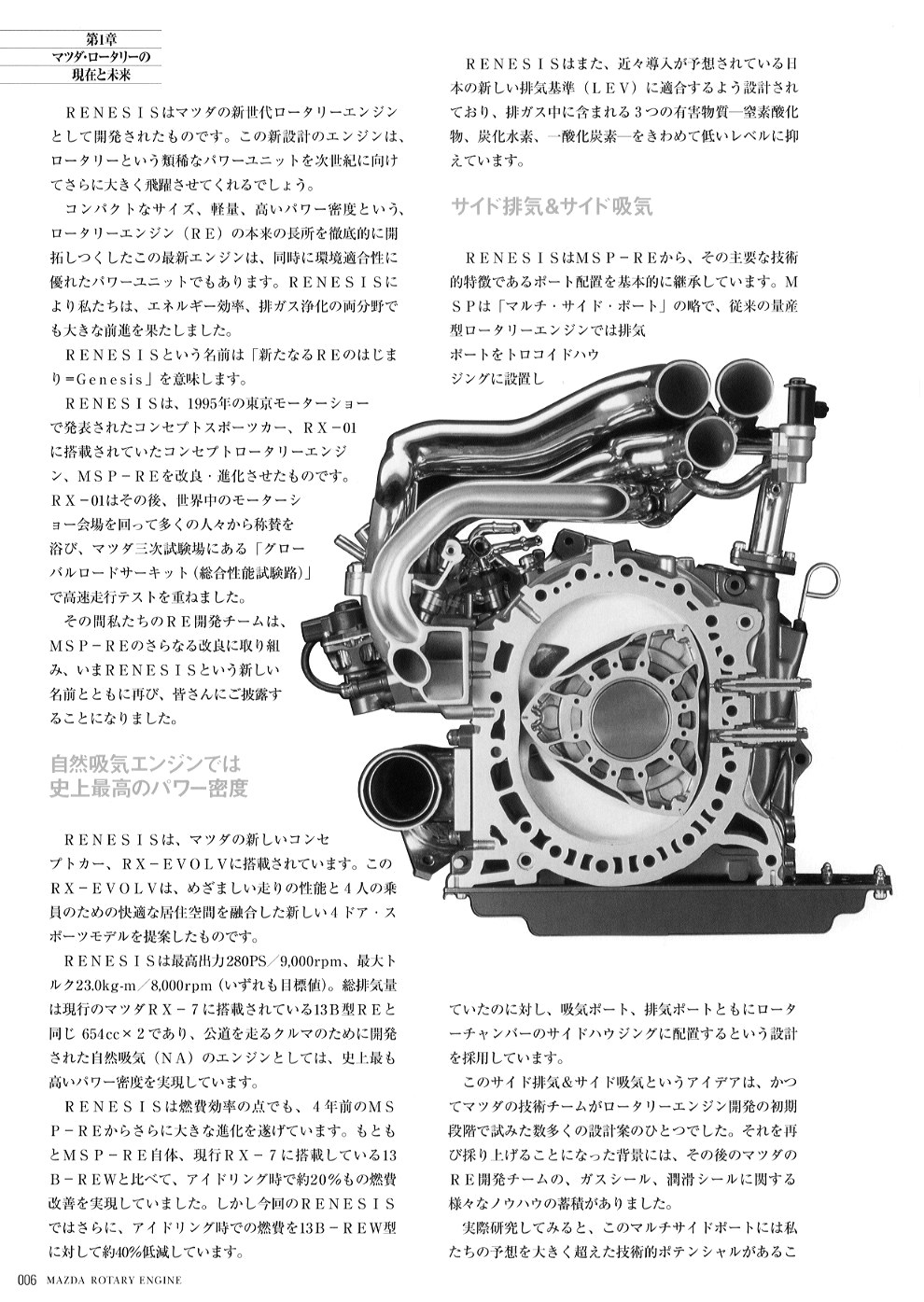
RENESIS, the key to MAZDA RX-8's front-midship layout, features a
side-intake,
side-exhaust layout, with the exhaust ports moved to the side housing of
the rotor
chamber. This allows the size of the ports to be freely set, resulting in
an expanded
air-intake port area which is 30 percent larger than in conventional
rotary engines.
This greatly improves intake resistance and contributes to an output of
250 hp at 8,500
rpm and maximum torque of 162 lb-ft at 7,500 rpm without having to rely
on a turbo-
or supercharger.
 Well folks another nail in the coffin of high intake air velocity.

 Paul Lamar
 Hold on there Paul.  This is just another typical press-release mish-mash
statement.  It is the EXHAUST port area that went up 30%.   Intake port area
is not really affected.    You are so knowledgable about so many things that
it amazes me that you don't realize the key importance of intake air
velocity.

As always, I offer a $500.00 reward to anyone who can show proof that intake
air velocity is not important to intake system tuning.

Tracy Crook
tcrook@rotaryaviation.com
www.rotaryaviation.com
No they are bigger too. Thats how they get the power. More air more power.
As much as 290 HP if you don't care about torque down low.

What you are missing is air resistance in a pipe is proportional to
at least the square of the velocity at low subsonic speeds and much
more than that at transonic and supersonic speeds. Many internal combustion
engines run transonic and perhaps supersonic air speeds in intake manifold

The Lemans engine had huge intake ports and in two rotor form would generate
240 HP at only 6000 RPM. A Power Sport engine with similar intake pipe lengths
but smaller dia. pipes generates 215 HP at 6000 RPM. For just a couple of
data points. The ports in modern aircooled aircraft engines are about
as large as they can be made. One reason they have good BSFC and good
power for the low RPM they run at.

This is proof enough. Send me the money.

Paul Lamar

The AirCraft Rotary Engine NewsLetter.              Powered by Linux.
ACRE NL web site.
http://home.earthlink.net/~rotaryeng/            http://www.linux.org