Al Gietzen wrote:
In a recent exchange about engines on our Velocity builders e-mail list, one
happy Lycoming user states:

"Say what you will, a well tuned Lycoming will give a BSFC of .375.
That's about as good as it gets for any four-stroke gasoline engine.  There
is just no truth to the "Lycosaur" paradigm."

My reaction is "in your dreams".  But then I'm prejudiced. (Probably not the
only one on this list).  Anybody ever hear of a BSFC like this on a Lyc
4-cylinder?

Al Gietzen
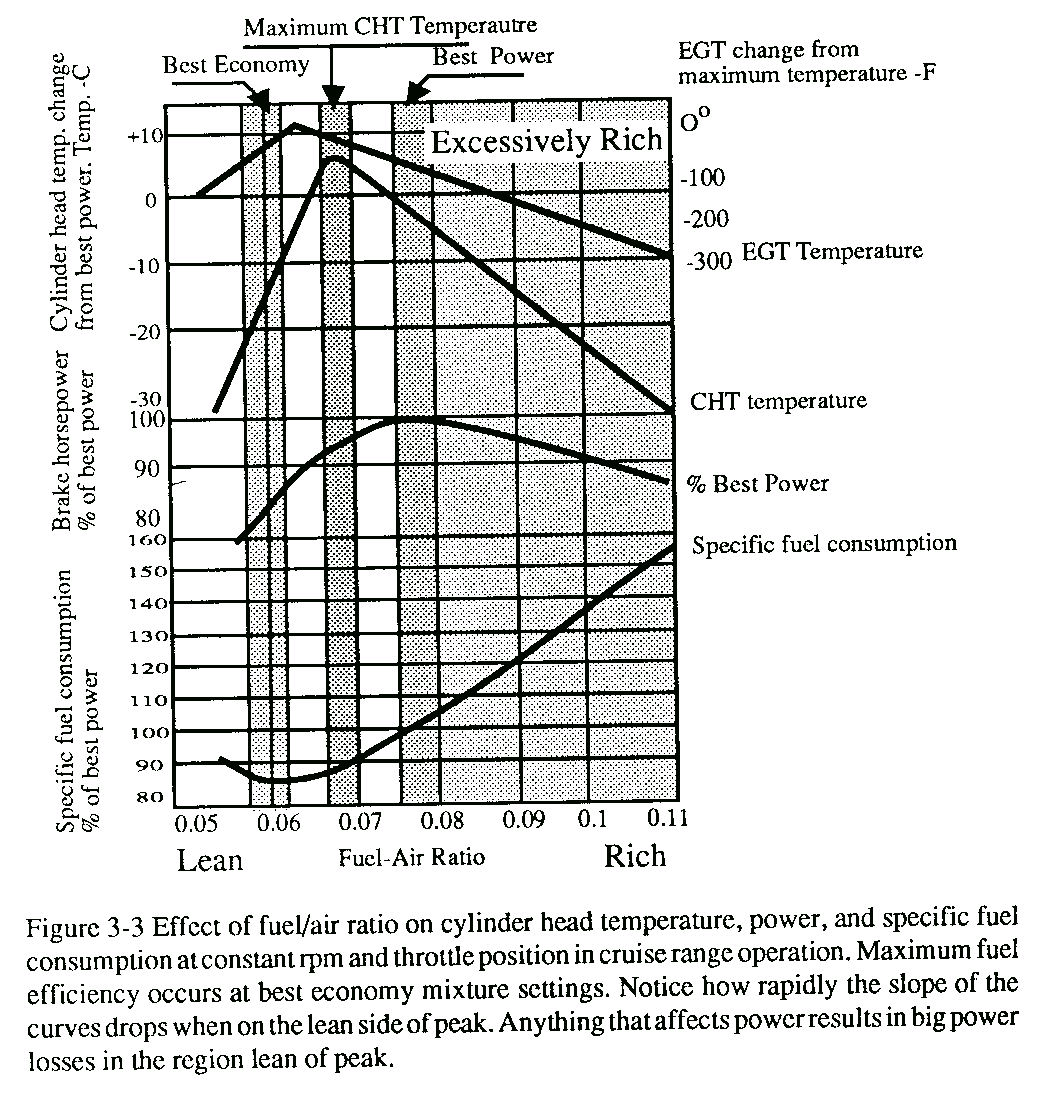
No way. Particularly as Lycoming does not allow running lean of peak.
Too hard on their precious $250 each sodium cooled exhaust valves.

More like 0.45. 0.375 BSFC is turbo compound country.

Paul Lamar
Paul, You are good at taking some known data points and solving for unknowns. The
LBF race at Fon du Lac (Oshkosk 83) was a very well documented real world
condition race for 500 plus miles. See Sport Aviation Nov 83 - page 58. My Long
flew two aboard at starting wt of about 1400 lbs in July temps and averaged
official 191.92 on fuel burn of 119.2 lbs. The course had 20 pylon turns and if
flown perfectly, adding the radius of the 20 turns makes the minimum distance
flown about 515 miles and actual speed about 198 mph to get credit for the 500
miles. Fuel burn incl warm up and standing start for time and after flying finish,
you had to fly a pattern, land, and taxi to ramp under power or be disqualified.
Fuel burn was measured by weigh out and back in on electronic scales in a closed
hanger. A judge monitored all turns and a penalty was assessed if you cut a pylon.

The known drag of a clean LongEZ is considered to be 1.6 equiv flat plate area,
but I don't know how to document that. Maybe Bill Freeman can confirm or dispute
that. The Lyc 0320 with 10/1 compression and Ellison throttle body was flown WOT
and way to the lean side of peak at 2600 rpm and cool heads and oil. I don't know
what the bsfc was for that operation, but I think it was about as good as a Lyc
can do.

Note that in measured conditions, the Long was more efficient (faster on less fuel
burn) than the Glasairs and Paser Mustang, but not as efficient as the purpose
built racers.

Question: What was bsfc for this operation?

Herb Sanders
Well if the flat plate is 1.6 the drag is (191 MPH)^2 times .0026 air density
factor at sea level times 1.6 square feet or 152 pounds.
Even less at high altitude where the air density is lower.

191 MPH is 280 feet per seconds. The net HP out of the prop
is drag times velocity in FPS divided by 550. That is 77 HP.
Even less at high altitude where the air density is lower.

Say the prop is 80% efficient so that makes the engine HP about 96.
Even less at high altitude.

119 pounds of fuel divide by 2.6 hours gives you 46 pounds of fuel per hour.
46 pounds per hour divided by 96 HP gives an average  BSFC of .48!!!

Take that Rick!!!!  ROFL

The O-320 with ten to one CR is about 160 HP so 96 HP is about 60%
which is about right for leaning and cruise at altitude.

I want to thank you very very much for that excellent data Herb.

YOU ARE MY MAIN MAN!!!!!!

BTW guys put a cheap manifold pressure gage in there and that will eliminate
a lot of educated guesses. Marsh Instrument Co Part # J4605. McMaster Carr $14.95

Also BTW. Shame on you Herb for leaning that poor Lycoming engine.

Paul Lamar

The AirCraft Rotary Engine NewsLetter.              Powered by Linux.
ACRE NL web site.
http://home.earthlink.net/~rotaryeng/            http://www.linux.org