dean van winkle wrote:

Paul

During the 1960's, I spent several years at Cessna in Wichita as a Design Engineer ( 210B, 205, and 206 ) and Flight Test Engineer ( 300 and 400 series twins ).  One of the test pilots that I flew with had performed the slip evaluations on the 172/175 aircraft.  He related that he went through a whole series of airspeeds and sideslip angles with full flaps, but when he found the right combination that blanked the downwind horizontal tail, the pitchdown was so violent that his feet were jerked off the rudder pedals and his shins were banged against the bottom of the instrument panel.  The 172 and 175 Owners Manuals from the 1960's state "Slips are prohibited in full flap approaches because of a downward pitch encountered under certain combinations of airspeed and sideslip angle".  I would emphasize that the prohibition is only for the full flap configuration.  There is no such prohibition for the 150.  I would also state that I have never heard of any structural concerns about the flaps as long as the flaps deployed airspeed limits are observed.

On this same subject, the AD that required the inverted slots in the 177 Cardinal stabilator was to eliminate the same kind of pitchdown found on the 172/175 with full flap slips.

Dean Van Winkle
RV-9A   13B NA
I noticed something like that in the 172 but I never explored things
extensively. I usually do this at altitude and try it using the full
range of elevator. One would think the airplane would stall and fall
out of the sky with full aft stick, full rudder and full aileron but for
some strange reason it seems to be stable in this configuration :-)
Except for what I thought was a mild pitch buck in the 172.

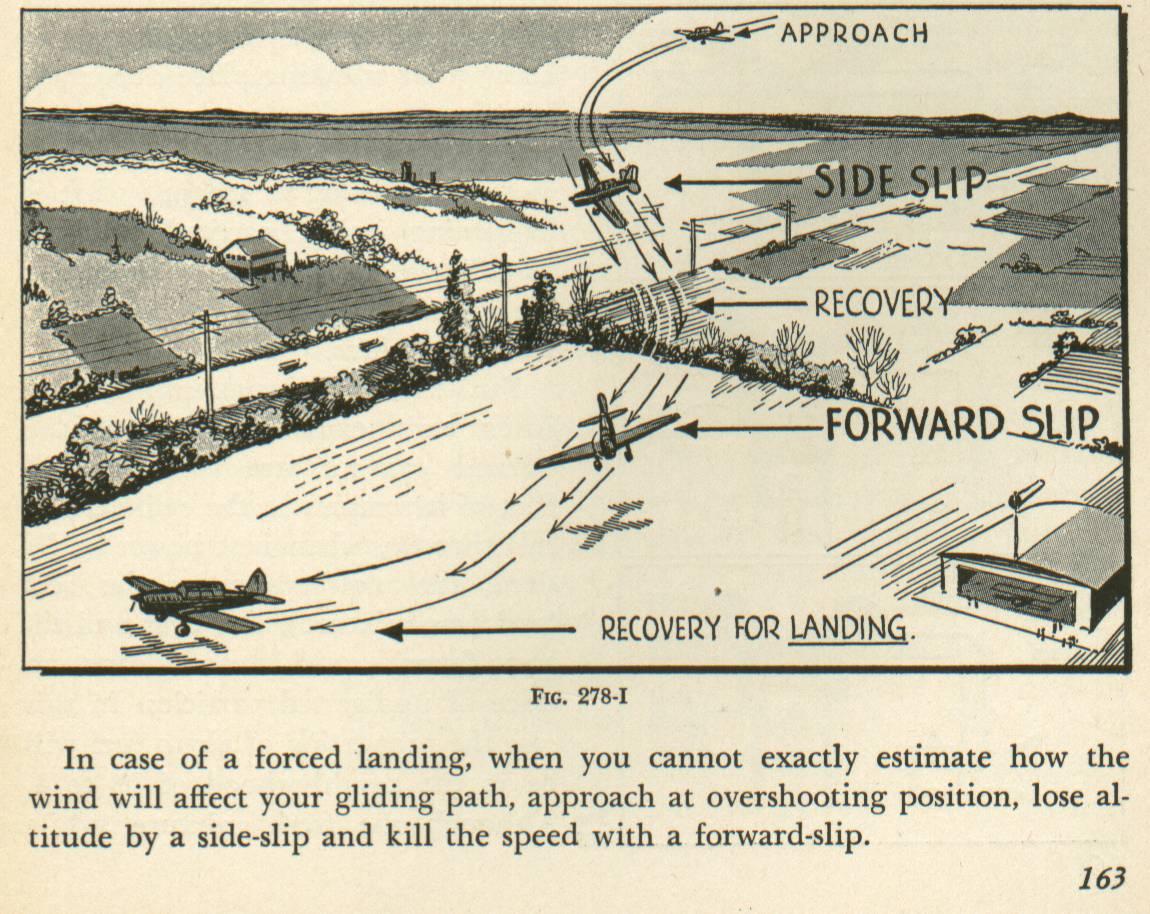
Here is a wonderful illustration from one of my favorite old books
called "Your Wings". First published in 1936 and written by Assen Jordanoff
with illustrations by F.Meagher, F.Carlson and E.Sloane.
This book was used as a text at Los Angeles City Flight School.

Paul Lamar

The AirCraft Rotary Engine NewsLetter.              Powered by Linux.
ACRE NL web site.
http://home.earthlink.net/~rotaryeng/            http://www.linux.org