Speaking of lift I flew the C182 up to Bonneville the first year that
Jim Mederer attempted to capture the E class land speed record
with a three rotor, three turbo 3rd gen RX7 with ice water intercoolers.
When I saw the car for the first time at the salt I asked Jim what the
lift distribution on the car was and he told me it had two hundred pounds
of
down force on the nose and nothing on the tail. In my characteristic best
diplomat mode I said "WHAT THE HELL....that's not going to work Jim!!!"
I then said: "At least tape up the slot under the spoiler with duct tape."

He got a bit mad at me for being so blunt and told me he was not allowed
to modify the shape of the body. He later told me I did not know it all :-)

After I made a few calculations on the back of an envelope I told him this
thing is going out of control right around 250 MPH. Don Sherman and Csaba
Csere where standing right there and heard every word.

Sure enough Jim got it up to 250 MPH and got sideways. The angular
acceleration
and consequent and subsequent angular velocity was a site to behold. The
car
lifted off the salt to an altitude of ten or fifteen feet and did a
Lomchavalk(s?).
The RX7 wound up spinning down the salt on its roof at over 200 MPH.
A Japanese film crew just happened to be near where this event took place
and got excellent movies of the whole thing. Jim was not seriously hurt.
The car was repaired, the aerodynamics fixed and it later went
on to capture the E class land speed record at 268 MPH as I recall.

Paul Lamar
Some of the folks on the other lists were wondering about this; the video is
available on the 'net if you search. RB 215 MPH.mpg or something like that.
One version has in-car video as well :)

We had concluded (due to lack of eyewitnesses on those lists) that the
under-tray of the FD was flat and thus lift regardless of front downforce.

We had figured he put NACA ducts or dimples on the undertray to encourage
negative lift on the later successful attempt.

Mike Harrington
I did not see the car on the second try so I have no idea what they
did. A rear belly pan with the correct amount of rake will indeed
generate a tremendous amount of down force on the rear. The first time
we tried that on the Chaparral 2F around 1967 it came loose at only
about 140 MPH. We were amazed at the force it generated.
We beefed it up and it served us well.

Normally, near zero angle of attack, the undertray has little to do with
lift unless it has a significant positive angle of attack. The main component
of automotive lift is the air flowing over the top of the car just like a wing.
The aspect ratio of a car going straight ahead is rather low so a large angle
of attack is necessary to generate a massive amount of lift. When the car
goes sideways to the wind the aspect ratio then becomes comparable to a wing
of the same dimensions and the lift is greatly multiplied. That is when the
car can and will take off if the speed is high enough.

Tell your friends the best thing you can do to a 3rd gen is put a high mounted
wing on the back. If it is mounted too low the low pressure area under the wing
will be canceled by the corresponding low pressure on the rear deck with
only an increase in drag as a result. Make the wing with an adjustable angle
of attack as too much down force on the rear will cause more lift on the front.

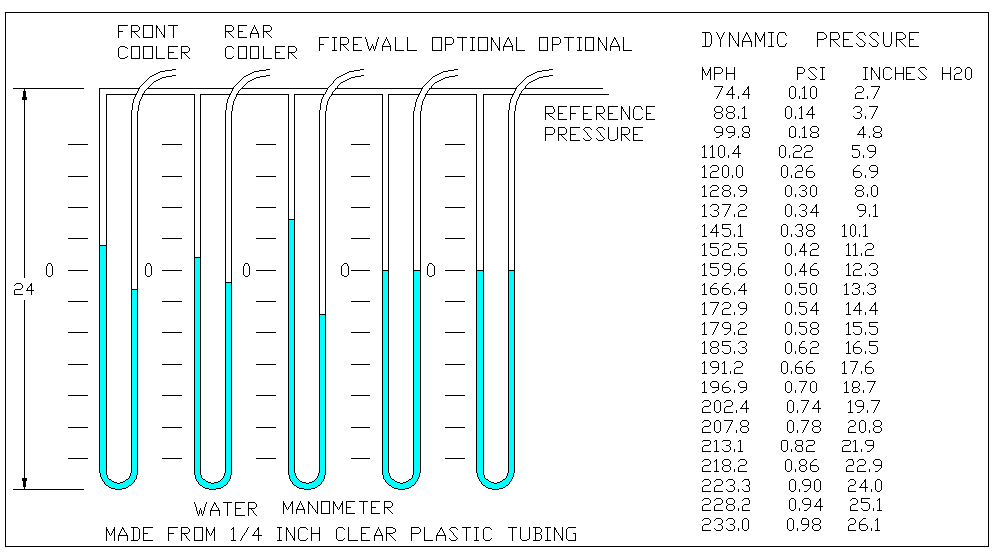
Send them this picture of an essential tool. The other tools are suspension
position indicators that can measure lift and down force directly using
average suspension positions as lift/down force sensors. Some of these
old magazine articles and technical papers of mine go into this
subject in great detail.

Most of the authors that have written on this subject since then
learned it from me. Many were my students at a small school I used to own :-)>

Paul Lamar

The AirCraft Rotary Engine NewsLetter.              Powered by Linux.
ACRE NL web site.
http://home.earthlink.net/~rotaryeng/            http://www.linux.org
Down in the Rear by Paul Lamar
(Use of rear spoilers)
Sports Car Graphic
Augast 1967

Aerodynamics & The Group Seven Racing Car by  Paul Lamar
Presented at the AIAA Symposium on The Aerodynamics
of Sports & Competition Automobiles
(Research I did while at Chaparral Cars.)
April 20 1968

Why Spoilers by  Paul Lamar
Sports Car Graphic
February  1969

Showdown for Spoilers by Paul Lamar and others.
Car Life
June 1969

More about Cornering Power by Paul Lamar
Road & Track
(Aero down force combined with tire properties)
October 1969

How to Hotrod VW engines  by Bill Fisher
HP Books
(Chapter on cross wind Stability and The Beetle by Paul Lamar)
1970

Microprocessor-Based System for Roll-Down and Acceleration Tests
by D.K. Lynn, C.R. Derouin, and Paul Lamar
Los Alamos Scientific Laboratory
Published in IEEE Proceedings 29th Vehicular Technology Conference
(The technical details of the road test system.)
Arlington, Illinois, March 28-30, 1979

A Matter of Drag by Don Fuller
(Article about the Lamar Instrument Road Test equipment.)
Road Test
May 1975

Road & Track May 1987
(Article about the use of Lamar Instrument test equipment used
to measure the runway acceleration performance of the Rutan Voyager
around the world non-stop aircraft record holder.)