<< Our discussion of intake air velocity made me think of
 > >an old British engine called the Cross rotary valve engine.
 > >As I recall. Here is a sketch from memory I made.
 > >When I was a kid I was fascinated by this engine.
 > >
 > >The large bearing was necessary as the force on the rotary valve
 > >was considerably during the combustion cycle.
 > >
 > >Note the huge intake and exhaust ports unencumbered by any silly
 > >poppet valves. This gave much more port area than a sleeve valve
 > >engine.
 > >
 > >The engine ran well and probably was the most successful of a long
 > >list of rotary valve piston engines including one designed by Felix
Wankel.
 > >
 > >Problems are cooling the valve, sealing  and the opening and closing
 > >times as the valve rotated at 1/2 crank speed just like a cam shaft.
 > >Also deflection of the valve might cause rubbing on the cylinder head.
 > >The spark plug rotated along with the valve. Bulk in the cylinder
 > >head was also a problem.
 > >
 > >I think perhaps with modern materials such titanium for the valve
 > >this engine may have a few possibilities. If the rotary valve is slammed
 > >around electronically to index the ports as required the timing problem
 > >could be over come. In fact the opening and closing times of both
 > >intake and exhaust ports could be closely controlled by a computer.
 > >
 > >I am not naive enough to think this will ever be tried but be wary
 > >of some shyster selling stock to develop this engine. I would say
 > >its chances of succeeding are at least 1000 to one and maybe
 > >as much as one million to one :-)
 > >
 > >Paul Lamar

 > Interesting.  If you flowed oil behind the valve with suitable
 > seals (not sure HOW) it would cool and support it.  Did this
 > ever make production?
 >
 > Bill Freeman
 > Long EZ builder & pilot
 > BSME, MSME
 > EAA Technical Counselor
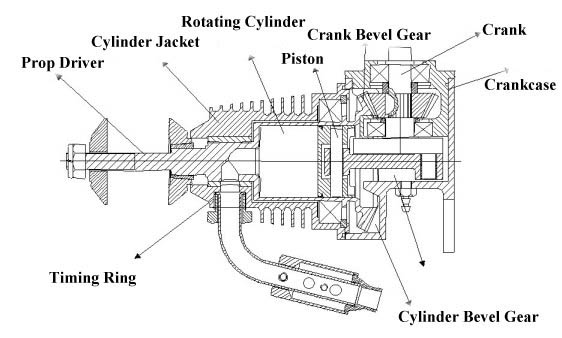
There is a model airplane engine available now that has a similar layout. The
whole cylinder rotates at half crank speed. Very interesting.
Lynn E Hanover
Yes I have some stuff on that. Here is a jpg. The neat thing about
this layout is the prop shaft runs at half speed to that of the
crank. The draw back is the valve opens and closes too slowly
there by limiting the breathing. With my version the rotary
valve is slammed around with high angular acceleration opening
and closing the the valve rapidly improving the breathing
and optimizing the timing for speed or torque. Kind of like a
cam shaft but without the drawbacks. In almost all Cross type engines
the rotary valve has been geared somehow to run at half crank speed
so far. To my knowledge.

Paul Lamar

The AirCraft Rotary Engine NewsLetter.              Powered by Linux.
ACRE NL web site.
http://home.earthlink.net/~rotaryeng/            http://www.linux.org