Its been some time since flying a 150,but doesn't the airspeed
indicator go out-off-wack when executing a full slip approach.
Patrick.
In a slip the pitot tube is only registering a vector of the forward
airspeed (visualize the forward component of a diagonal "cross wind" on the
ground).

More importantly, the static port of the aircraft is now seeing an increased
pressure due to ram air, thus less differential pressure and less A/S reading.

I did my training in a C-172 and when practicing slips kept the reduced A/S
reading above the stall point knowing that when I let out of the slip I would
have a good safety margin.
Scott Moore
Not true on the static pressure. Usually there are static ports on both sides
of the airplane.

The ram air problem is taken care of on experimental air planes (not the kind
we build) by a pivoting pitot tube that points into the wind.
Paul Lamar
It had been several years (10) since I flew and I only remembered the one
static port on the 172s that I rented.   I pulled out my manuals for the 172
Skyhawk, and the 172RG Cutlass since these were my primary trainers.  The
preflight in the manual for the 172 reads "Static Source Opening (left side of
fuselage)." and the 172RG reads "Static Source Openings (both sides of
fuselage.)"

Since the 172 only has the left side static port, a left slip would read a
lower than real airspeed, and a right slip a higher than real airspeed.
Because of this, I only felt comfortable doing the left slips with an
indicated airspeed safety margin (greater A/S than indicated).

I never flew the 150, but would bet $.25 that it only had the one static port
as well.  I realized dual static ports would help prevent this erroneous
reading.  Since Patrick questioned "doesn't the airspeed indicator go
out-of-wack when executing a full slip" I was responding to that type of
trainer A/C.

Paul, keep us on our toes.  I'll do better next time, I promise.  {:>)

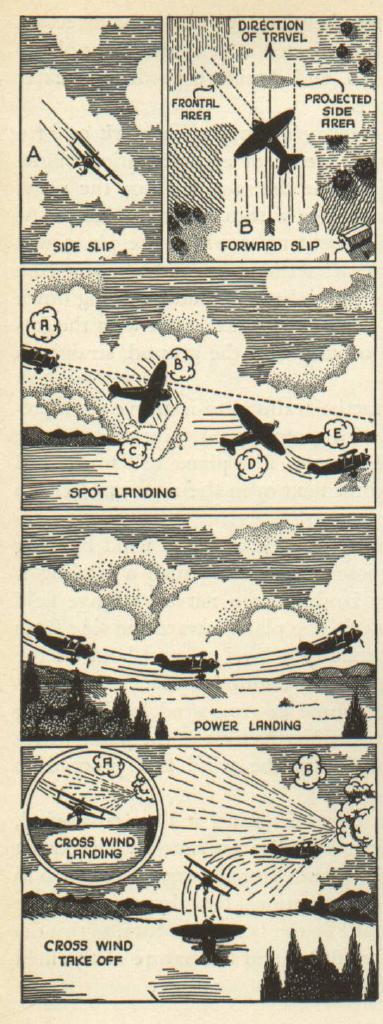
BTW, I liked the photo of the "how to slip on approach".  What kind of
aircraft can do the 90 degree side slip?  If it only had a single left side
static port, the airspeed must be indicating about negative 80 kts on "cross
wind"!  (;>

Scott Moore
juno@dog.com
N-316RJ (reserved)
Yes you are right. I checked the 1981 172P manual that I have.
That is a real oversight on the part of Cessna not to put
static ports on both sides of the airplane. I am very surprised.

There are several kinds of static ports. Some are built into the pitot
tubes them selves. I suspect (and this is a matter of usage) a REAL
pitot tube has the static ports built in. I'll try to find
an illustration. Perhaps those early Cessna's had real pitot
tubes.

The 1981 172P  manual that I have says not to do steep slips with flap
settings greater than 20 degrees due to a slight tendency of the elevator
to oscillate under certain combinations of airspeed, side slip angle and
center of gravity loadings. I was able to experience this myself
and it was indeed mild.
What kind of aircraft can do the 90 degree side slip?
One with high rudder authority :-)

BTW the difference between a forward slip and a side slip is
the wings are held near horizontal with the ailerons in a forward slip.
See another great illustration below.

One of the neat things about slips I suspect is it is nearly impossible to
stall the airplane while in a slip although I have never really tried it in
more than several different kinds of airplanes. I know with a Citabria you can
pull the stick full aft, full aileron and full rudder and
it won't stall. This I think is because the downward component of the velocity
vector is quite high keeping your overall kinetic energy up while running
the wings at a relatively low angle of attack. Of course if you kick it
straight, level the wings and keep the stick back it will eventually and
soon stall but that is what you want in a spot landing. In a steep approach
using flaps and power alone it is quite possible to stall if you don't place
close attention to the air speed. Also power is required for the steepest
approaches using flaps alone. You may not have this power available when you
need it.

To review why we are spending a lot of time on this. We have all become
test pilots because of the experimental nature of non aircraft
engine systems installations. I am saying all this not to teach you how
to fly. I am encouraging you to practice these techniques for the day that
will come and when you will experience a loss of engine power. In other
words this could save your butt someday!

Paul Lamar

The AirCraft Rotary Engine NewsLetter.              Powered by Linux.
ACRE NL web site.
http://home.earthlink.net/~rotaryeng/            http://www.linux.org