We'd love to build stratified charge engines. Anyone got $5MM laying around to help?

Jon
Is that all?
I believe that a medium displacement stratified charge engine can be designed, tooled, and taken to the prototype demonstrator stage for about $5 million. The larger the engine gets, the more difficult the development. (Very small is probably hard to do also, but I don't think anyone wants something lawnmower sized.) Curtiss-Wright/Deere/RPI worked under government contract, which adds quite a bit of cost for things that are not directly related to the product (not necessarily bad things, but perhaps less necessary for a "lean" commercial effort). The overhead structures at the companies were also very, very high. I think the marine and aviation engines would have similar base ratings -- say 400 hp at 5000 RPM?  I think we already have some of the capabilities within the folks on the list, plus a few others. This could be done as a "virtual company," with a lot of CAD drawings flying through the ether...
Anyone game?

Jon Lauter
Rotary Power Marine Corporation
Starting with a Mazda I hope. I have a few ideas.
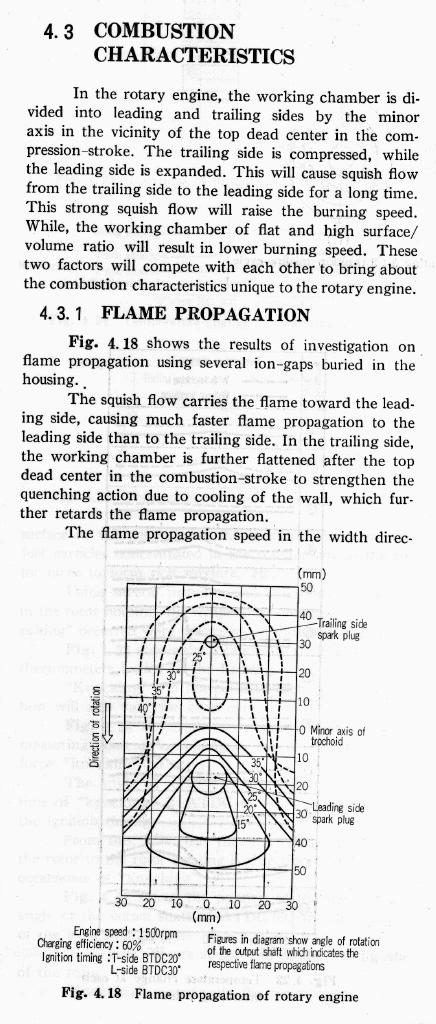
As the rotor comes up to top dead center the squish area on the trailing side
gets smaller and some mixture squishes out of there. If the rotor could
be grooved in such a way to squish the mixture in a way that concentrate it towards
the spark plug the natural stratified charge of the rotary might
be enhanced. Some sort of glass rotary engine could be made to
high speed photograph the ebb and flow of the mixture during this phase.
Not one that runs of course. Just for the purpose of studying the
aerodynamics in the compression and  combustion chamber.
Perhaps a bit of high pressure fresh air could be injected at
just the right time in this small volume squish area to purge it of
fuel rich mixture. Nothing burns in there anyway.

Paul Lamar
I believe that a stratified charge engine will have little or no gain for aircraft.
The big gain is
at low throttle settings where it minimizes throttling losses and allows full expansion
with reduced heat input - much as the so called Diesel engine. Most aircraft
use is at larger throttle openings where direct injection engines will often have
poorer power and specific consumption because mixing with a full charge is
better with the vaporization and gaseous mixing of a carb or port injection.
(for example Diesel smoke at full power)
Vance
Thats true for most combustion chambers Vance but I think there is more
to be had out of the wankel chamber with some sort of strat charge.
At least CW and JD got below .4 in a wank with strat charge.

I have been thinking about my air injection scheme and I have convinced
myself that it is a good idea :-)> You don't need a lot of volume
and pressure. Just before the mixture fires it is probably only about
150 PSI max in the combustion chamber. If you squirt the fresh air
in on the trailing side it should purge that area of mixture
and get the explosive stuff up towards the leading edge of the
combustion chamber where it wants to burn anyway.

You are talking conventional direct injection strat charge and I am talking
mixing the fuel well with the air in the intake runners and then converting
the homogenous charge in the combustion chamber to strat charge. Making the
trailing side super lean with the additional fresh air. It would also
be a slight supercharge effect.

The big question is; will the additional HP required by the air compressor
negate any improvement in the BSFC? The best compressor would be driven
by a geared exhaust gas  blow down turbine.

What do you think Jon?

I also think one of use could try this.

Paul Lamar

The AirCraft Rotary Engine NewsLetter.              Powered by Linux.
ACRE NL web site.
http://home.earthlink.net/~rotaryeng/            http://www.linux.org