Let me know if you need the QB compiler.
If you guys want it you can download the Basic Professional Development
System PDS 7.1
aka Qbasic Pro 7.1. It's public domain and includes a lot of extra commands
and such for
doing data, graphics etc over and above the Qbasic 4.5 version.

There are a few download  sites and a quick search on google for "PDS 7.1
download"
will find more, but here's a couple that have all Qb versions.

http://ebox.stilius.net/cgi-bin/ebox.pl?page=index_qbasic

http://www.pkworld.de/

http://www.programmersheaven.com/zone6/cat28/16442.htm

There are a bunch of sites and some connect faster than others.  The only
thing about this is that
the install set I have comes to 5.4 megs and these zips are 2.4ish so they
must have cut out samples or
something.

QB is great for doing quick and not so quick programming, it takes very
little time to get something
running compared to VB. Quick C  is another one that should be public
domain by now (last ver was 2.5)
which gives you even more control over the hardware and better graphics.
Both are about the same size
for install, both are easy to program in but the C stuff runs a bit faster
but then you have to deal with C
headaches ;-]

Dave
I did not like PDS 7.1 as much as QB 4.5. Seems they added so much more
and that took more of the 640K which left less for the program.
Unfortunately as I recall it was never developed into a full DOS extender
version which would have been a kludge of course but still would work fairly
well. The ACADR12 that I use is a DOS extender version. I also run
a DOS extender version of Lotus 123. Not the best way to do it but it
seems to work well. Microsoft considered DOS extender programs a threat
to their hegemony and the emerging Windows OSs.

The best way of all would be a 32 bit DOS. Never happened unfortunately.
What this all means of course is any program you write in QB will have
a source code below 32K or an executable below about 64K as I recall.
Not exactly sure about these limits. Not a problem for a engine monitoring
program but could be a problem for a moving map program.

Now the command mode of Linux on the other hand would be fast and not have these
size limitations. 4 gig DRAM memory addressing.  If you add X windows however
everything gets bloated again.

I have just discovered a development package called QB2C which is just
great. Runs on Linux takes a sub set of QB and converts it to C source
code and ultimately a compiled version. Check it out :-)>

http://wwws.irb.hr/~stipy/qb2c/qb2c.html

Paul Lamar
Paul,
If you don't mind, I have a couple few bunch of basic questions on the subject of roll-your-own moving map/engine monitor.  If I were to assemble a basic system using a PC motherboard, what would be the bottom of the barrel processor that could handle this task?  (I have an old 386-20 in my junk drawer)  Is there a limit on the high-end, or would a PIII or P4 be best of the best, or gross overkill?  What minimal sized hard drive would be necessary?  Would a CD-ROM be necessary too?  How much RAM should I have?
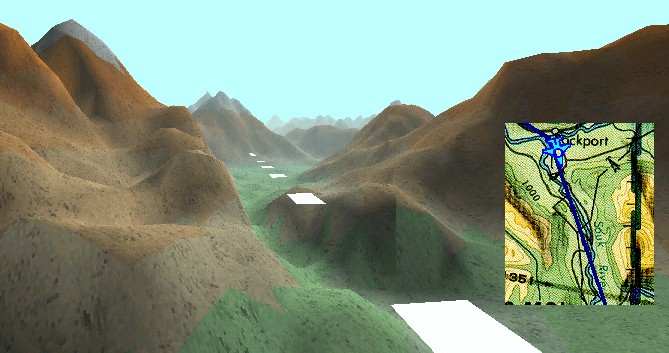
Unless you want to run my simple free software a lot of the moving map programs on the
market use Windoze and they are getting pretty sophisticated such as #D terrain.
See the capture from the Free Flight site below. That means if you want to
run this stuff you will need a fast mother board and large hard disk.
Not much of a problem as even the fastest mother boards are around $400
instead of free :-)

Simple QB DOS software... any 386SX and up mother board will work
fine. The latter the better. Your mother board will work fine.
Also, would a special video card be required for a LCD monitor? If so, could you suggest some low cost makes? Is there a certain make/model of LCD that will work with a PC, or could I use whatever I can fit into my panel? Since my a/c doesn't have a full bubble canopy, I don't think I need a 1000 nit LCD.
Not if you use one of the latter desk top flat LCD monitors. Any  VGA and above
video card ... even the cheapest ones on the market will work fine. Even older
ones with 2K of memory will work fine. Again these should be near/or free.
Finally, how hard would it be for a non-programmer to learn QB2C to the point of being able to get this up and running.  (I had some DOS Basic programming many years ago, but have forgotten most of what I had learned).

Sorry for all the questions, but inquiring minds just gotta know.
Thanks,
Mark
No problem at all Mark. We can go off list and I will help you in detail.

About five minutes. You can practice on the Windoze computer you are using.
Just some real time hardware access features of QB won't work.

CLS                '(comment marker) clear screen
PRINT "My name is"

QB had a device known as a smart editor. It checked your code for
syntax errors and label misspelling in real time as you typed it in.
In computer terms the computer sits around and twiddles its thumbs for
99.99% of the time while you are typing. This time should and could
be put to good use with a smart editor that checks what you are typing.

It's potential for learning to program was... and still is enormous.
It was limited at the time by the silly 640K memory limitations of DOS.
MS killed the QB smart editor when they went to Windoze and VB.
One of the programming tragedies of the century. He should be shot!
The potential of a QB like smart editor with 128 meg of memory and a
1GHZ processor to work with is mind boggling.

BTW You know it is kind of interesting. One of the things the C advocates  used
to say was that a C compiler made faster code than BASIC compilers.
That is not necessarily true any more. It depends on the quality of the BASIC
compiler. The end result is a binary file and a computer is a computer.
A computer can translate ANY programing language into a high quality
binary file. It is kind of silly to write a program in ANY programming language
that is hard to learn like C. The ultimate programming language would recognize the
human voice, like on Star Trek. "Do this first." "Now do this." etc., etc., etc..

Paul Lamar

The AirCraft Rotary Engine NewsLetter.              Powered by Linux.
ACRE NL web site.
http://home.earthlink.net/~rotaryeng/            http://www.linux.org