Paul I agree. I just dynoed a street port 86-88 six port. What a
disapointment. I used turbo rotor housings. I street ported the exhaust which
wasn't much and enlarged the center housing, nothing with the end ports( with
the sleves removed ). Went from 180 to 200. From 6700 rpm to 7700rpm and
141ft/lbs to 148ft/lbs. Put on the 89 intake and went to 210hp and 152
ft/lbs. I had 175 hp@ 6,000. hell a stock 4-port does that without doing
anything. As I speak their is a company in your area that has made a six-port
into a four port. A big four port with not great results. Anyhow I'm done
with those. Next on the dyno is a Cosmo 13B , ported with ceramic seals. Have
you seen these engines? It has 20B housings and porting stock, wich is much
larger than 3rd gen engines. Skip
Snip

      Skip,  SkipnNance@aol.com
   Let me get this straight. I agree the 13B/20B Cosmo ports are larger than
 86-91 second generation but I understood that the 93-95 third generation ports
 are the same size as 13B/20B Cosmo ports. Whats the straight skinny?

      Kelly Troyer
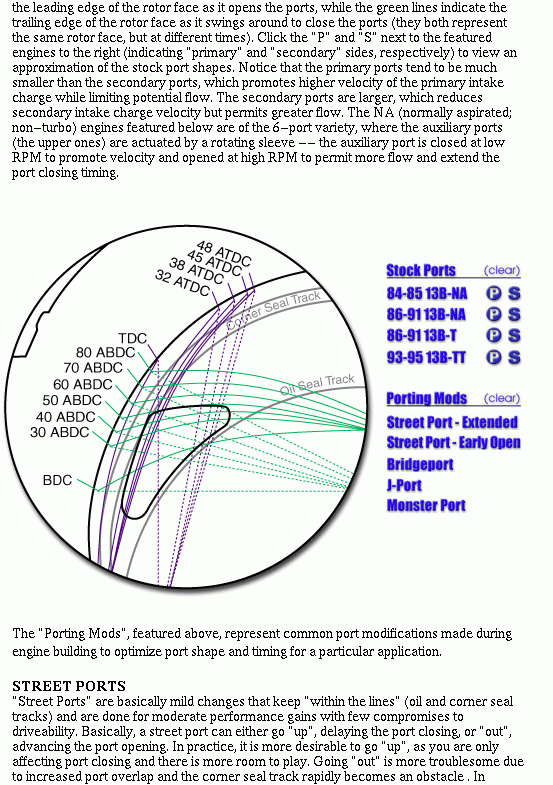
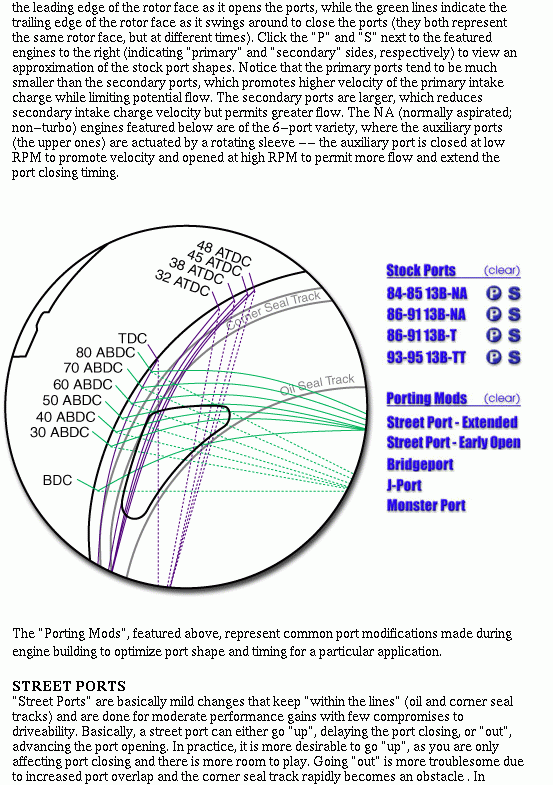
You can put in the year and side or center housing port and this real cool
interactive web page will show you the port size and timing.

http://www.rotaryengineillustrated.com/RE101pages/4-ports101.html

Here is the side port size and timing for the 93-95 side ports.
Unfortunately there is nothing for the Cosmo or 20B.

Paul Lamar

The AirCraft Rotary Engine NewsLetter.              Powered by Linux.
ACRE NL web site.
http://home.earthlink.net/~rotaryeng/            http://www.linux.org