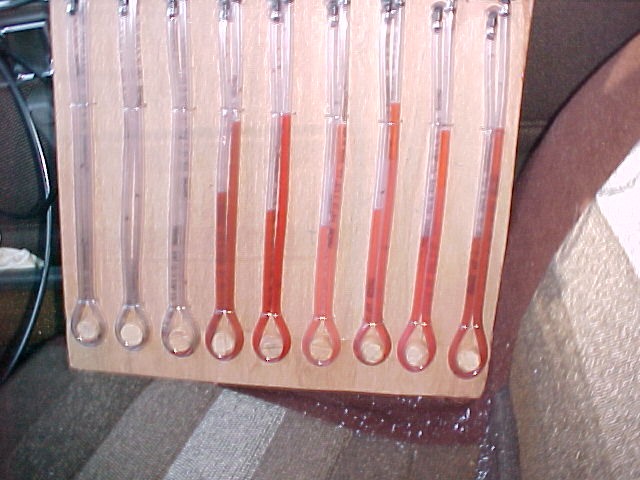
Al Gietzen wrote:
Also, I have found that water in tubes less than about 3/8" have hysteresis due
the surface tension.  This might result in some error in your readings.
Paul Lamar responded:
The tubes I used are about a 1/4 inch ID. BTW Al do you know if a bit of
household detergent reduces the surface tension?
Al,
I think you mean capillary action rather than surface tension.  It is my
understanding that surface tension is the effect that causes water to bead on a
hydrophobic surface (like a waxed car), and wet out on a hydrophilic surface
(Saran wrap).  Capillary action, although caused by the same ionic molecular
attraction as surface tension, refers to a liquid's tendency to climb a tube.
This same phenomenon is behind the concept of a "meniscus" (the low spot in the
surface of a test tube of fluid, such as your fuel sampler).
Paul,
Whether a household detergent would reduce the hysteresis in your water manometer
depends on the surface tendency of the tubes: are they hydrophilic or
hydrophobic?  A hydrophilic plastic will cause the water to climb the tube walls;
a hydrophobic plastic will cause the water to "bead" (inverted meniscus).  Also,
the type and concentration of the soap solution affects it as well.  If you're
serious about addressing this problem, make a test panel of different strengths
and types of soap solution, and then dip tube coupons in the solutions to see the
effect.  If it were me, I'd pretend the hysteresis wasn't there.  :-)

Another possible solution is to use larger diameter tubing in the readout portion
of the manometer.  This of course changes the absolute measurement, but you really
only wanted comparative measurements, right?

Russell Kent
It climbs the tube I think. Very hard to tell for sure. With a 1/4
ID tube the effect is minuscule. Perhaps the red food dye helps.
There does appear to be a tiny bit of hysteresis. Vibration
from the tires settles it out. I suspect vibration in an aircraft
would also settle it out.

BTW I made an error. The pressure tap in front of the rad is
on the left in this picture and the pressure in front of the rad
is an inch or two below dynamic pressure. The rest of the rake pressures
are pretty close to each other indicating dynamic pressure.

Paul Lamar

The AirCraft Rotary Engine NewsLetter.              Powered by Linux.
ACRE NL web site.
http://home.earthlink.net/~rotaryeng/            http://www.linux.org