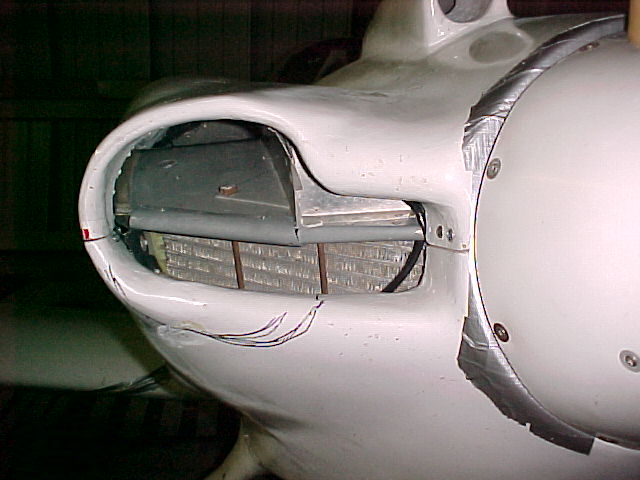
In the picture of the left cowl opening below one can clearly
see the static pressure tap using porous kitchen foam hot glued to
the end of the drip irrigation tubing.

For more pictures on the test see Tracy web site at:
http://www.rotaryaviation.com/

click on "What's new at RWS cooling Test."

Paul Lamar
Paul,

  You've labeled this a "static pressure tap", which I find a little
confusing. Obviously, like an airspeed indicator, the manometer has a
pressure port and a static port, and this is clearly a pressure port. What
are you using as a static reference? Cockpit air? Or are you tapped into
Tracy's static system, or some other known static source. If using cockpit
ambient then the measurements are good for relative pressures on a given
airframe but not necessarily good in absolute terms as the air in the
cockpit is likely also pressurized to some (unknown) degree.

  Thanks for the valuable info. In particular, the pressure measurement
across the oil cooler. Since most guys seem to suffer from oil cooling
problems, its good to know that at least in Tracy's case it appears that
his oil cooling could be improved quite a bit by an improved inlet/duct.

Mike Wills
I am glad you brought that up Mike. For lack of a better term. Perhaps just
pressure tap would be the thing to say. Technically its correct and it is
no different than the static pressure taps on the sides of the RV.

Actually what we used was dynamic pressure as a reference because our manometer
was only 12 inch high. If we had used static pressure as a reference then
we might have blown all the liquid out of the manometer at some speed.
In fact we were limited to 120 MPH for the under the fuselage reading
as that was near ambient pressure at that speed.

In effect we were using the calculated dynamic pressure at 120 MPH as
our reference. Tracy was a bit confused at first on this too. However
we made several flights using the airspeed indicator at 120 MPH for
our dynamic pressure reference and the numbers repeated rather well.
The overall error I would guess would be plus or minus 1/4 inch.

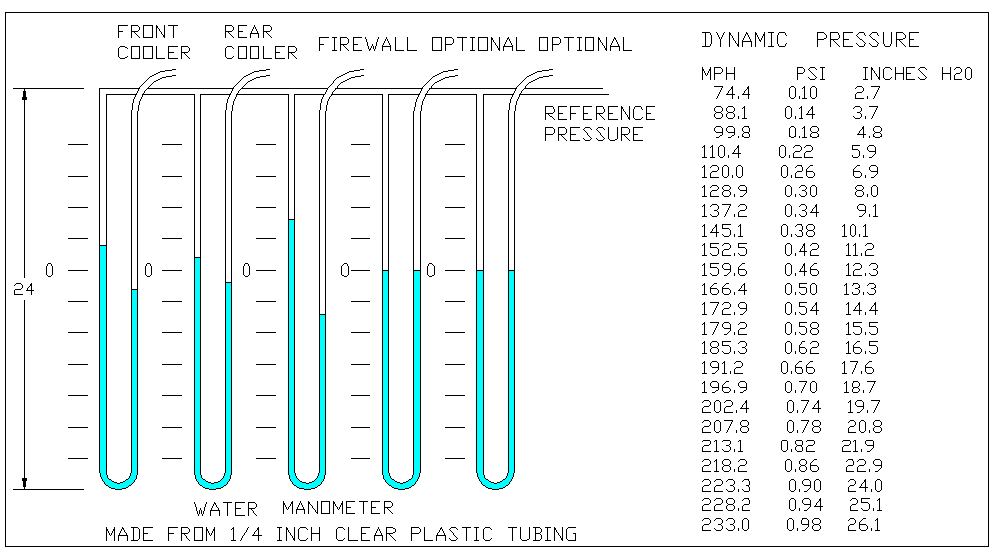
The best thing to do is make up an 18 or 24 inch manometer as shown in
this drawing. Then you can use the pitot static system as reference
pressures.

BTW an airspeed indicator is less than than ideal for measuring pressures.
It is a linear function of air speed while a water manometer reading is
proportional to the square of air speed.


Tracy current oil scoop would work better if he installed a proper
cowl flap opening on the bottom of the fuselage to lower the cowl pressure.
His right radiator would also start working better but still not as
good as the left radiator.

The upper part of this picture is Tracy's oil cooler opening and duct.

Paul Lamar

The AirCraft Rotary Engine NewsLetter.              Powered by Linux.
ACRE NL web site.
http://home.earthlink.net/~rotaryeng/            http://www.linux.org