Stan Blanton wrote:

Hi all,

Here's my first post to the list.

I was looking at the Racing Beat web site and saw they have aluminum housing available. What is the experience with these? Things like heat transfer and thermal expansion come to mind. I know they are real expensive but the weight savings is attractive. Is there any data out there on these housings?

Stan Blanton
A Rotary Wannabe
Jim has several hundred hours on the dyno at the 300 HP per rotor level.
But I don't know anybody rich enough to have run them in an aircraft yet :-)>
Alturdyne claimed they ran some in a one rotor BD 5 motor but I am
not sure if it flew. Their main business was gen sets.

Here is an idea I had a while back. The cut away shows what you must
do to get the water to go where it is supposed to go.

Paul Lamar
Paul that is something we had thought about as well.  The steel would give a good surface for the seals to ride on.
By splitting the housing in half it would be easier to cast the aluminum.  Or even mill a billet.
The sealing between the two parts would be the major drawback.
It's also possible to harden the aluminum to wear better than the steel.
Is anyone else working on lightweight housings?
Royce
You just need four extra  teflon encapsulated silicone O-rings  per rotor.
Everett Hatch built some light weight end housings. Power Sport may still
own the casting patterns.

Paul Lamar
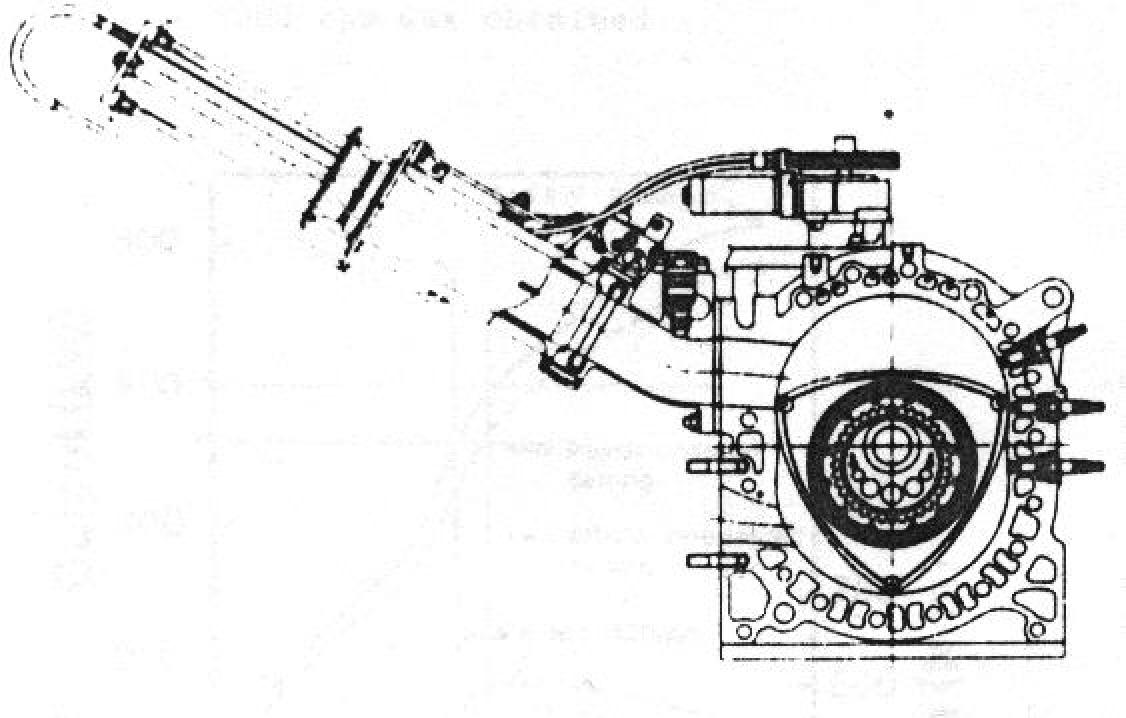
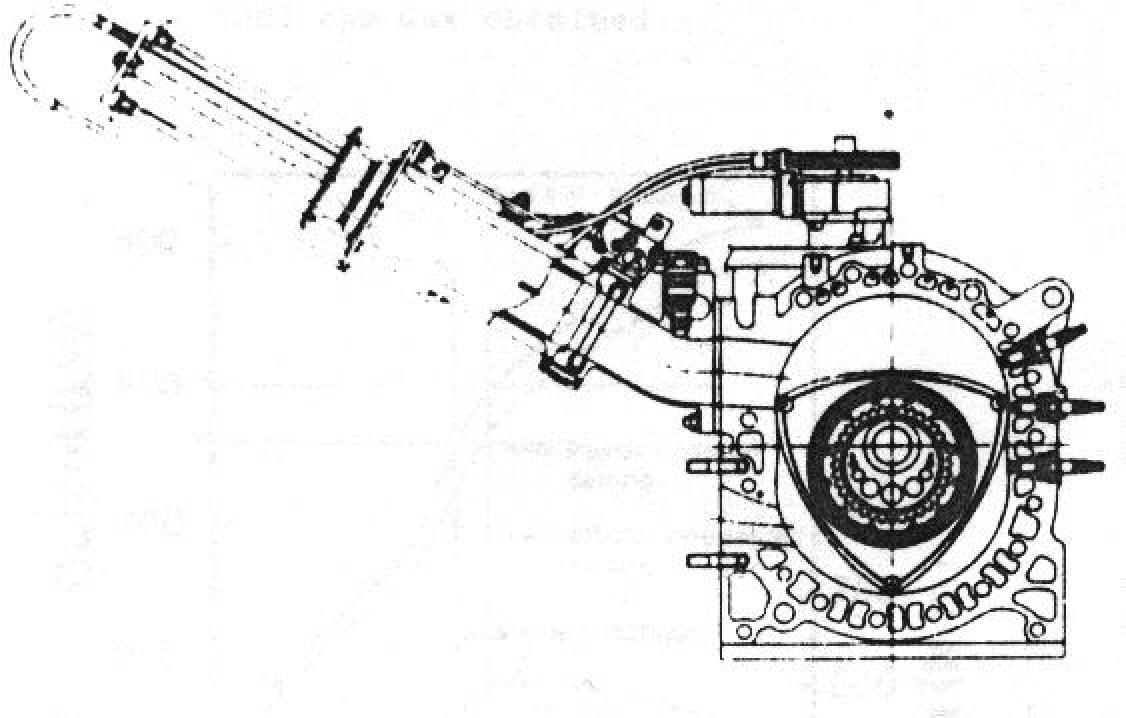
Here is a picture of Everett's engine. It is much much easier to cast
or mill two piece end housings if you use peripheral intake ports. Peripheral
intake ports also get you a lot more N.A. HP. Up to 120 HP per rotor at 6000 RPM
and 170 HP per rotor at 9500 RPM. The P-ports shown here are good for about
107 HP per rotor at 6000 RPM.
Paul Lamar
Anyone care to explain about peripheral ports, what they do, what they look like, etc, to us rotary newbies?

Royce Wise
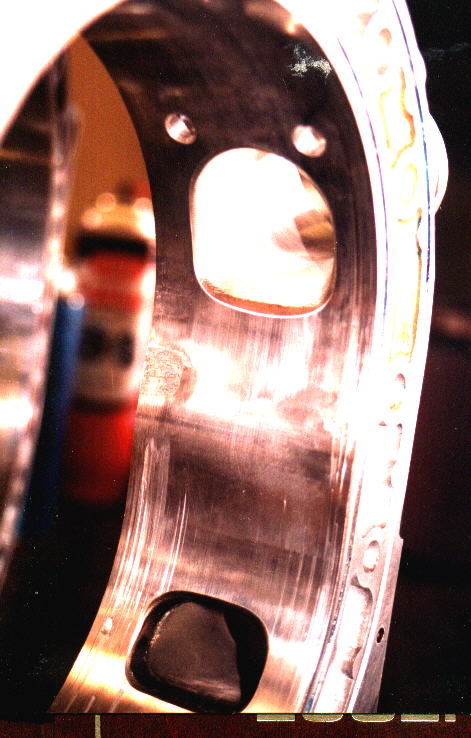
Peripheral ports are straight shots into the intake chamber through
the rotor housing. As such there are minimal pumping loses. Volumetric
efficiencies are typically over 120% over a wide RPM range. They are
not used in Mazda street cars as the idle and low speed running are
affected. See the web site for more pictures.

You can make your own or you can buy new rotor housing from Racing Beat
that have been modified. Power Sport builds their own and they are the
secrets to their obtaining 215 HP at 6000 RPM with a N.A. engine.

Paul Lamar


The AirCraft Rotary Engine NewsLetter.              Powered by Linux.
ACRE NL web site.
http://home.earthlink.net/~rotaryeng/            http://www.linux.org