Barnhart wrote:

Been reading enough manuals to know just enough about turbos to be dangerous....

What are the displacements for the 13b and 20b in cubic inches?
Good question. If you just take one chamber from each rotor the 13B is
1.3 L. At 61 cubic inches per liter or 80 cubic inches. It breathes like
a two cycle so to get the equivalent of a four cycle you must double that
or 160 cubic inches total for a 13B. When it comes to a turbo charger however you
need to take into consideration the excellent volumetric efficiency and use
a number like 120% of the 160 cubic inches. The 20B will be 50% more or
240 cubic inches and it will breathe about like a 288 cubic inch piston engine.
Will be going with a low boost  20b, 7lbs max.  Like the Greg Richter school of thought on turbos.  Only need 300hp.

My original idea was to go with a turbo matched at about 2500 rpm. My 300 hp would be at about 4500 rpm. A basically higher rpm installation. Having flown normalized turbos before, the situation of a go around came to mind.  Would this work if the throttle wasn't "slammed" and a slower turbo throttle input used? I don't want to overspeed the turbo.
I have no idea. Sounds like you are using a small turbo and yes if you do
you will have to worry about turbo over speed. Methinks if you use a big turbine and small compressor you won't have to worry about anything including a waste gate.

I was stunned to notice that Dave Garber uses no waste gates, no intercoolers
and he his running those 12A's at the 350 HP level (55" Hg MAP) at 8500 RPM.
Probably on 100 LL.

What PSRU ratio are you using Barney?
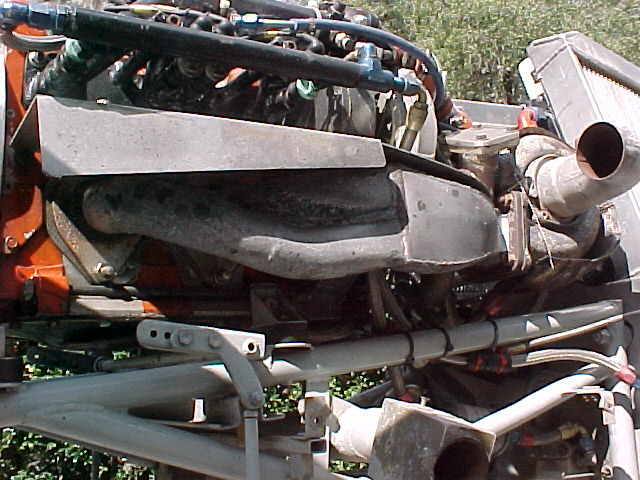
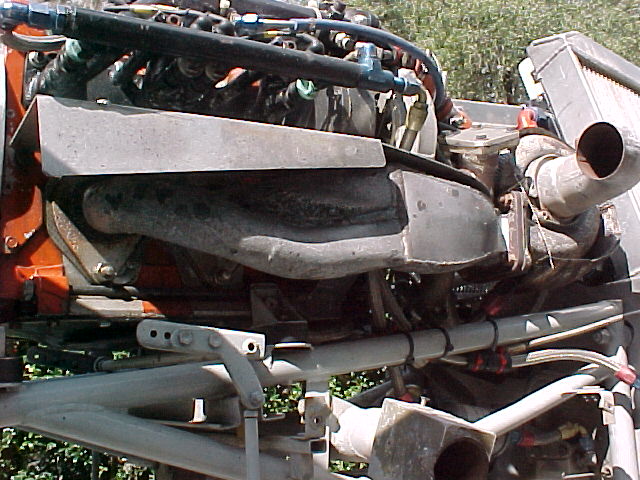
I'll need a custom oil pan with the radiator being underneath the engine. I'm going to have an extension on the turbo side of the oil pan to let the oil return down in fairly straight line. It might be a little more weight, but will not create problems on the turbos seals, more time for the oil to loose the air in it.
What counts is the pan oil level. The turbo return line should be above the
pan oil level and well below the turbo. Use a 3/4 inch return line and shield
it from the hot turbine.
This really caught my eye in MacInnes book on turbos. Page 27.
"The octane requirement of an engine goes up one point with each pound of boost from the turbo charger."

Barny B
That may be true for piston engines. I am not sure what the ratio
for rotaries is if any. I would however keep the temp of the intake charge
below 130 F.

Paul Lamar

The AirCraft Rotary Engine NewsLetter.              Powered by Linux.
ACRE NL web site.
http://home.earthlink.net/~rotaryeng/            http://www.linux.org