Jerry Hey wrote:
Predictable performance is a critical part of making up a firewall
forward package for any design.    For the Tailwind,  I originally
set the goal of 180 hp/6000 rpm with a NA 13-B.  I was told that
should be no problem.   But exactly how does one achieve that
performance? Assuming Tracy's ignition and fuel injection,  we still
have the exhaust system  and intake manifold design.   Also, there
is the issue of Street  Porting or even a mild PP if there is such a
thing.  Can anyone say that if I do the following, the HP will
be............?   If the NA rotary can deliver180 hp, then it may
very well become the engine of choice for the Tailwind.

Of course,   the recommendations have implementable.  No point in
talking about a tuned exhaust, if there is no place to put it.

  I want to go on record to the Tailwind community saying what is
possible.  I would like to provide a list of SPECIFIC
RECOMMENDATIONS on  how to set up the engine to achieve the
performance.

    Although, I have followed the debate about spinning engine
    faster
(and faster) to gain more hp that is not what I am talking about.
What HP can be made at 6000 rpm?    I like this engine speed for the
TW because of the reduction ratios of Tracy's drive and  because
bearing loads are lightest at this rpm.  The Tailwind does not need
more than 180hp under any circumstances.   It is a very  hot
performer with an 0-320.

Jerry
Tracy has about 180 HP with long intake runners and no inserts in the
exhaust ports. His exhaust system is nothing special with a Y in the
pipe too close to the rotor housings. Everett said the optimum
individual exhaust pipe length is about 32 inches. Also Tracy uses the
high compression rotor in a four port turbo engine. As I recall Bruce
did some mild street porting on the side ports. Nothing earth shaking
here. No one thing made much of a difference. To get more or to be
sure you are getting at least 180 and probably over 200 at 6000 RPM go
to peripheral ports like Power Sport.

Paul Lamar
Jerry,
Powersport makes 215 HP at 6000 rpm.  The intake dia. is only 1.5".
There is a
LOT of room to make more HP than 215 for a PP motor.  You can take
this to the
bank because Powersport has the dyno sheets to prove it (and yes, I
realize that all
dynos read a little different).  If I had lot's of money, I would buy
the Powersport
unit.  Alas, I don't so I'll build my own.  Besides, I like Tracy's
EFI better.

Ken P.
Following PowerSport's lead is a good idea.    If the engine can
potentially make 215 maybe I can get away with my exhaust system and
intake manifold and still  get 180.   Lots to think about.   Jerry
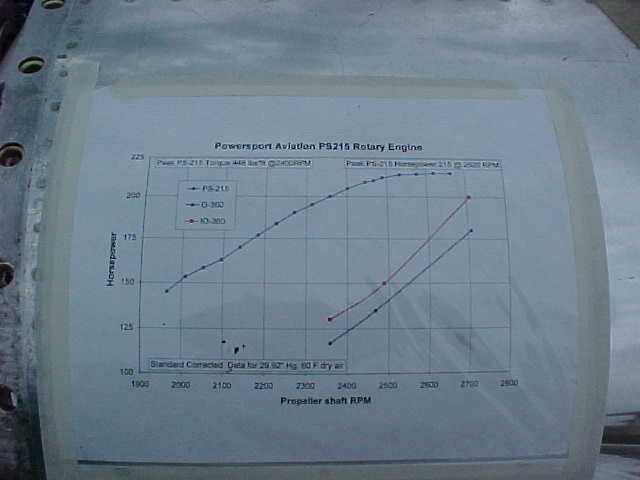
Here is the Power Sport dyno curve using prop RPM.
Notice the HP curve is nearly flat from 2500 to 2700 prop RPM indicating
the breathing is starting to be limited by the small 1.5 inch intake
runner they are using. It could also be the length of the intake runner
pipe is getting too long for the RPM.

The other curves are for aircraft engines with fixed pitch prop load.
The red one is for a 200 HP Lyc IO-360 and the blue for a 180 HP Lyc O-360 I think.
The Power Sport curve is full load at all RPM's and WOT.
Something you won't see in an airplane unless you have a variable
pitch prop. This also puts the p-port nay sayers to shame.
175 HP WOT at 2200 prop RPM is 5280 engine RPM with Power Sports
2.4 to one gear box.

Paul Lamar

The AirCraft Rotary Engine NewsLetter.              Powered by Linux.
ACRE NL web site.
http://home.earthlink.net/~rotaryeng/            http://www.linux.org