I spent quite a while chatting with this guy, Micael Murray at OSH. He
was
also exhibiting a turbine but was also talking realistic numbers. He had
a
"firewall aft" display suitable for a Long-EZ or other pusher on display
that
is slated to go into a factory Velocity. WOT flights in a Long-EZ would
be
very short, something like 24-30 GPH.
What is more interesting is his other research into "propfans" like the
8
blade unit he is currently working on.
An intrigueing quote "It was designed specifically for use on the little
T-62T-32 turboshaft engine, but could be used with any engine capable of
turning it at 6000 rpm, and possessing a small frontal area; perhaps a
small
rotary."
Check him out:
http://home.digital.net/~murray/project.htm
...Chrissi
Small turbofans have the same scale boundary problems Monty mentioned. I
doubt seriously
that Williams will get the .5 pound of fuel per pound of thrust they
claim for their small turbofan engine. They refuse to give me test numbers
even though I have asked for them for the past three years at OSH. The
engineers
recognize me coming and and exclaim: Oh no! Not Paul Lamar! He is going to
ask
us what the actual fuel burn is again. Frankly they have scammed us for
100 million
of our tax money.

Paul Lamar
A thrust specific of 0.5 at static is no big deal - I am sure that Perry is
doing much better
than that. As all of the smart people have said  (rightly) - static thrust
is almost meaningless
unless you are flying at ultralight speeds - Hey! how about we put a Tracy
redrive on
one of those little 142 lb 160 hp Solars on a KIS 2 place for a true rotary
hot rod
for popping out to Fox field for a burger - we might have to tank up to get
back -
but what a bitchen sound and smell - Vance
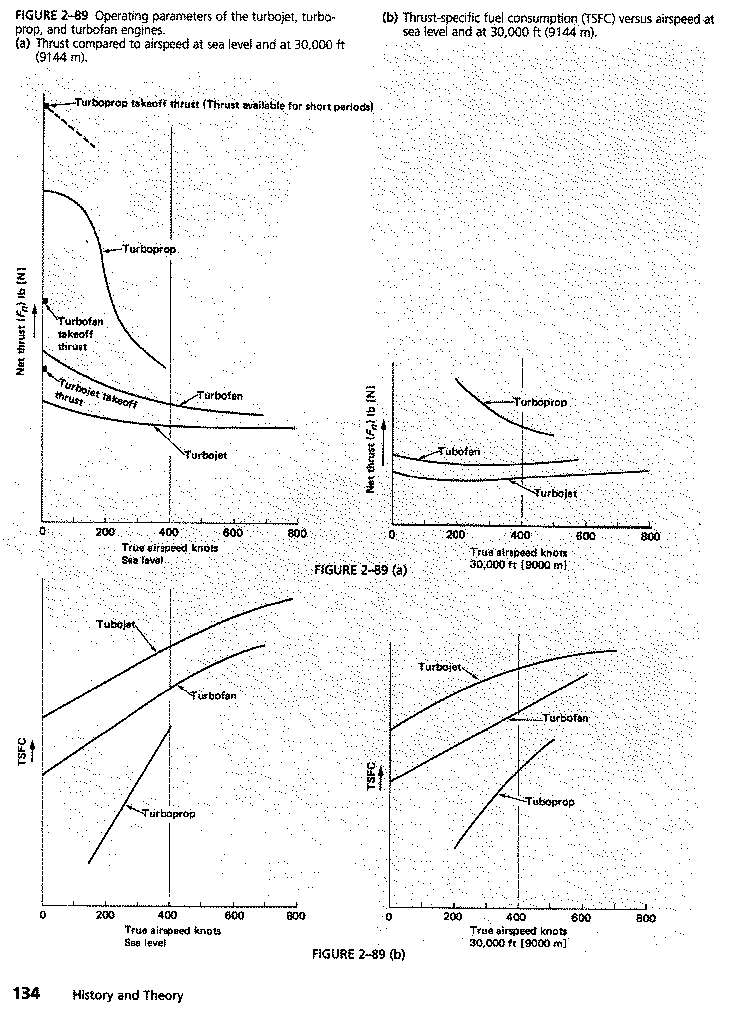
First; static thrust on a turbofan or pure jet is meaningful as thrust is almost
constant with speed unlike a prop.  Here is that very important chart again.
Look at the upper left chart.

Second; a thrust specific of .5 for a small turbofan (Perry is using rotary) is a big deal
as one is more common. The big 2700 pound thrust Williams is 0.5. Williams claims the
little 750 thrust version is also .5 which is highly unlikely given the scale effect.

This is why I think a 1000 HP turbo three rotor ducted fan would make a good substitute
for a small turbofan on a business jet. Twice the range with half the fuel burn.

Paul Lamar

The AirCraft Rotary Engine NewsLetter.              Powered by Linux.
ACRE NL web site.
http://home.earthlink.net/~rotaryeng/            http://www.linux.org