Actually,

Michael and I have communicated on the phone and via email several
times.
His prop fan is an interesting project. If you are not going at least
300kts
it is not as efficient as a propeller. At or above 300kts to around
mach
0.8 the prop fan is attractive. The solar T-62 does not have enough
power to
load the disk properly. You need at least 200-260hp for a 32 in fan.
Trying
to go 300kt on 200-260hp is a challenge indeed. If you installed this
fan
with a direct drive rotary it would work, but the aircraft would have to
be
specifically made for the combination. Tip speed needs to be below
800ft/s
to maintain subsonic flow over the blades. This means 32 in for 6000
rpm. To
keep the power loading where you want it, you can't go to more than 2
rotors
or turbo-charge without increasing dia. To do this you will need a
reduction
drive and a bigger fan, which negates the benefit of the direct drive
fan.
A peripheral port two rotor, direct driving Michael's fan will work for
the
following aircraft which carries one person and has ridiculously low
drag
numbers. Top speed 300-325kts depending on cooling drag. I could make it
go
a little faster by sacrificing the stall speed, which is around 55-60
mph.
If I let the stall speed be 80 I might get a little more speed. The
majority
of the drag is caused by the fuselage on this design, so it is
relatively
stiff with respect to wing changes (within reason) Using the prop fan
would
also reduce climb and take-off performance vs a variable pitch prop.
Compared to a fixed pitch speed prop, it might actually be better. If
you
loose a blade on something spinning at 6000 rpm while traveling at
300kts,
it could get your attention {8-0!!. Might be kind of fun to give the
Questair folks some competition with a rotary :-)  Mine only caries one
person and 50 lbs of baggage, so buy two and fly formation! Hell the
whole
engine for my bird would cost less than a cylinder assembly for one of
those
things, and you probably would burn less fuel flying two of these than
one
Venture.

Can you imagine what this thing would sound like?

Monty
I think to get the drag down in the transonic speed ranges where ducted
fans
become more efficient than props.... you are going to need swept wings.
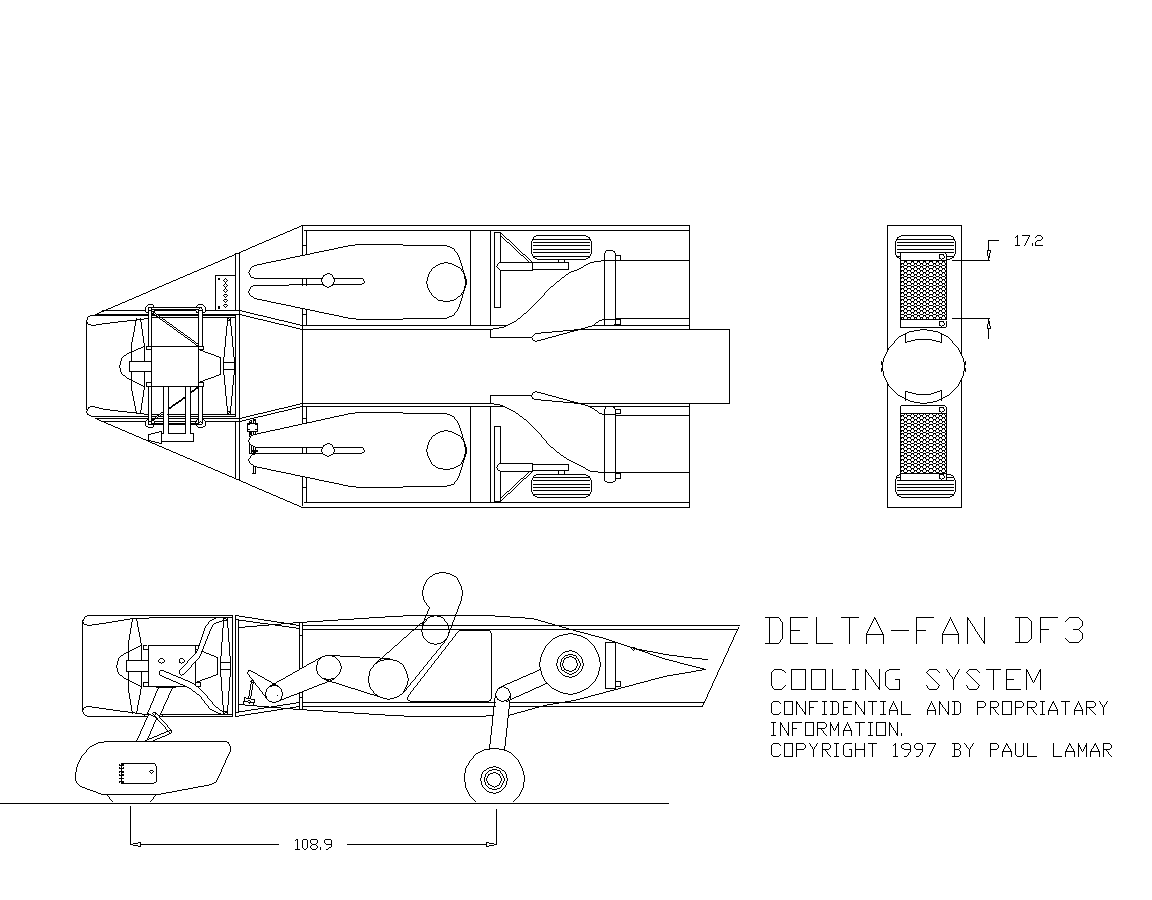
Here is an idea I had quite some time ago. The airfoil needs modifications
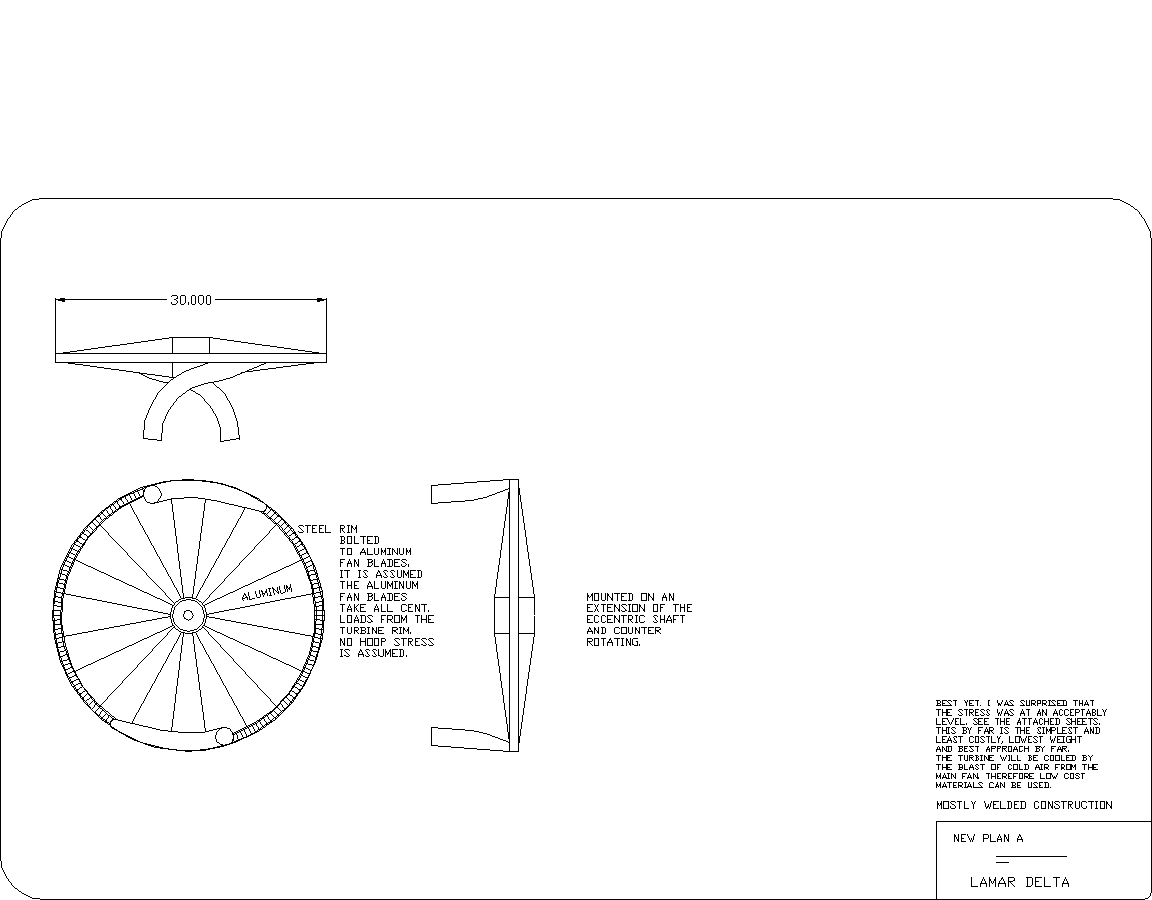
for the transonic speed range. It also uses an aux fan with an exhaust
driven
turbine on its outer diameter for a turbo compound effect and lower fuel
burn.
Paul Lamar
Paul,

I didn't design for the transonic range,  because there is simply not enough
HP to do that with a two rotor. Just to get to 300kts requires a flat plate
equivalent of .8 sqft and a fan efficiency of .8 with 260 hp. That is pretty
hard to do. That only gives about mach .44 or so. Besides, this design uses
an un-ducted fan (UDF) not a ducted fan. NASA tested these things back in
the 80's. They work well in the high subsonic to transonic range. Because
they are variable pitch and do not have the drag of an external duct, they
might work well for a single passenger 2 rotor aircraft.

To get to transonic you are going to need some big hp numbers for a useful
aircraft. We are back to the constant HP vs constant thrust problem, which
is the reason that we went to jets in first place. Piston and rotary engines
are only good for subsonic to .5 mach maybe .6. A prop will work to about
Mach .45, above that a UDF would be better. If you really want to go fast
and use a ducted fan you would need a concept something like yours, I
haven't run numbers for that configuration, but I will, you have piqued my
interest :-).

Monty
Try to run the numbers with a 900 HP turbo 3 rotor. When I first did that back in 1997
I did not even know about three rotors :-)> The aux fan is freewheeling and driven
only by exhaust gases.

Paul Lamar

The AirCraft Rotary Engine NewsLetter.              Powered by Linux.
ACRE NL web site.
http://home.earthlink.net/~rotaryeng/            http://www.linux.org