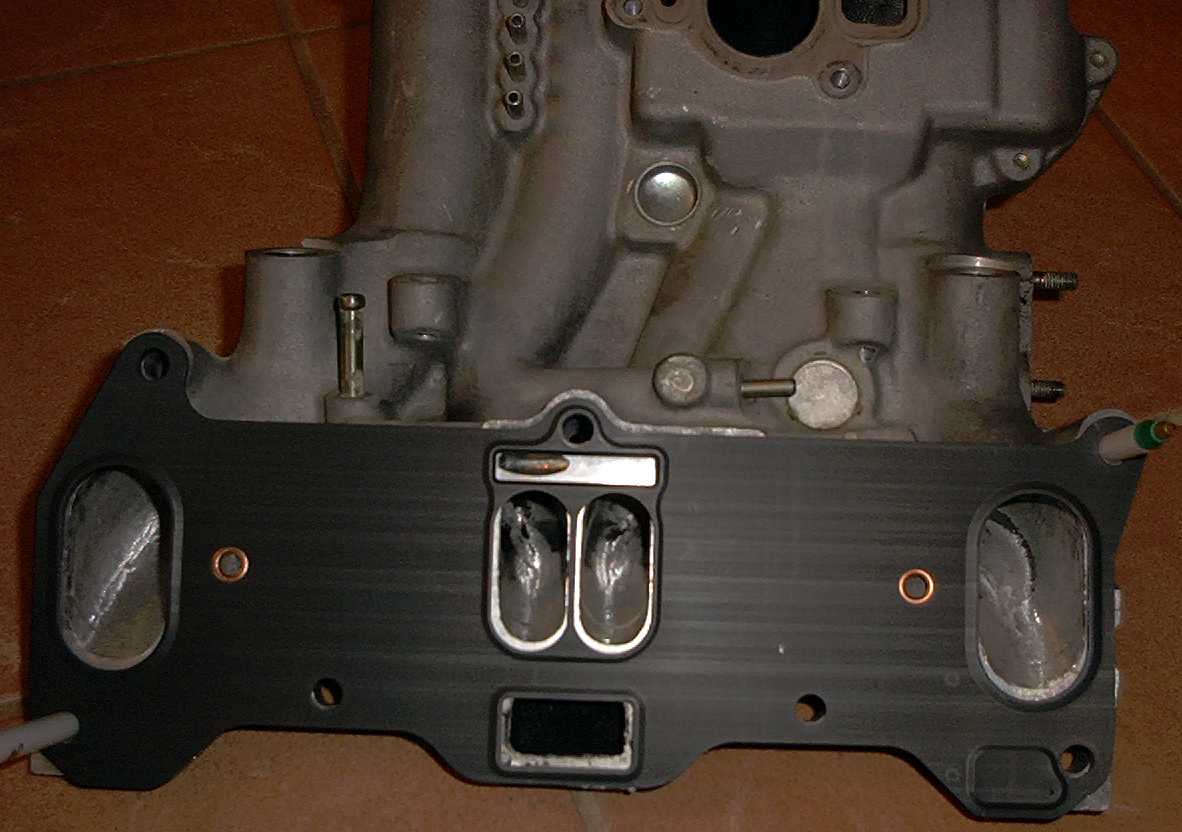
I think you used it to make an acrylic template, if I remember
correctly. You subsequently sent it back to me. I'm using it on a
kitcar
engine build up.
Comparing it to the drawing you just sent (TurboMA5), there are many
differences, just by taking a ruler to the gasket. It does not look
like
the holes will line up. For example, the cl to cl distance you give
as
10.925 is about 10.45" on this gasket; I think I recall the center
housing is thinner in the 93+ engines, but don't quote me.
In any case the gasket will be on its way to you tomorrow via
Priority
Mail. I do need it back, the buggers are expensive.

Marc Wiese
Now I remember. Here is a picture of the Lexan template I made from
your 93 turbo manifold I think. Does your manifold look like this one?

At the time I did not have a four port engine.
Its up in the hangar kicking around. As I recall, except
for the missing center bolt in the six port, the other hole pattern
is identical to the six port and 88 four port. I will dig it up
tomorrow.
I doubt seriously the 93 center housing is thinner.

As I said if this manifold does not fit the 93 send it back and
I will refund the money even if you paid the money to Tom Kendall :-)>
I will know more in a few days.

BTW don't take that drawing as the gospel. Tom got a 88 four port
turbo
to copy the hole pattern.
Paul,
That is not a 93 13Brew tt lower manifold in your picture.
The template also looks a bit off too. Maybe that is a Cosmo type
manifold? Here is a picture of an FD 1993+ lower manifold-the one I sent
you, it is 'slightly' ported, the gasket fits nicely. I am sending you
this gasket, and will stuff in the 'engine differences' summary from
Mazda (3 pages). The intermediate housing is NOT thinner, I stand
corrected, you are right. I'm getting old and my memory is failing!!!
 [Marc Wiese]
OK does look like the upper left bolt hole is in a different position.
It looks like it is directly under our runner.
I think we can accommodate that by drilling an access hole in the outer
runner wall and using a short metric socket head screw inside the runner.
Then you tap plug the outer hole. A trick I learned from Chevy V8 head bolts
under the intake runners. It is going to cost more to do that machine
operation.

Paul Lamar

The AirCraft Rotary Engine NewsLetter.              Powered by Linux.
ACRE NL web site.
http://home.earthlink.net/~rotaryeng/            http://www.linux.org